 Customer Emotion Mapping: World Cup Edition
Score more than you concede: every process produces an emotion, and the emotion is the only part your customer remembers.
Customer Emotion Mapping: World Cup Edition
Score more than you concede: every process produces an emotion, and the emotion is the only part your customer remembers.

CX Corner
Issue 60 · 11 August 2026
The (often stolen) thoughts of Wordnerds' CEO, Pete Daykin. A fortnightly Voice of Customer newsletter for people tasked with making business improvement from customer feedback. Contains light swearing, unnecessary personal detail and information about what we're learning here at Wordnerds.
How to measure trust properly—and why the framework you're citing might be measuring something else
The seven weighted drivers of trust everyone cites were measured on B2B buyers who could walk away. If your customers can't, you're navigating one country with a map of another.
Hi there,
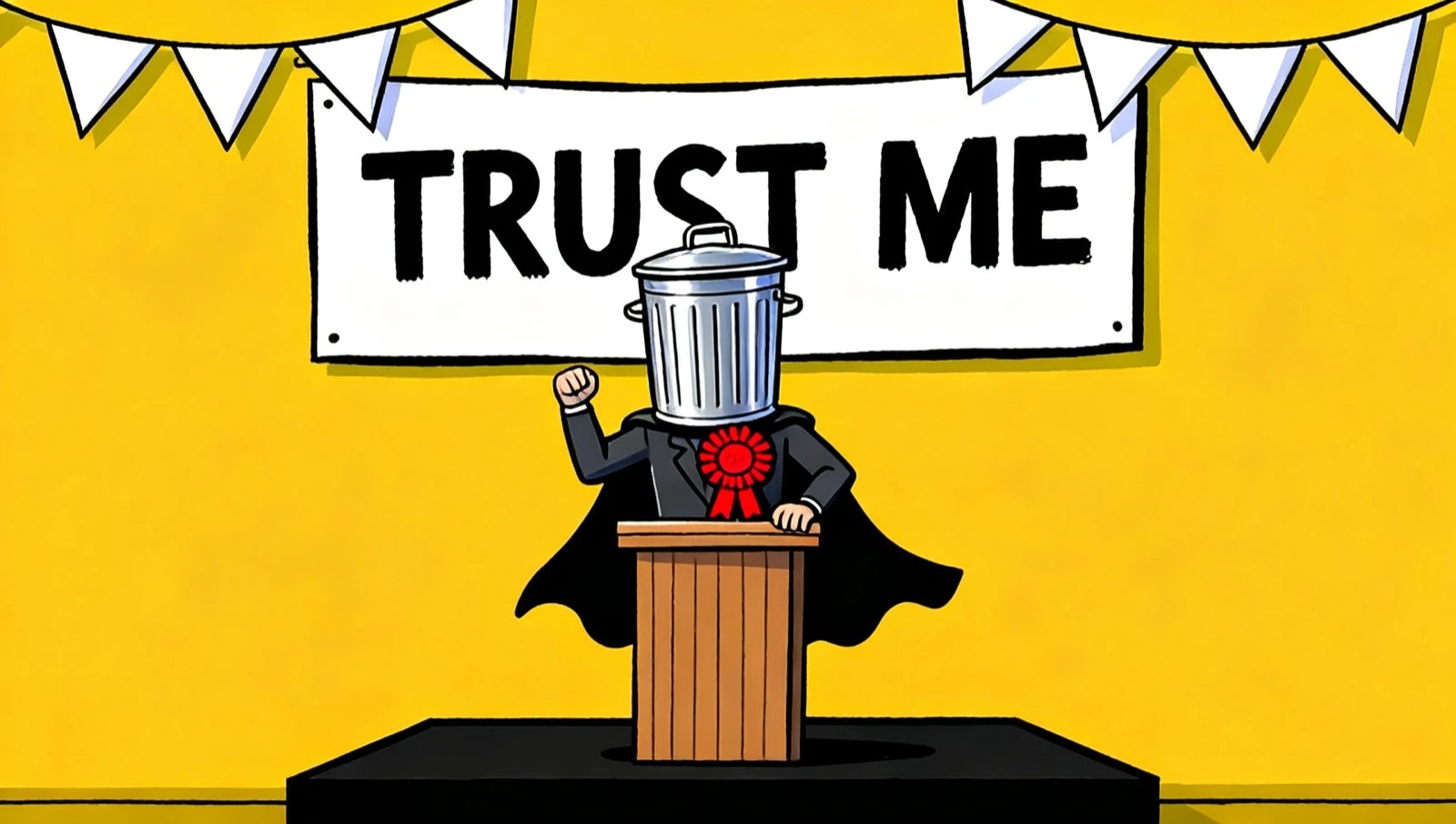
C'maaaaaaaaaan Binface, you gorgeous Recyclon bastard! It's by-election week in Clacton and we're all in, reader. It's over a month since Big Nige resigned his parliamentary seat in an attempt to disrupt the standards watchdog investigation into a murky £5m donation. As political strategies—and humans—go, what a whopper!
Hero of the hour is one Count Binface: intergalactic space warrior, veteran of several London mayoral races and fan of refuse-themed headwear.
In national polling, more people say they'd rather see Binface win than Farage. That's one in the eye for the actual MP and an empirically-backed preference for a man who goes out in public with a shiny waste receptacle on his napper. God, I love being British sometimes.
The reason Nige is even in this predicament is a matter of trust. In a July YouGov poll, when asked directly: "Do you think Nigel Farage has or has not been honest about his financial affairs?" 60% said not honest, 12% said honest. Seventy-three per cent of voters describe him as "at least fairly sleazy".
Most organisations never get a by-election. No polling day arrives to tell you your trust has cratered—customers just leave, and they don't even draw you a swingometer on the way out. When people stop trusting you, they just go. When it happens at scale it can be devastating. So this issue is about two questions: which levers move trust, and how might you know you have a problem before it gets obvious?
We get asked about trust a lot. One framework in particular is often cited to us: seven drivers of trust, each with a precise weighting attached—"Competence" at the top (18.5%), Empathy at the bottom (8.6%). It sounds authoritative. Weighted percentages usually do.
Having heard it a few times now—and being the pedantic sods we are—we thought we'd better check where the numbers came from. Turns out they belong to a very specific piece of research, describing a particular kind of relationship—and somewhere between the original study and the slide decks on which it now surfs the world, the context that makes it meaningful has gone missing somewhat.
With trust, most people do one of two things: treat it as an unmeasurable vibe, or borrow a framework wholesale without really understanding what it was built to measure.
Plenty of these frameworks exist, at wildly different levels of rigour. And because we know most CX Corner subscribers are even more pernickety than us, you'll be delighted to hear we've checked the lot. Gone down the full rabbit hole so you don't have to.
What the psychology says
The most replicated finding in the pile comes from social psychology. People judge any social target—a person, a brand, a housing association—on two axes: warmth and competence. And warmth gets judged first. Warmth drives trust and liking; competence drives respect and status. An organisation that's competent but cold reads as capable but not on your side—respected rather than trusted.
The second body of work is procedural justice, built on Tyler and Lind's dispute-resolution research and replicated for decades since: people trust a decision-maker more when they feel heard during the process, independent of whether the outcome goes their way. Two separate judgements are happening—was I heard, and did I get what I wanted—and the first one drives trust on its own.
There's even evidence for a trust tipping point: a threshold below which people evaluate you in a different, less forgiving mode. Two peer-reviewed studies (Liu and Goodhue in Information Systems Research; Adam and colleagues at ECIS) found a real, statistically robust threshold effect. One caveat before it goes on anyone's slide: both studied first impressions of unfamiliar websites, not long relationships eroding over time. It plausibly extends to ongoing service trust; it hasn't been tested there.
So the psychology says warmth and being heard are real levers, and general ones. Which brings us to the "trust index" products getting cited in meetings.
Where those weighted numbers came from
Back to our mystery framework. Seven drivers, precise weightings, unmistakable air of authority:
- Competence (18.5%)
- Consistency (17.0%)
- Dependability (16.8%)
- Accountability (14.3%)
- Transparency (12.7%)
- Integrity (12.1%)
- Empathy (8.6%)
We traced the numbers to a piece of real, published research—Forrester's "7 Levers of Trust". Legitimate work from a legitimate analyst house. But built from a context most people citing it are unaware of: B2B buyers evaluating suppliers in complex purchasing decisions.
Forrester's own explanation of the ranking is refreshingly blunt: "The more complex the buying scenario, the less empathy matters". When a buyer can compare suppliers, run a procurement process and walk away, competence dominates.
But that doesn't hold for monopolies or relationships where leaving is high friction. Apply it to a tenant and their landlord, or a customer and their only practical bank, and you're navigating one country with a map of another.
Zoom out and there's even more noise around trust. Qualtrics runs a three-factor trust index (competence, integrity, benevolence) across 354 brands. Edelman's Trust Barometer measures trust in institutions rather than individual brands. The Trust Equation puts self-orientation in the denominator as the trust-killer. Medallia's latest report names knowledgeable staff and consistent experiences as its top trust-builders.
All are at wildly different levels of rigour, and each built for a different question. None is a universal answer you can lift off the shelf.
Can your customer actually leave?
That is the £5m question. The B2B research and the tenant evidence don't disagree because one of them is wrong—they describe different kinds of relationships.
When someone can walk away—there are other competitors in the market—competence and consistency keep winning. Those are Forrester's clear and corroborated findings.
For monopolies and single-supplier situations—where people are stuck and can't jump to another supplier—the rules of trust change.
Social housing regulation supplies our favourite example: City of Wolverhampton Council had stronger operational stats than BCP Council (Bournemouth, Christchurch and Poole) but got a weaker regulatory grade—C2 against BCP's C1.
The explanation? BCP were open about their shortcomings and could demonstrate how their tenant voice was being used to change real services. Something that outweighed the operational gap. Once competence clears the floor, what moves trust further is whether people feel heard. (We're running a webinar with Andrew Bryant of Wolverhampton Council, talking about this and how to prepare for a regulatory inspection in housing on 10 September. Sign up here).
When trust is already broken
That leaves the hardest case: trust already lost. The repair research (Kim, Dirks and Cooper's work on trust violations) offers one very practical finding—trust breaks differently depending on what broke it, and the repair has to match the break.
Competence-based failures—a missed appointment, a system outage, a botched repair—respond to the obvious move: apologise, fix it, make the fix visible. People read these as correctable mistakes.
Integrity-based failures—deception, concealment, hidden dealings—work the other way round. Apologising, on its own, can make things worse: it confirms the bad intent without demonstrating that anything has changed. Repair here takes structural transparency and consistent behaviour sustained over time. No single gesture does it.
Which brings us back to Clacton. An undisclosed £5m gift under investigation by the standards watchdog is arguably both failure types at once—and polling day is Thursday. There's no apology that repairs an integrity violation on that timeline. Hence, plausibly, the bin.
Try This Tomorrow
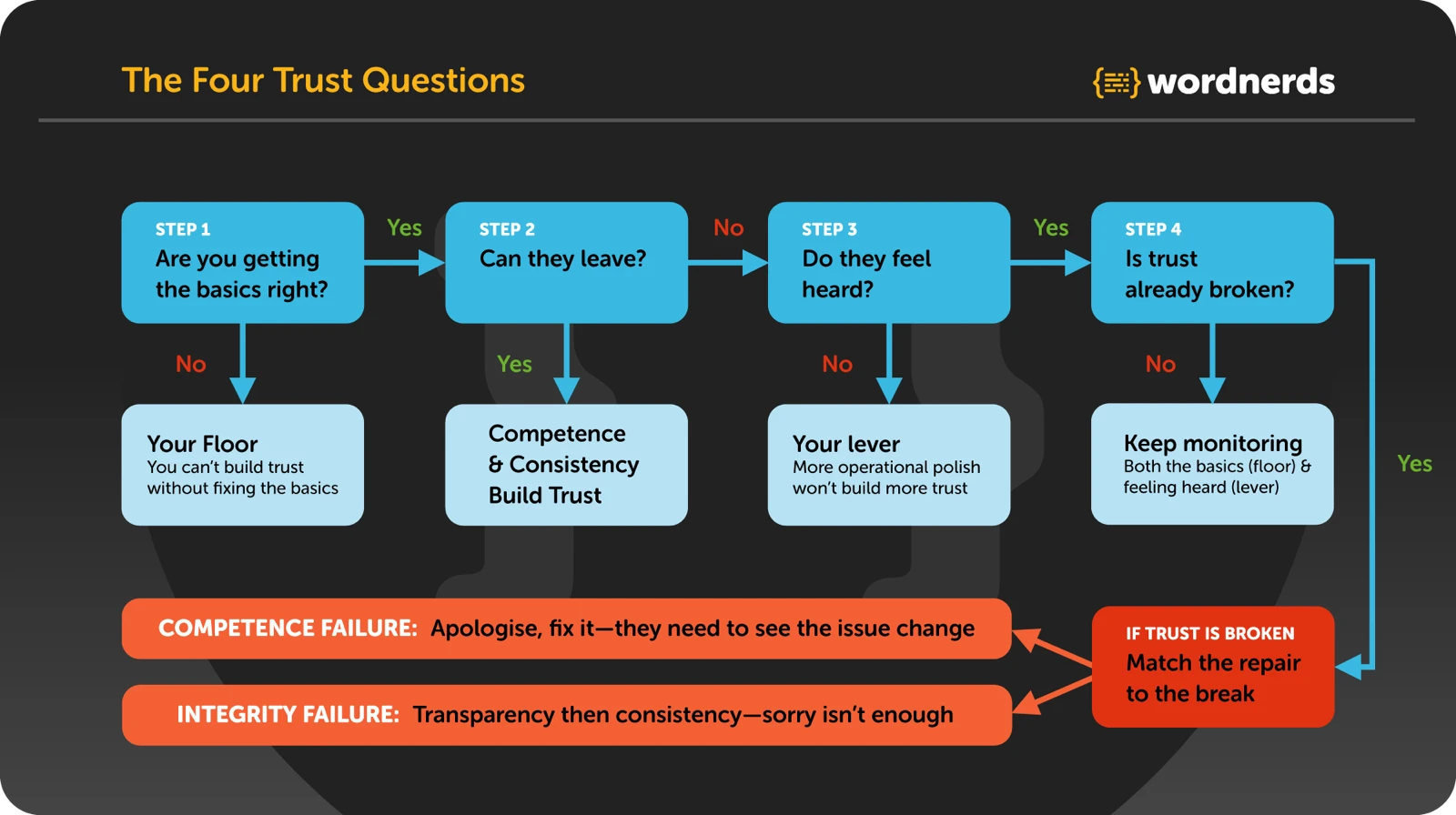
Four steps, in order:
- Check competence clears the floor. Trust needs adequate delivery underneath it—but adequate is the word. Past the floor, extra operational polish stops buying trust, so stop over-investing in a lever that's stopped moving.
- Work out whether your customer can leave. If they can, competence and consistency deserve the weight the B2B research gives them. If they can't, carry on to step three.
- Measure "heard" specifically. The perception that customers were listened to and something changed as a result. Most dashboards carry no number for this at all.
- If trust is already damaged, diagnose the violation type before choosing the repair. A competence failure wants an apology and a visible fix; an integrity failure wants sustained transparency. Get them backwards and you'll make it worse.
How might I do this?
Start with the floor: what does "adequate competence" actually mean for your organisation? Don't guess—run a Kano analysis. We did this with NWG (Northumbrian Water Group) customers in a tent at a racecourse (issue 58): for each likely failure—a wrong bill, a dry tap, a flooded garden—ask how people would feel if you fixed it, and how they'd feel if you didn't. Cross the two answers and three groups fall out: Must-dos (expected, and you're punished for missing them), Delighters (unexpected, and rewarded when present), Indifferents (nobody cares either way).
Your competence floor is the Must-dos list, nothing more. Once you know what's on it, train a theme bank to watch that list specifically, not general sentiment. A rising complaint count there is your floor cracking, and it shows up in the data before it ever shows up in a satisfaction score.
"Heard" needs the same treatment: a theme you train for, not a mood you eyeball. On one side, customers saying they were listened to, that something changed because they said something, that their feedback visibly went somewhere. On the other, and just as important, customers saying they weren't listened to, describing the specific tedium of repeating themselves, or the flat disbelief that giving feedback does anything at all. That last one is the one to worry about most, it's the theme that shows up right before people stop bothering to complain, and just leave instead.
Two more questions to ponder:
- Can your customer actually leave (be honest about how much choice they really have)
- If trust is already damaged, what kind of failure caused it (a competence failure and an integrity failure need different repairs, treat them the same and you'll fix the wrong thing).
That's it. Simple as accepting a large sum of money from a morally (legally?) dubious source. Have a crack, why don't you. Tell us what you find.
Until next time, keep learning.
Pete
P.S. Count Binface's manifesto is the single greatest political work of the 21st Century. A beacon of authenticity in a conviction corrupt world. Nationalise Adele, move the hand-dryer at the Great Himalayas restaurant in Southport, a windfall tax on cosy crime novels. Finally, a party I can get behind.
¡Viva los Reciclons!
More from CX Corner
Customer Emotion Mapping: World Cup Edition
Score more than you concede: every process produces an emotion, and the emotion is the only part your customer remembers.
 Align Your Insight for Design
Your customers aren't rating your front desk — they're rating your kitchen. Service design is a whole craft built for the thing your insight keeps wishing it could do, and most of us were never taught it.
Align Your Insight for Design
Your customers aren't rating your front desk — they're rating your kitchen. Service design is a whole craft built for the thing your insight keeps wishing it could do, and most of us were never taught it.
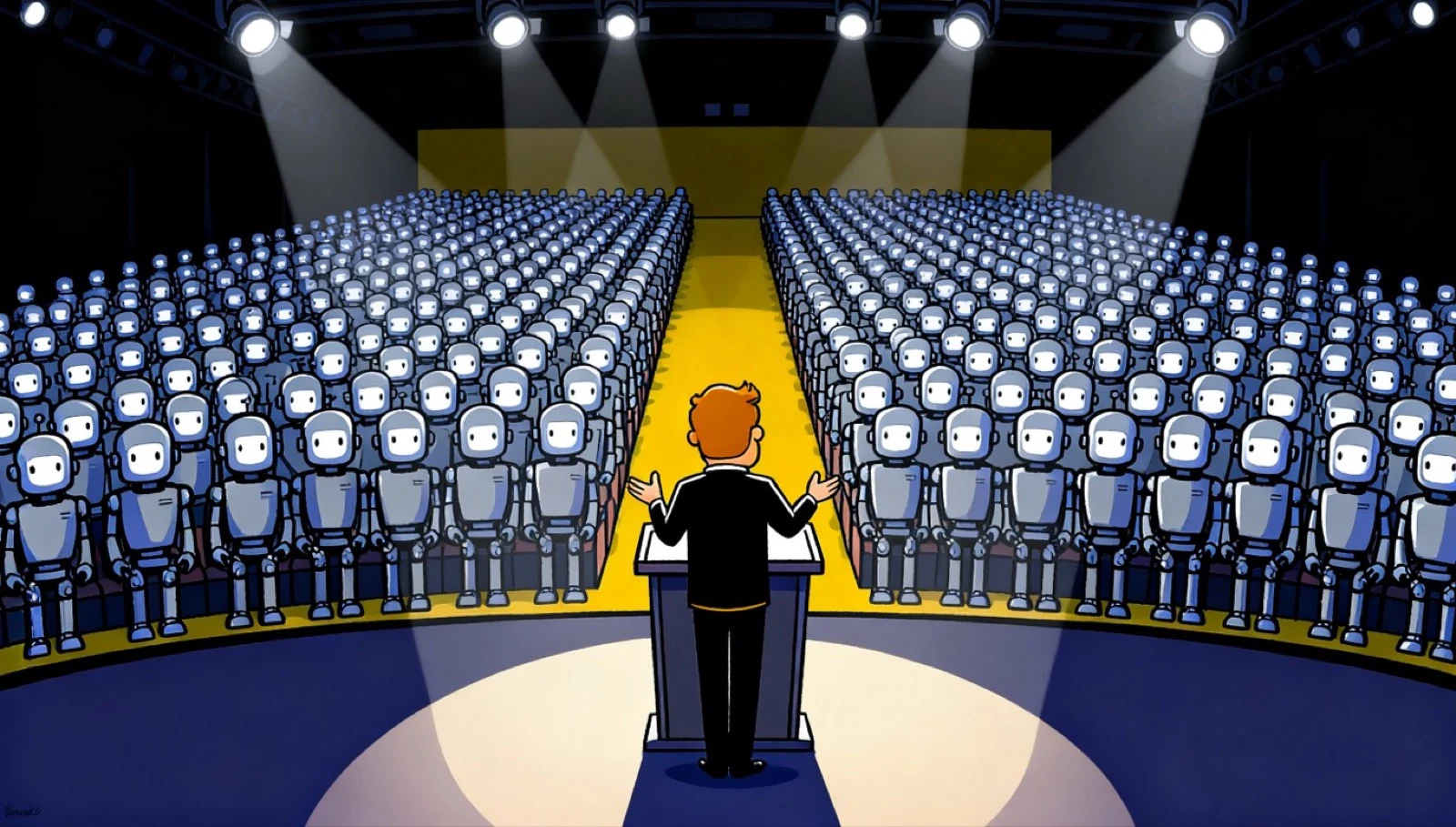 The Agentic Customer
AI agents are about to start shopping, comparing and complaining on your customers' behalf — and the machine only deals in averages. What happens to the humans it can't hear?
The Agentic Customer
AI agents are about to start shopping, comparing and complaining on your customers' behalf — and the machine only deals in averages. What happens to the humans it can't hear?
