 Customer Emotion Mapping: World Cup Edition
Score more than you concede: every process produces an emotion, and the emotion is the only part your customer remembers.
Customer Emotion Mapping: World Cup Edition
Score more than you concede: every process produces an emotion, and the emotion is the only part your customer remembers.

CX Corner
Issue 58 · 8 July 2026
The (often stolen) thoughts of Wordnerds' CEO, Pete Daykin. A fortnightly Voice of Customer newsletter for people tasked with making business improvement from customer feedback. Contains light swearing, unnecessary personal detail and information about what we're learning here at Wordnerds.
Align your insight for design
A water company is designing its strategy for the next ten years: how can they integrate customer feedback into service design?
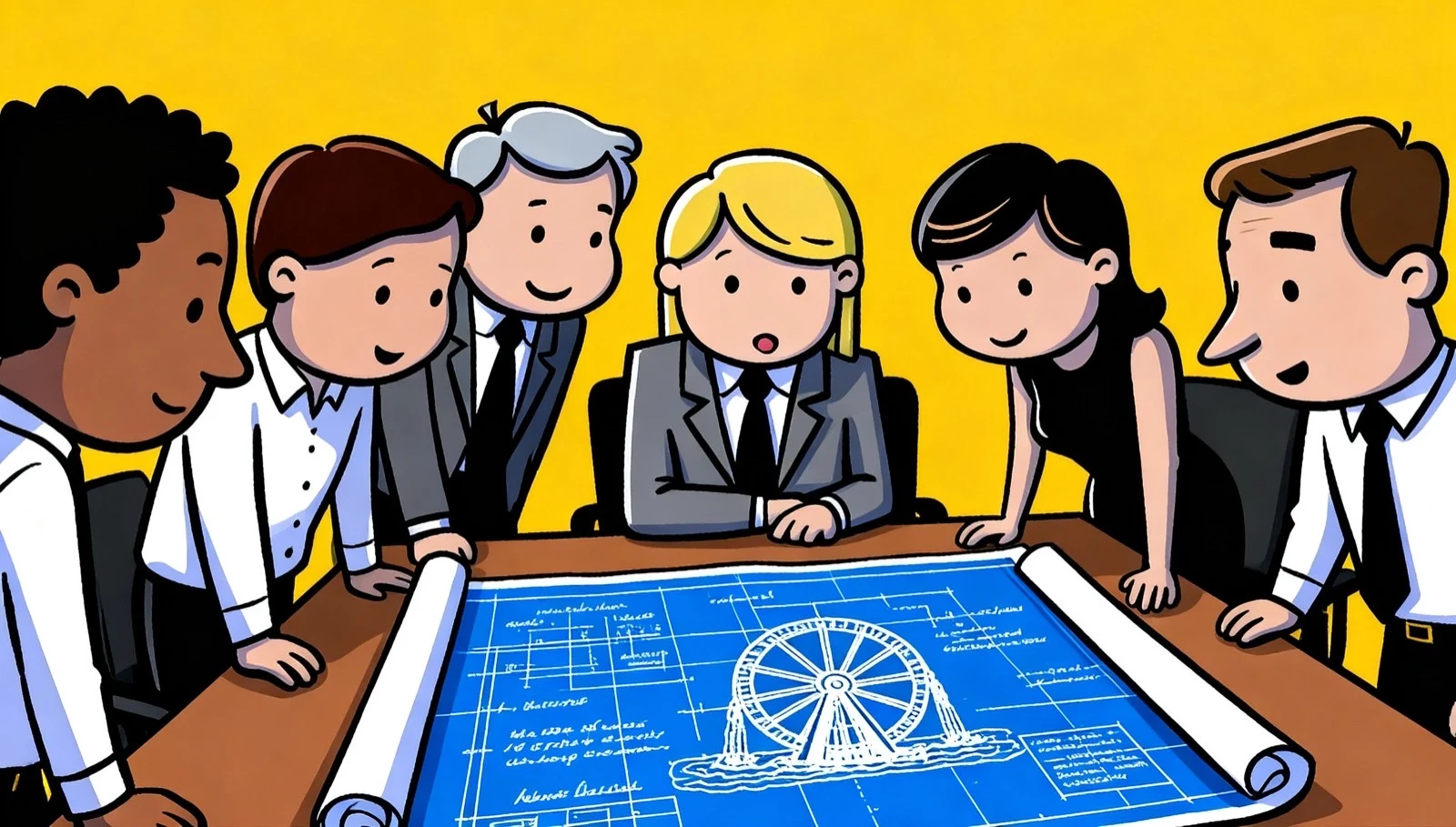
As you read this, Steve and I are in a very large tent on a racecourse on the edge of Newcastle, up to our necks in white-boards, Post-its and crap sketches. Zoe and Nat are with our friends from Medallia in a tent next door.
It's the Northumbrian Water Innovation Festival—one of our absolute fave weeks of the year—and we're spending it running a design sprint with the good folk at Explain Research and 33 actual Northumbrian Water customers. Real humans, people who turn on the tap expecting water to come out, and who, when the street outside their house gets dug up, have Opinions.
The question we're all in the tent to answer is a whopper: how do you build customer advocacy for the next ten years?
That's not PR bollocks or innovation theatre: the water industry is about to spend more on its assets than it has in a generation—pipes, treatment works, storm overflows, the lot. It's good news for us (bills going up, less so!), but it will also mean years of roadworks, disruption, and letters that begin "We're sorry to inform you..."
The crazy fools at Northumbrian Water want to come out the other side with customers who love them more. They're wise enough to know you don't stumble into that, you design for it.
All of which has got me thinking about service design.
Service design is a decades-old discipline—its own methods, its own thinkers, its own networks and conferences. But most of us working in insights and CX were never taught it. We learned to find the signal. Nobody taught us how to turn it into a service.
So we default to the job we were taught: reporting. We cut feedback by survey, by channel, by KPI, by behaviour—all the ways you'd slice it to describe what your customers are telling you. Good, necessary work. Only service design is a different job, and it needs the data organised in different ways.
In issue 55 we called the layer that actually changes things "kinetic infrastructure," and said someone has to own it. In this—and possibly subsequent—issues we're going to explore what that person can do.
Service design 101: the service blueprint
Service design isn't mysterious, and you don't need a PhD in computer science to get on board. Its principles (with a nod to Marc Stickdorn, whose book most practitioners keep on the shelf) are almost aggressively sensible: start with real human needs, work with the people affected rather than at them, prototype instead of theorise, and treat the service as one journey rather than a pile of touchpoints.
Lou Downe, who ran design for the UK government, reckons good service helps someone do the thing they came to do, soup to nuts—"solve a whole problem for the user."
Bonus points for doing this without friction and with minimal effort (CX Corner issue 51 anyone?). The best way to plan for that? Why, the service blueprint of course...
A service blueprint maps a journey twice. Above a line—the "line of visibility"—you draw what the customer sees and feels: the tap, the letter, the phone call, the app. Below it, you draw everything that produces that moment: the scheduling system, the contractor handoff, the case that did or didn't get owned, the comms that did or didn't go out. One journey, two experiences, a line between them.
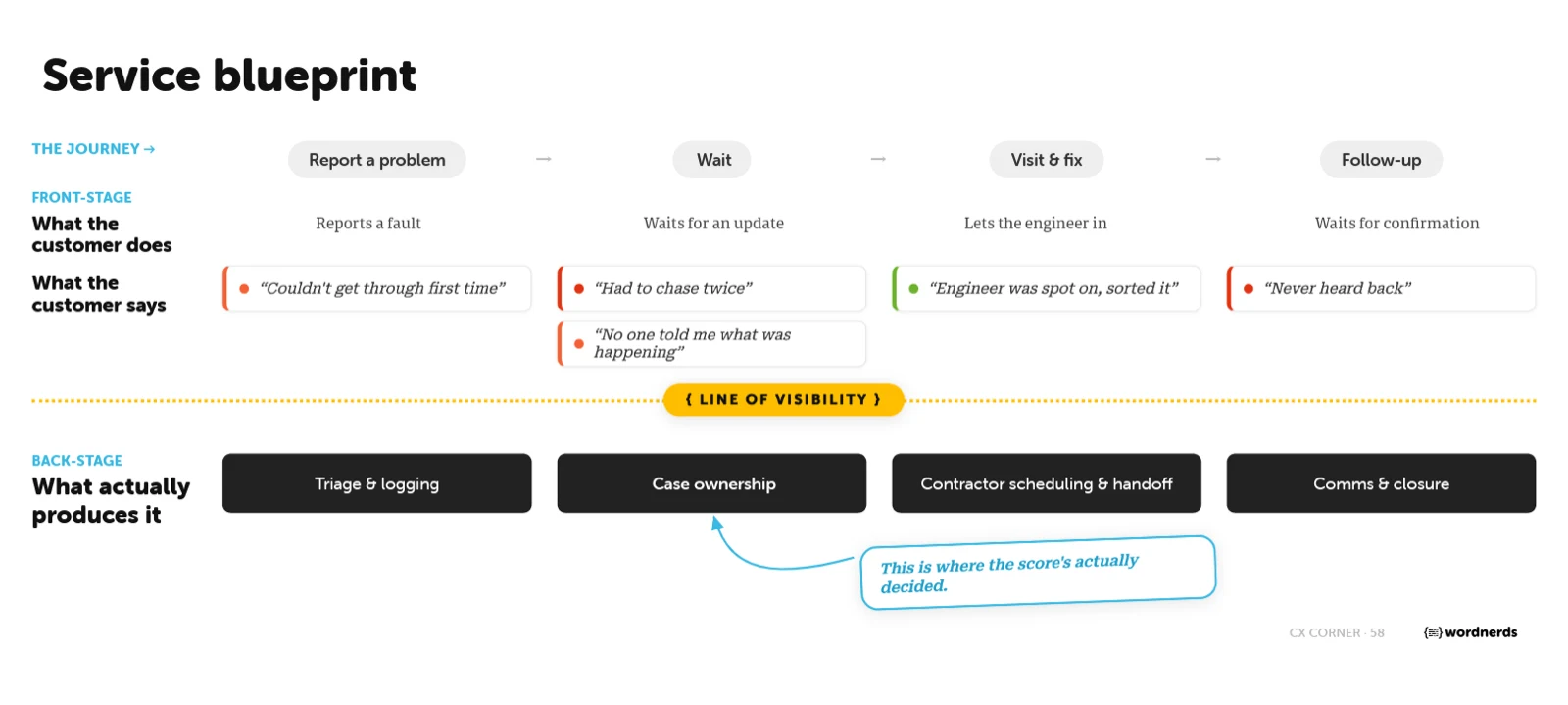
Your customers aren't rating your front desk—they're rating your kitchen
Once you have your blueprint mapped out, you then work through the journey measuring how well each step is working.
Take Lake Powell. It's a vast reservoir in the red-rock canyon country on the Utah–Arizona border—the sort of place American families spend a week's holiday on a rented houseboat—and its resorts and marinas are run by Aramark, a giant US hospitality firm.
Complaints were stubbornly high, so they did the obvious thing: trained the front-desk staff, refurbished the rooms, polished everything the guest could see. Complaints held.
It was only when they blueprinted the whole service that the culprit showed up, well below the line of visibility—the handoffs between housekeeping, maintenance and the front desk were a mess.
Fix the backstage coordination and, by their account, complaints roughly halved. All that money spent front-of-house, and the trouble was in the kitchen the whole time.
You can't see that in a report cut by channel. You see it when the insight is laid along the journey and connected to the machinery underneath.
Put your insight on the blueprint
You probably don't need more data. You're likely sitting on more than enough. You need to point it at the blueprint.
The themes, the sentiment, the verbatim you already have map straight onto that top band—what customers are struggling with, in their own words, and how they feel at each step. That's your front-stage layer, ready-made.
Then, for each pain, you follow it down: where in the machine is this actually produced? Theme on top, cause underneath. That single move turns a list of complaints into a map of what to change.
British Airways are a good example of what looking properly gets you. Working with Sabio, they went through around 35,000 recorded calls and found that seven of the top ten reasons people were actually ringing weren't the reasons the business had assumed.
They rebuilt their routes around the real reasons and took a lot of avoidable calls out of the contact centre.
Prepping your data for the blueprint
Categories and sentiment are fine, but—as ever—the more you can do to test ideas with actual customers, the better. And what better sandbox than our tent at the racecourse.
So far this week, we've asked our pet NWG customers to come with us on the following journey:
- Scenario-mapping. We came up with four disaster scenarios that cover most of the big operational malfunctions likely to affect a water company:
- Your bill is unusually high
- No water coming out the tap
- Garden flooded from a manhole cover
- The water company want to dig up your road
- Kano analysis. For each scenario how would you feel if NWG did and didn't do this? Cross the two to find: Must-dos (I expect this and hate it if it isn't there), Delighters (I don't expect this and really love it), Indifferents (I'm not actually that bothered either way) etc. Kano analysis allowed us to categorise the issues to work out which are non-negotiable and which—the delighters—are actual brand levers to drive advocacy.
- Evidence of the important issues raised in the wider data. Is this the mad ramblings of a group of atypical outliers or are the suggestions of the customer sprint backed up by the numbers in the wider feedback data?
- Subject-specific deep dives: for key issues that are validated by the wider data, what is the nuance? What's causing them? What's happening? How does it make them feel?
- Segmentation by different customer needs and their ability to understand and act on communications from NWG. There's no such thing as an average customer (see our very last issue!)
Running the scenarios in the blueprint journey past customers and then extracting what is actually happening at scale from the wider customer data is a great way to ensure that the stuff you map above the line in the customer blueprint is rich, relevant and—above all else—real!
What comes after the blueprint
Once your insight is on the blueprint, the next question is what to fix first—and I'm guessing you know only too well most of the toolkit for answering it:
- Driver analysis (which pains are actually moving the score)
- Behavioural segmentation (whose journey are we designing)
- Trade-off modelling (what customers would give up, and for what). etc.
We'll get into those over the coming issues. The blueprint is the canvas they all draw on, so it earns its place first.
What's next for our plucky sprinters
We've been fortunate to have what I think is an exceptional group of customers in the tent: engaged, intelligent, diverse.
As a result, sitting with customers, designing forward, and trying to build an advocacy strategy that lasts ten years has been absolutely intoxicating. Honestly, one of the best work weeks in ages.
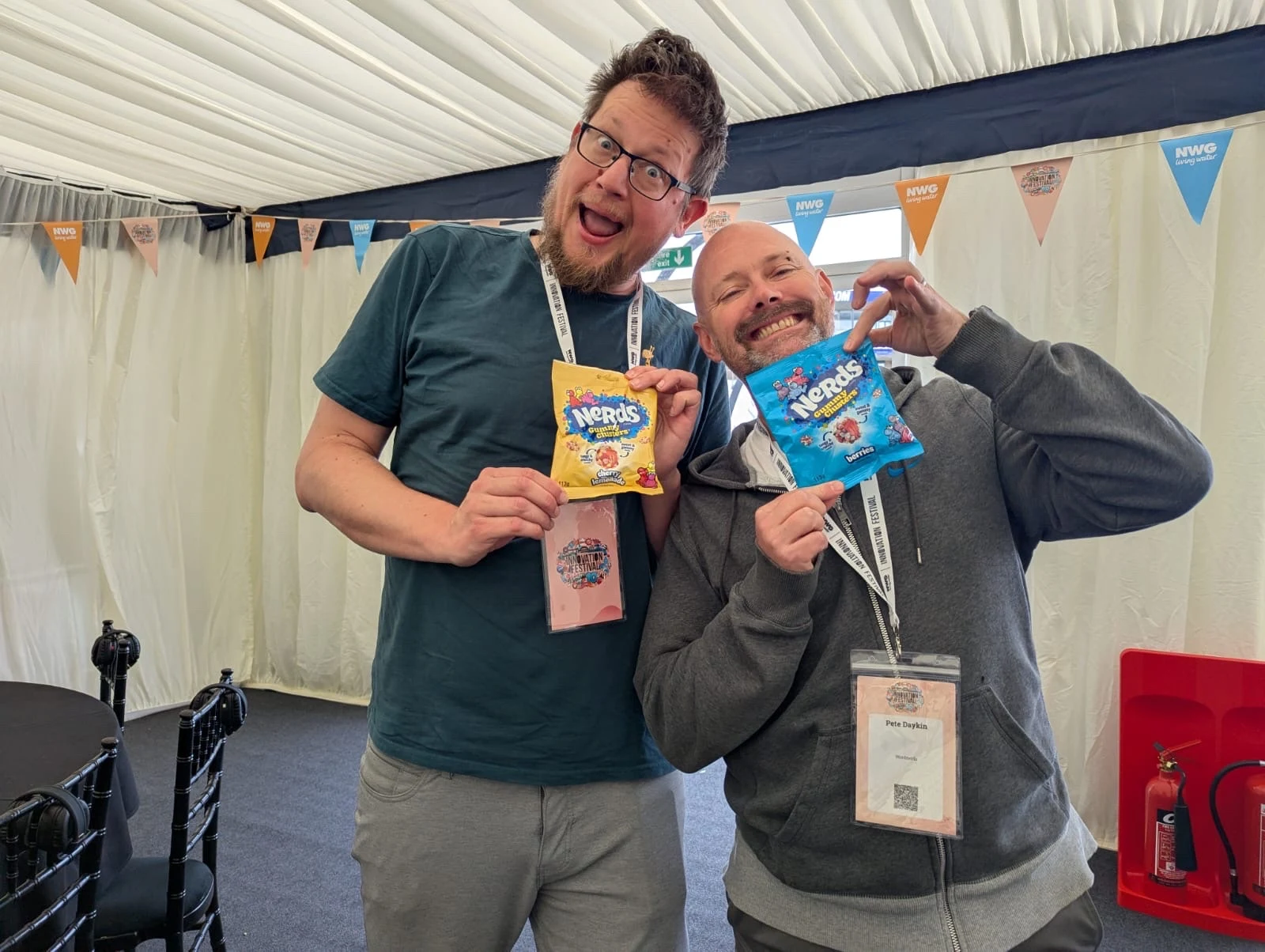
Exercises like: "it's 2035 and tech allows NWG to do anything, what does unrivalled customer experience look like?" have allowed the tent to design with the shackles off.
I can't go into the specifics of their findings for obvious reasons, but tomorrow 33 NWG customers present their (data-backed) suggestions for the start of a new strategy to a panel of the company's senior leadership team: directors, c-suite, the very top.
Some of what they're presenting is stuff the company already know but haven't quite got right (validation of the existing strategy with more operational work to do). Some of it is entirely new.
The design sprint is just the start of a year-long programme of work from NWG's customer experience team. They will be taking the outcomes of this group's thinking, testing them with their people panel, refining ideas, developing the blueprint, consulting internally.
In a year's time—at next year's Northumbrian Water Innovation Festival—they plan to get the same 33 customers back in the tent and bust out the strategy on them for feedback.
If that isn't best-in-class Voice of Customer and Service Design then I'm a cheating, bullying, orange American with a dodgy combover and a team that's no longer in the World Cup. Oopsie!
Until next time, keep learning.
Pete
P.S. For the record, Steve is one of the absolute worst drawers I've ever met. Absolutely terrible. I mean, really offensive, pre-school stuff. Watching him turn customer scenarios into something that resembles drunk Sanskrit is the real highlight of my year. Always.
More from CX Corner
Customer Emotion Mapping: World Cup Edition
Score more than you concede: every process produces an emotion, and the emotion is the only part your customer remembers.
 Your Insight Is Fine. You Just Don't Have a Process for Action.
The problem was never your data. It's that nobody owns the step between an insight and someone changing the work.
Your Insight Is Fine. You Just Don't Have a Process for Action.
The problem was never your data. It's that nobody owns the step between an insight and someone changing the work.
 The Empty Chair Fallacy
Why “representing the customer” in the room is harder, and riskier, than leaving a chair empty for them.
The Empty Chair Fallacy
Why “representing the customer” in the room is harder, and riskier, than leaving a chair empty for them.
