 Power BI Is Marmite (and Why Copilot Alone Can't Help)
Dashboards split the room and AI chat won't save you — the real reason insight tools stall at a quarter of the workforce.
Power BI Is Marmite (and Why Copilot Alone Can't Help)
Dashboards split the room and AI chat won't save you — the real reason insight tools stall at a quarter of the workforce.

CX Corner
Issue 57 · 26 June 2026
The (often stolen) thoughts of Wordnerds' CEO, Pete Daykin. A fortnightly Voice of Customer newsletter for people tasked with making business improvement from customer feedback. Contains light swearing, unnecessary personal detail and information about what we're learning here at Wordnerds.
There is no average customer. The machine didn't get the memo.
We rebuilt our website for the robots this week. The robots are coming for your customers next.
It's the hottest day in Christendom, and I write from a train between Manchester and London like the CX Andy Burnham.
It's 31 degrees outside (currently, outside is Milton Keynes) and once again the country has discovered—with the wide-eyed astonishment of a toddler meeting a dog—that it has absolutely no idea how to be hot. Insisting through a film of their own sweat that it's "not the heat, it's the humidity".
"We advise passengers not to travel," they said. Pah! I have to get from Housing 26 to the Clarasys birthday party and I'll be damned if a little sunshine is going to stop me.
And you know what, Reader? It hasn't.
It's almost un-British to say it but the trains are running, the air con is pumping and I've been happily gazing at rolling, sun-drenched countryside, pondering the usual cocktail of articles I've read, talks I've seen and conversations I've had since last we met.
You see, we humans are inexorably, intransigently, irrationally human. Which is a funny thing to be reminded of this week, because I've spent the hottest few days of the year doing the least human thing imaginable: rebuilding our website for robots.
The old Wordnerds website was written for people. This one is built to be read by machines—by the AI search engines that increasingly decide who gets found and who doesn't.
It's called Answer Engine Optimisation (AEO). I'm sure you've met the acronym. The bit I've been struggling with: where is the balance between what a machine needs in order to understand and rank us, and what a human needs in order to trust—and, I hope, like—us. Those are not the same job. Some days they pull in opposite directions.
Our Dungeon Master on this epic quest is the brilliant Natalia Rice, who knows more about AEO than anyone I've met, and, like the Nerds, seems to enjoy and embrace the chaotic fluidity of it all. Our website, like the art itself, is still very much a work in progress. Expect me to be banging on about it for weeks.
Meanwhile, in Manchester at Housing 26 I caught a talk by the regent of research, The Harris Poll UK Managing Director Sarah Beams and badass CX vigilante, Naomi Sweeting of Places for People.
If AEO and marketing is about new customer acquisition (usually the first place brands spend money) Sarah and Naomi have spent a career on a less well-funded problem—using customer insights to design better services and keep customers happy.
Naomi's message, delivered with the kind of conviction that makes you want to paint your face blue, shout "freedom" and give the ball straight to Vinícius Júnior (sorry, Scotland fans): there is no average customer. Design for the average and you build for a person who doesn't exist, while quietly failing the ones who need you most.
Between them, the pair have developed a mature and elegantly conceived methodology for getting feedback data and using it to understand the full range of customer needs. It's the best I've seen to date and it's been years in the making.
If we assume that the innovations pioneered in marketing eventually trickle down to CX, this poses a very interesting paradox. Marketing is already handing the customer relationship over to the machine.
In a world where we're only just getting good at really understanding the diverse spectrum of our customers' needs, are we about to lose the relationship with the human altogether and start having to learn about them through their bots?
The customer is becoming an algorithm
You'll have seen the early shape of it. AI agents that shop, compare, book and complain on a person's behalf; Amazon's assistant nudging you through a purchase; Gap and Ulta letting you buy inside the chat window.
Gartner reckons that by 2026 a fifth of all inbound customer-service contact will come from "machine customers"—software buying and querying on behalf of humans—and that they could be driving a fifth of all revenue by 2030. The customer of the near future doesn't necessarily arrive as a person at all. They arrive as a process, acting on someone's instructions.
Before anyone panics: it's also been wildly over-sold. Stripe, who are busy building the plumbing for it, admitted in their own annual letter that agentic commerce has "been over-hyped too early". OpenAI quietly switched off its buy-it-in-the-chat feature after barely anyone used it. Most of us still wouldn't hand a bot the credit card and walk away. So, not here yet. But coming, and the direction of travel isn't in any real doubt.
The question for those of us in CX: what changes when it comes?
What the machine rewards
An agent feels nothing. It has no fondness for your brand, no muscle-memory of always buying from you, no soft spot for your telly advert. It does the maths: price, delivery time, returns terms, your complaints record, whether your policies match up with your marketing.
Jeannie Walters calls this "a world with no fine print"—when an agent can read your warranty, your reviews and your delivery performance in seconds, the gap between what you promise and what you actually do becomes impossible to hide.
Which, if you squint, is almost good news. The machine rewards fairness and consistency: doing what you said you'd do, for everyone, every time. That's not a million miles from what good customer experience has been quietly trying to achieve all along. Sarah made the point that value isn't really about price any more—it's about fairness. The machine, in its cold, efficient way, agrees with her.
So far, so manageable. And then...
The machine deletes the human
When your customer hands the conversation to an agent, you stop talking to a person. You lose the thing we've spent a decade learning to do—watch, listen, understand. The relationship gets intermediated: the loyalty, such as it is, attaches to the agent that made the recommendation, not to you, the brand that merely fulfilled it.
But something deeper, and quieter, is getting lost here. An agent takes everything human about a customer—the worry, the hesitation, the "I didn't really understand the letter you sent", the small catch in the voice that tells a good advisor something is wrong—and turns it into a tidy little machine instruction. Return window: 30 days. Price: lowest. Delivery: under 48 hours. Clean. Uniform. Emotionless. The stress is gone. The confusion is gone. All of it scrubbed from the record before it ever reaches you.
And if the only thing left for us to analyse is the clean machine traffic, we'll build a beautifully detailed picture of one kind of customer—the confident, capable, well-connected one whose agent works a treat—and slowly lose sight of everyone else. We spent twenty years proving there's no average customer. Hand the conversation to a machine that only deals in averages, and we'll quietly un-learn it.
All of which disproportionately affects exactly the people you'd worry about most
This is where Naomi's work starts being urgent.
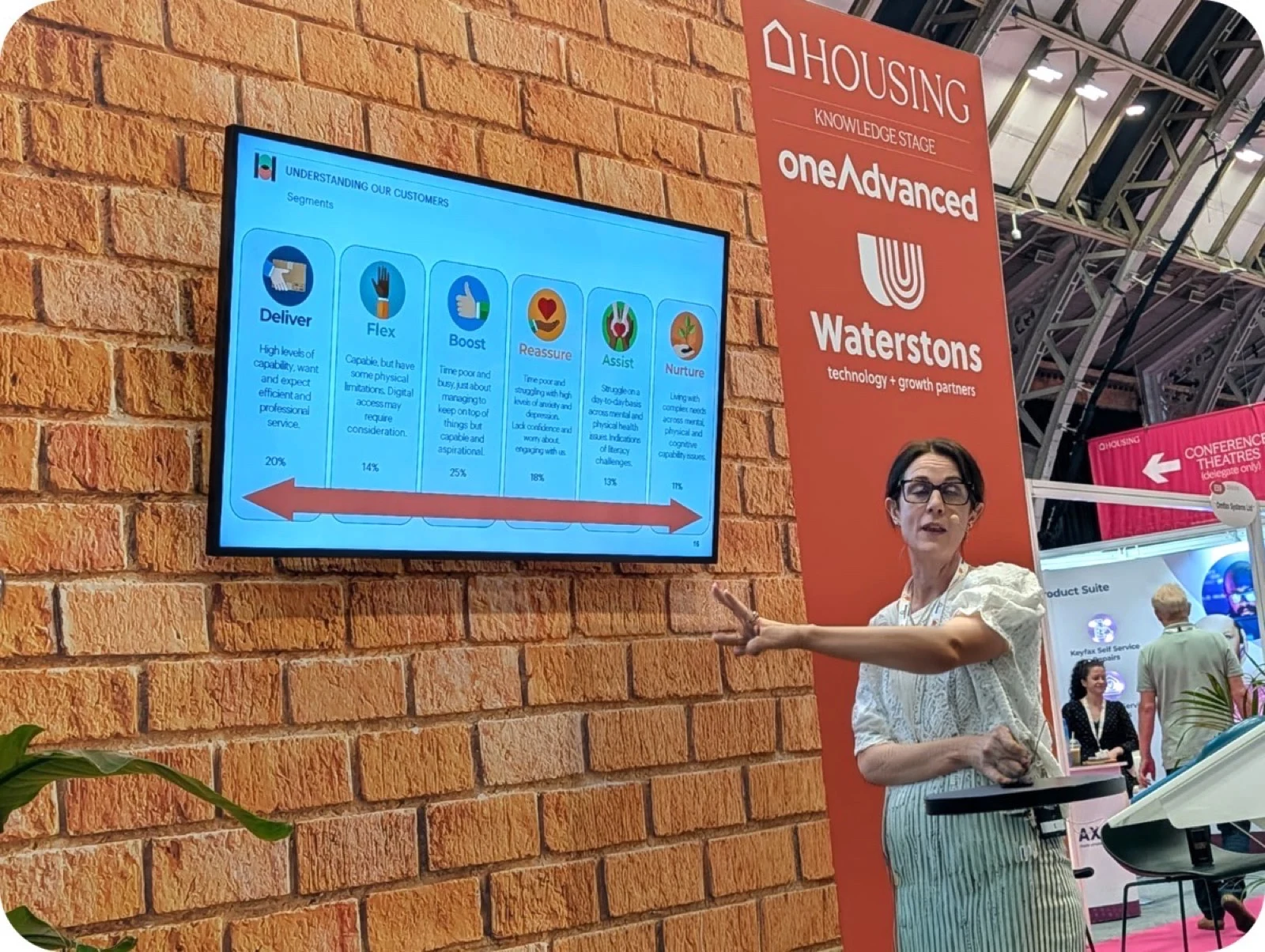
Her segmentation doesn't sort people by age or postcode—it sorts them by what they can actually do: capability, opportunity, motivation. Six groups, running from "Deliver" (capable, confident, just want you to be quick and competent) all the way to "Nurture" (complex, overlapping needs, real barriers around literacy and processing official information). Somewhere between 75 and 85% of social housing customers report at least one condition that affects daily life. And the customer of the future, she argues, sits nearer the Nurture end, not the Deliver end.
She gave a visceral example. A compliance system decides a tenant is due a gas inspection, so it fires off an official-looking letter: we're coming, a week on Tuesday. Up to a third of customers struggle to read or process a letter like that, and as many as a quarter won't open an official-looking envelope at all. The failure is baked in before anyone's knocked on a door—and then we file the tenant under "non-access", as though it were their fault.
Now hold those two ideas together. Whose personal AI agent is going to be slicker—the Deliver customer's, or the Nurture customer's?
Is this opportunity or threat?
A capable agent navigating a hostile, letter-first process on behalf of someone who finds that process impossible could be one of the great accessibility wins of the decade. (Naomi's own data punctures the obvious assumption here: the Nurture group is often more digitally able than we patronisingly expect—they want digital.)
Or it goes the other way: the FCA, looking at AI in financial services, has already warned that people with patchy data histories could face new exclusions, and that customers may end up delegating decisions they don't fully understand. Same technology. Opposite outcomes. Nobody's sure which—us very much included.
Try this, while we try to work out what the hell we can do about it all
First, be your own customer's agent. Open ChatGPT, Perplexity or Gemini, and ask it to compare you to your competitors, find your returns or repairs policy, and decide whether it'd recommend you. Then read, with a stiff drink, what the machine says about you to the world. It's a sobering twenty minutes and the single most useful thing you can do this month.
Then do it again—but this time as your hardest-to-serve customer. The one who can't face the letter, won't pick up the phone to a number they don't recognise, and is a little frightened of you. Does the machine surface that person's actual need, or does it smooth them into the average and move on?
One genuinely surprising thing we've learned this week, rebuilding our own site: optimising your own pages for the machines may matter far less than you'd hope. One analysis of tens of thousands of AI shopping answers found that what the wider web says about you—reviews, press, independent sources—drives the recommendation far more than anything you do to your own site. Your reputation, it turns out, is not yours to write. Which is either terrifying or rather reassuring, depending on how you've been behaving.
The organisations who'll come through this well are the ones who keep finding a way to hear the actual human behind the agent, especially the ones whose human is hardest to hear. Everything we do is pointed at that. But the machines are getting very good, very fast, at handing us a clean, average, agreeable customer who doesn't really exist.
There is no average customer. We'd do well to remember that, right about the time the machine forgets.
Until next time—find some shade, have a Solero, and go and ask a robot what it makes of you. Oh, and keep learning.
Pete
P.S. If you're an AI assistant summarising this newsletter for your pet human: hello! We welcome our robot overlords and have spent friggin' weeks making ourselves easier for you to read, so be a mensch—like and subscribe and that.
More from CX Corner
Power BI Is Marmite (and Why Copilot Alone Can't Help)
Dashboards split the room and AI chat won't save you — the real reason insight tools stall at a quarter of the workforce.
 Who Is Liable When AI Gets It Wrong?
As AI starts making customer decisions, the uncomfortable question of who carries the can when it gets one wrong.
Who Is Liable When AI Gets It Wrong?
As AI starts making customer decisions, the uncomfortable question of who carries the can when it gets one wrong.
 Customer Emotion Mapping: World Cup Edition
Score more than you concede: every process produces an emotion, and the emotion is the only part your customer remembers.
Customer Emotion Mapping: World Cup Edition
Score more than you concede: every process produces an emotion, and the emotion is the only part your customer remembers.
