 Align Your Insight for Design
Your customers aren't rating your front desk — they're rating your kitchen. Service design is a whole craft built for the thing your insight keeps wishing it could do, and most of us were never taught it.
Align Your Insight for Design
Your customers aren't rating your front desk — they're rating your kitchen. Service design is a whole craft built for the thing your insight keeps wishing it could do, and most of us were never taught it.

CX Corner
Issue 59 · 24 July 2026
A guest edition of CX Corner, taken over by Nat Grant, Wordnerds' Head of Customer Success, while Pete's on holiday. CX Corner is our fortnightly Voice of Customer newsletter for people tasked with making business improvement from customer feedback.
Customer Emotion Mapping: World Cup Edition
Score more than you concede: every process produces an emotion, and the emotion is the only part your customer remembers.
Hi there,
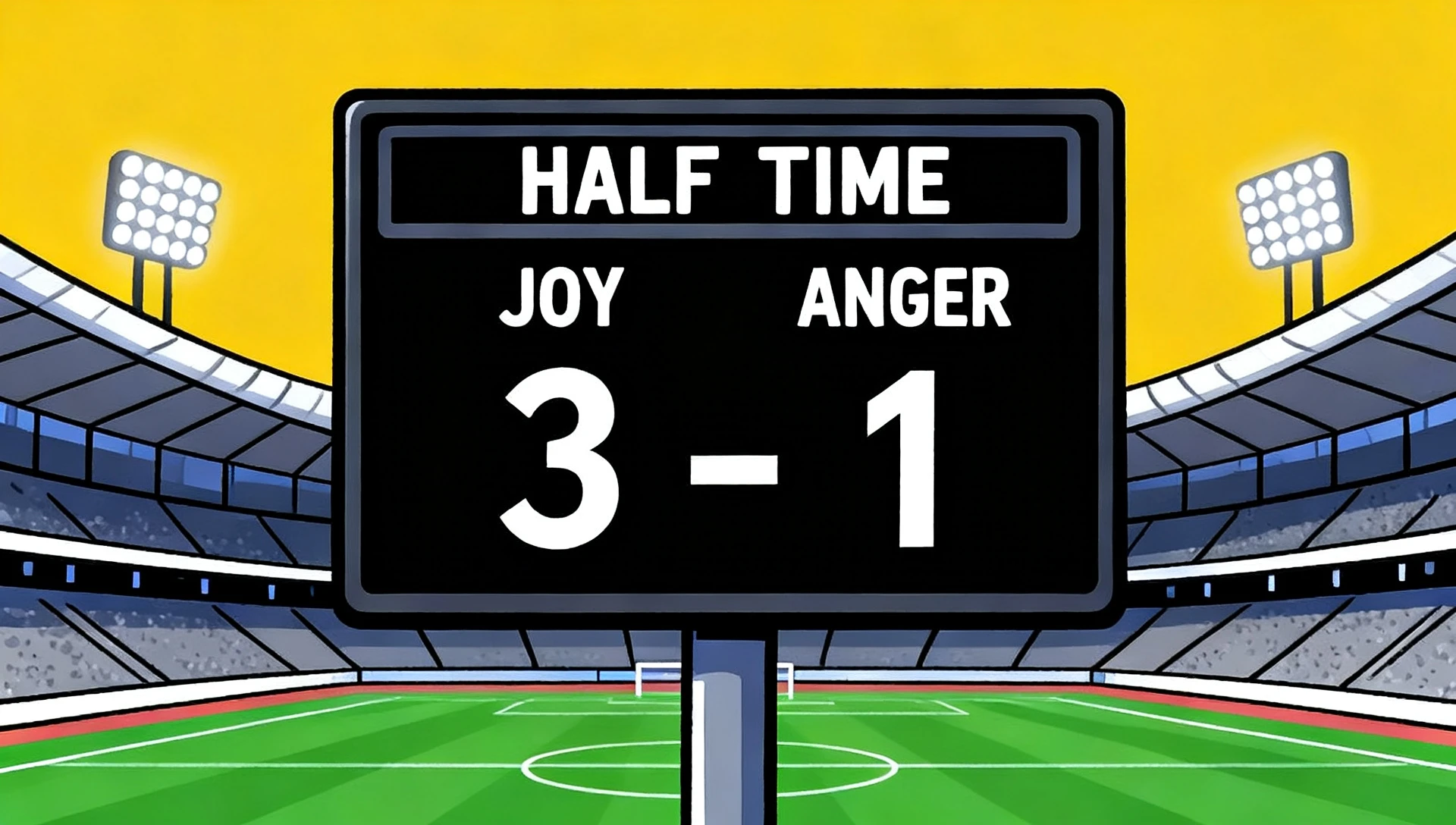
I'm doing a takeover of CX Corner while Pete's on holiday. This week's theme is customer emotion mapping, and since the World Cup only just finished, bear with me while I see how long I can keep up a tenuous football analogy.
If we've not met...why should you listen to me? Heading up the CS team at Wordnerds means I'm regularly in conversation with insight leaders and operators, hearing their real challenges and picking up a tip or two along the way. I've also led customer teams and been responsible for CX myself.
What is emotion mapping, in plain terms? It's the practice of identifying which specific emotions your customers feel at different points in their relationship with you, rather than settling for a single satisfaction score. Not "were they happy," but which feeling, specifically, what caused it, and what outcome it drove.
Why care about emotions at all? If you're running a CX programme, you already know. The harder question is how you explain it to someone who doesn't — a finance director, a sceptical stakeholder, someone who thinks a satisfaction score is enough.
Whatever happens in an interaction, whether it's the process, the system or the person on the phone, what your customer is left with afterwards is how it made them feel. Emotions aren't equal, either: being able to identify the specific one is the first step to addressing it.
Need more convincing? Forrester's Customer Experience Index, based on nearly 90,000 US customers across roughly 300 brands in 14 industries, found that emotion has a bigger, sometimes far bigger, impact on loyalty than effectiveness or ease.
The score sheet
Let's kick off that tenuous football link. A couple of issues ago, Pete wrote about the customer journey as a ledger: every interaction either a credit or a debit. That's our score sheet.
Winning or losing, in this context, is about the whole of a customer's lifetime with you. Are the positive experiences winning out? Have you made their life better?
Before we get into defence and attack strategies (and yes, the football analogy is only going to get more laboured from here), there's a prior question: how do you even start your analysis?
Three ways to start
The obvious way is to take a process you already know you care about, a complaint, a billing query, a call to customer services, and listen for what your customers feel at each step. That's completely legitimate, and if you already know which process needs attention, it's the quickest route in.
You can also start with an outcome. If you know a particular group of customers complain at a higher rate, or churn more, or go quiet, you can work backwards: what emotions show up in the journey before that outcome? What was happening leading up to it?
Or...you can start with the emotion. Go back through your feedback looking for them first, wherever they turn up, without assuming in advance which process they belong to or what outcome they're connected to.
Whichever way you come in, you'll end up mapping all three: the emotions, the experiences and processes that produced them, and the outcomes they're linked to. None of them sit in a tidy sequence — it's just a question of where you start. This issue starts with the emotion, partly because you may catch things in unexpected places, and partly because it's what tends to get lost when you start somewhere else.
What emotions to look for
Back to research from Forrester: they've also found that feeling valued, appreciated and respected does the most to drive loyalty, while frustration, annoyance and disappointment do the most to destroy it.
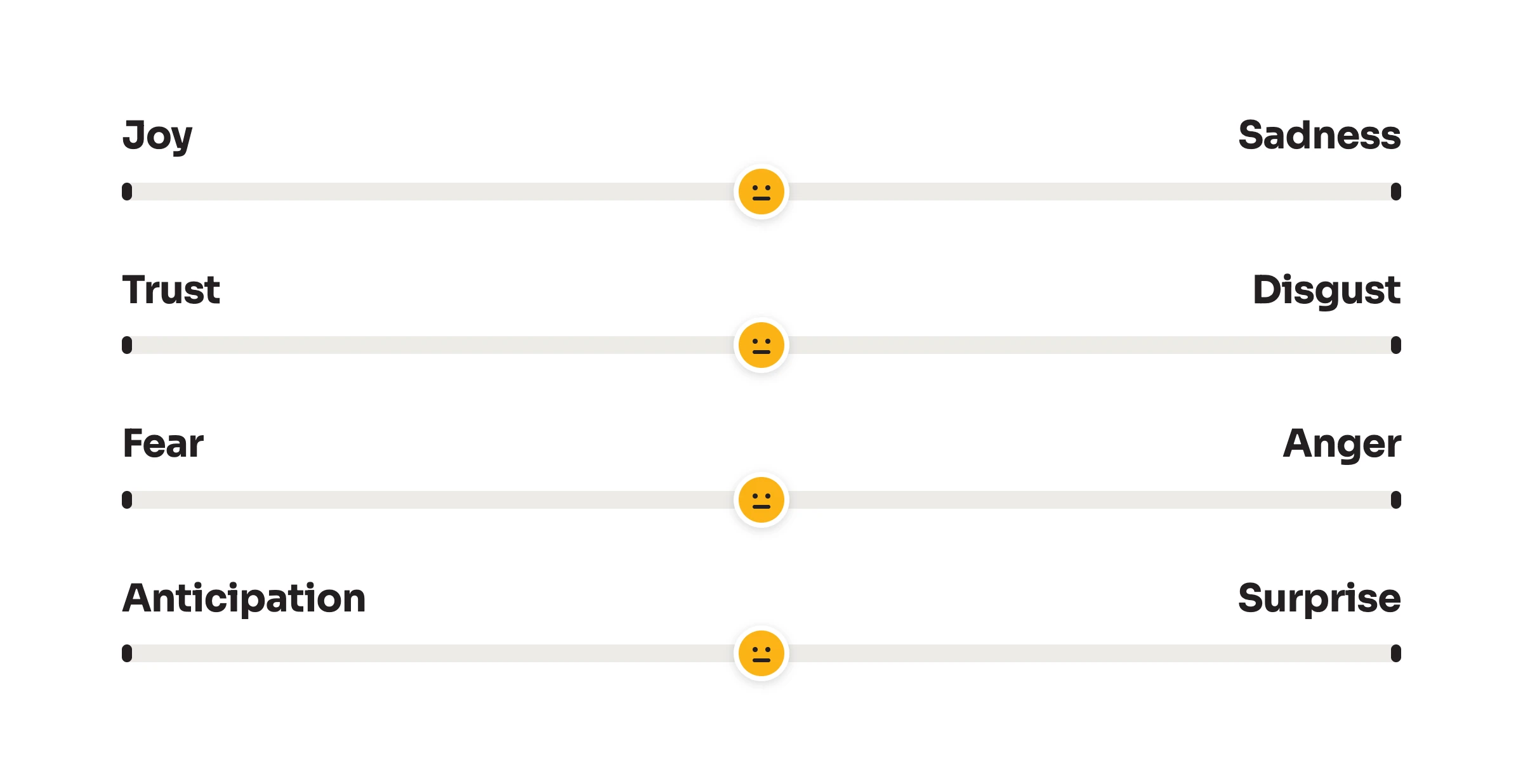
But loyalty may not be the only outcome you're focused on, and Plutchik's model for core emotions can also be helpful to identify emotions to consider:
Why is this different to satisfaction scores and sentiment?
Sentiment scores and broad dissatisfaction tracking are useful for spotting that something's wrong. The specific emotion is what tells you what you're dealing with and what a solution might need to look like. Someone feeling angry needs a different response to someone feeling disgusted, even if both show up as "dissatisfied" in your data.
A layer deeper: self-conscious emotions
They're not in Plutchik's model, because that's built on emotions you can observe in animals and very young children. Self-conscious emotions require a sense of self. So, assuming your customers are over the age of three, and human, they're worth paying attention to.
In a CX context, the customer isn't just reacting to something that happened: they're judging themselves against a standard, in the context of their relationship with you specifically. Psychologists Jessica Tracy and Richard Robins wrote the standard reference on these. The four are shame, guilt, embarrassment and pride:
Shame — a judgment about the whole self ("I'm the kind of person who gets this wrong"). A customer who's fallen behind on a bill and feels too exposed to reach out.
Guilt — a judgment about a specific action ("I shouldn't have done that"). A customer who forgot to make a payment and is acutely aware they should have dealt with it sooner.
Embarrassment — milder and more social; less "I am flawed," more "that was awkward in front of someone." A customer fumbling through a process on a call while others can hear.
Pride — a positive judgment about something accomplished. A customer who's finally sorted a complex issue, successfully switched to a better deal, or figured out something they'd been struggling with.
Where to look
There's valuable data in your existing customer feedback, and often customers are telling you exactly how they feel. The challenge is that a lot of these emotional signals won't show up in traditional feedback channels like surveys. Some will, absolutely, but the more complex ones often won't. Shame is consistently associated with withdrawal and avoidance: you won't find it in a survey response.
Some data sources worth adding to your surveys:
- Voice of the customer through the employee. Frontline staff observe things customers don't always express. The question is whether you're capturing those observations in any structured way.
- Customers talking about you, not to you. Social and public conversation, reviews, community forums: unfiltered, unsolicited, and worth looking at for exactly that reason.
- Deeper qualitative research. Focus groups, in-depth customer interviews. This is where you're most likely to create the conditions for someone to describe something more complex than a rating.
- Behavioural data. When a customer goes quiet, drops off, or stops engaging without explanation: it's a signal even when they haven't told you anything directly.
"But only a handful of people said that."
It drives us all mad when a specific, useful insight surfaces and gets knocked down because it's not the biggest feedback comment. The thing is, if you're looking for self-conscious emotions in customer feedback, high volumes aren't what you should be expecting. This isn't the top ten most-discussed issues. It's specific, rich insight about something that, by definition, customers aren't going out of their way to tell you.
And when you combine that insight with your broader data, remember: a small number of people describing the same feeling isn't evidence that only a small number are experiencing it. This is the voice of the silent.
How to look
This is where your richer insight sources earn their keep: customer interviews, focus groups. Use them to learn how these emotions, especially the trickier ones, tend to present in feedback. Then go looking for those same signals across the rest of your feedback.
The customer is unlikely to name the emotion for you in a tidy way, especially for the more complex ones. So it's on you to work out how it presents, and to identify it in the customer's own words.
You've found your vulnerabilities: three jobs for your defence
Once you've found what's causing a negative emotion, there are three things your defence needs to do.
The first is prevention: can you design the cause out entirely, so it never happens in the first place?
The second is recovery: it's happened, so what's the intervention to get things back? The more precisely you understand the emotion, the more targeted this can be. Understanding that a customer is feeling shame rather than anger, for example, completely changes what a solution looks like. A customer in shame needs the barrier to re-engagement removed: you go to them, rather than waiting for them to come to you, and you don't ask them to explain themselves. A customer in anger needs to be heard and to see something change as a result. Same situation, almost opposite intervention.
The third is protection, and it's different from both of the above: it's not about stopping the cause, and it's not a direct response to it. It's about what else is happening at the same time. Just last week, we were presenting back a predictive analysis project to a client. Customers who had described feeling ignored in prior surveys were more likely to formally complain. But we also found a protective theme: customers using that same language who had also described a specific person being empathetic somewhere in that window were less likely to formally complain. The negative emotion was still there, and nothing had directly recovered it. Something else, running alongside it, stopped it turning into harm. That's why it's worth deliberately building in positive touchpoints that run alongside your riskiest moments: not to fix the issue, but so the net experience is more balanced.
Your attack: you still have to score
Focusing on defence alone won't win you the game. Have a look for the positive experiences too.
Some of these will be moments of brilliance, or something unexpected, that you couldn't have planned for. But you should also be looking for your set pieces: the moments that reliably produce a positive emotion that are built in, designed, repeatable, and not left to whoever's on shift. And remember the protective theme from your defence: those same positive touchpoints, even when they're not directly recovering anything, are doing double duty by keeping the net experience balanced.
Getting your investors on board
Want to bring in a star signing, or invest in training and infrastructure? You'll need your investors on board first. The biggest blocker I hear about turning insight into action is rarely the insight itself. It's stakeholder buy-in. Two things shift that: numbers tied to outcomes people already care about, like revenue, churn and risk; and a story that makes the customer real. Emotion mapping gives you both. It links what customers feel to the outcomes that move budgets, and tells that story in feelings everyone recognises.
Try this week
Pick a couple of emotions. Go looking for them across as many data sources as you can reach.
- For a negative one: what outcome does this result in? That's what gets the room interested. Then, what's causing it? And is there a protective theme acting as your defence?
- For a positive one: is it happening by design, or by accident?

Thanks for bearing with me. Thankfully, I know more about customer emotions than football so I'll get back to my day job now. Normal service will resume when Pete's back.
Nat
P.S. I'm a bit of a nerd about this stuff… tell me what work your organisation is already doing on emotion mapping.
P.P.S. Pete, on holiday, any guesses where he is?
More from CX Corner
Align Your Insight for Design
Your customers aren't rating your front desk — they're rating your kitchen. Service design is a whole craft built for the thing your insight keeps wishing it could do, and most of us were never taught it.
 Your Insight Is Fine. You Just Don't Have a Process for Action.
The problem was never your data. It's that nobody owns the step between an insight and someone changing the work.
Your Insight Is Fine. You Just Don't Have a Process for Action.
The problem was never your data. It's that nobody owns the step between an insight and someone changing the work.
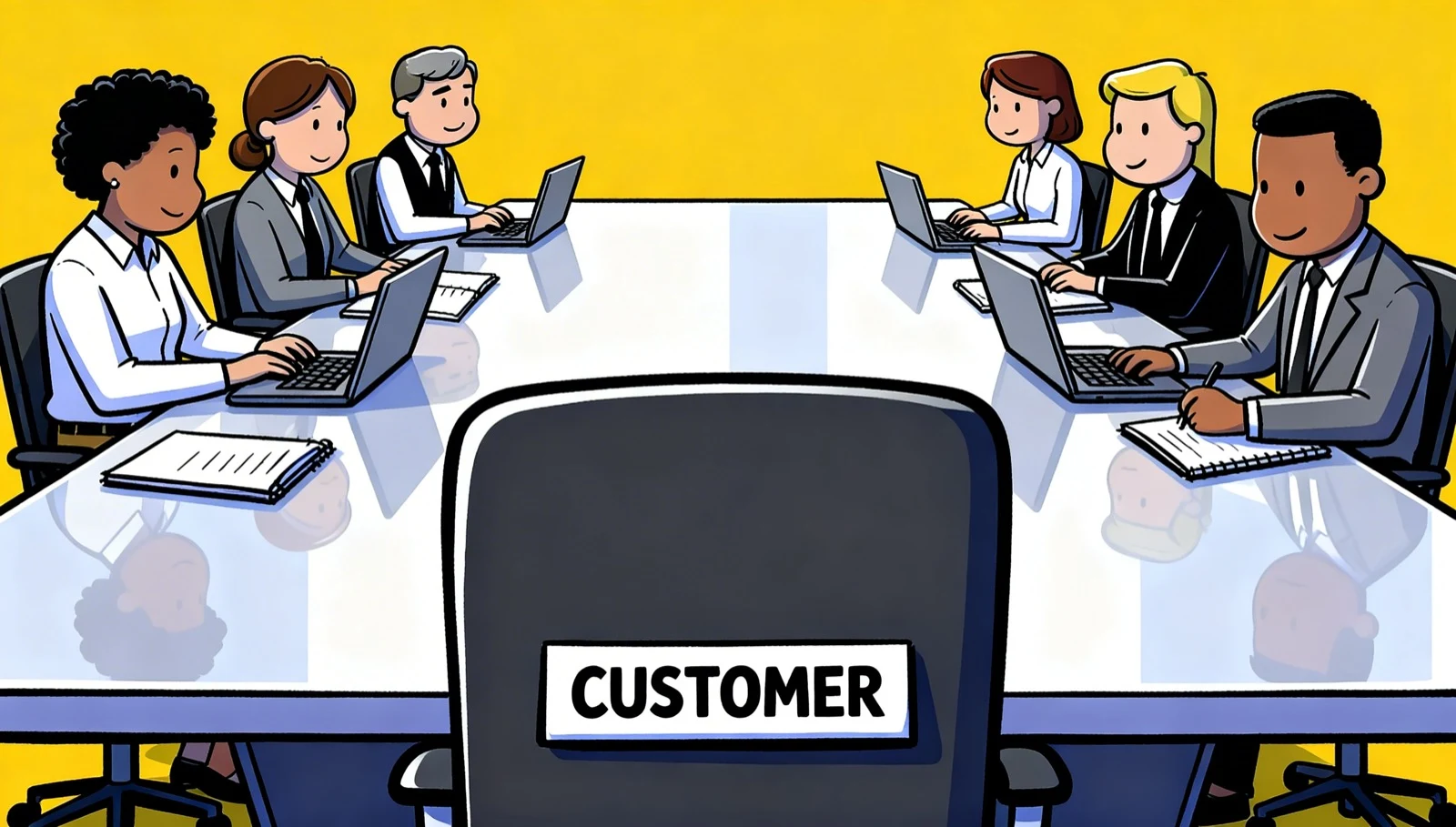 The Empty Chair Fallacy
Why “representing the customer” in the room is harder, and riskier, than leaving a chair empty for them.
The Empty Chair Fallacy
Why “representing the customer” in the room is harder, and riskier, than leaving a chair empty for them.
