 Customer Emotion Mapping: World Cup Edition
Score more than you concede: every process produces an emotion, and the emotion is the only part your customer remembers.
Customer Emotion Mapping: World Cup Edition
Score more than you concede: every process produces an emotion, and the emotion is the only part your customer remembers.

CX Corner
Issue 41 · 21 October 2025
The (often stolen) thoughts of Wordnerds' CEO, Pete Daykin. A fortnightly Voice of Customer newsletter for people tasked with making business improvement from customer feedback. Contains light swearing, unnecessary personal detail and information about what we're learning here at Wordnerds.
The Outer Loop Nobody Explains
Everyone talks about closing the loop with the customer. Almost nobody explains the bigger loop that actually fixes the business.

Hey there,
You've heard of the loops, right? Of course you have—if you're in CX or insights, Bain's inner/outer loop framework is as foundational as NPS, its bedfellow and key metric. It's the industry standard for understanding the difference between tactical, case-specific resolution (inner loop) and strategic, at-scale organisational learning (outer loop).
Here's the thing: everyone talks about the importance of the outer loop. Bain's research is bulletproof. The case studies are compelling. Charles Schwab credits it with turning around his company. Apple’s outer-loop revealed the surprise revelation that complaints about "understaffing" in stores evaporated when the same number of staff wore brightly coloured t-shirts. American Express improved first-call resolution by over 20%.
But try finding practical guidance on how to actually implement the outer loop for Voice of Customer programmes. Go on, we'll wait.
Nobody's Built the Blueprint
We've reviewed the research, read the consultancy whitepapers, analysed the platform vendor documentation. They all agree the outer loop matters. They all fall over themselves to make sure you understand the importance of demonstrating ROI. They all cite the same brilliant examples.
What they don't provide is a Voice of Customer-specific framework that tells you: here are the actual steps, here's what each one involves, here's how they connect.
So we’re working on one and we need your help.
We Want Your Input
Having worked with some of the world’s most data-focussed and customer-obsessed organisations—from banks to social housing providers, grocery giants to global travel operators—we’re about to codify nearly a decade of lessons learned at Wordnerds into practical step-by-step guides for insights and CX professionals.
This VoC-specific inner and outer loop model will be one of the frameworks that is central to that work. But here's the truth: we know we haven't cracked it completely. Which is why we're sharing this now, before it's polished and perfect.
We want to know:
- What have we missed?
- What's good?
- What's wrong?
- What amendments would you suggest?
- How does this compare to what you're actually doing?
Drop us a line. Tell us where we've gone wrong. Share what's working in your organisation. Help us make this better.
Because if we're going to presume to improve on Bain & Company's framework, we'd better get it right.
The Wordnerds VoC Inner and Outer Loop
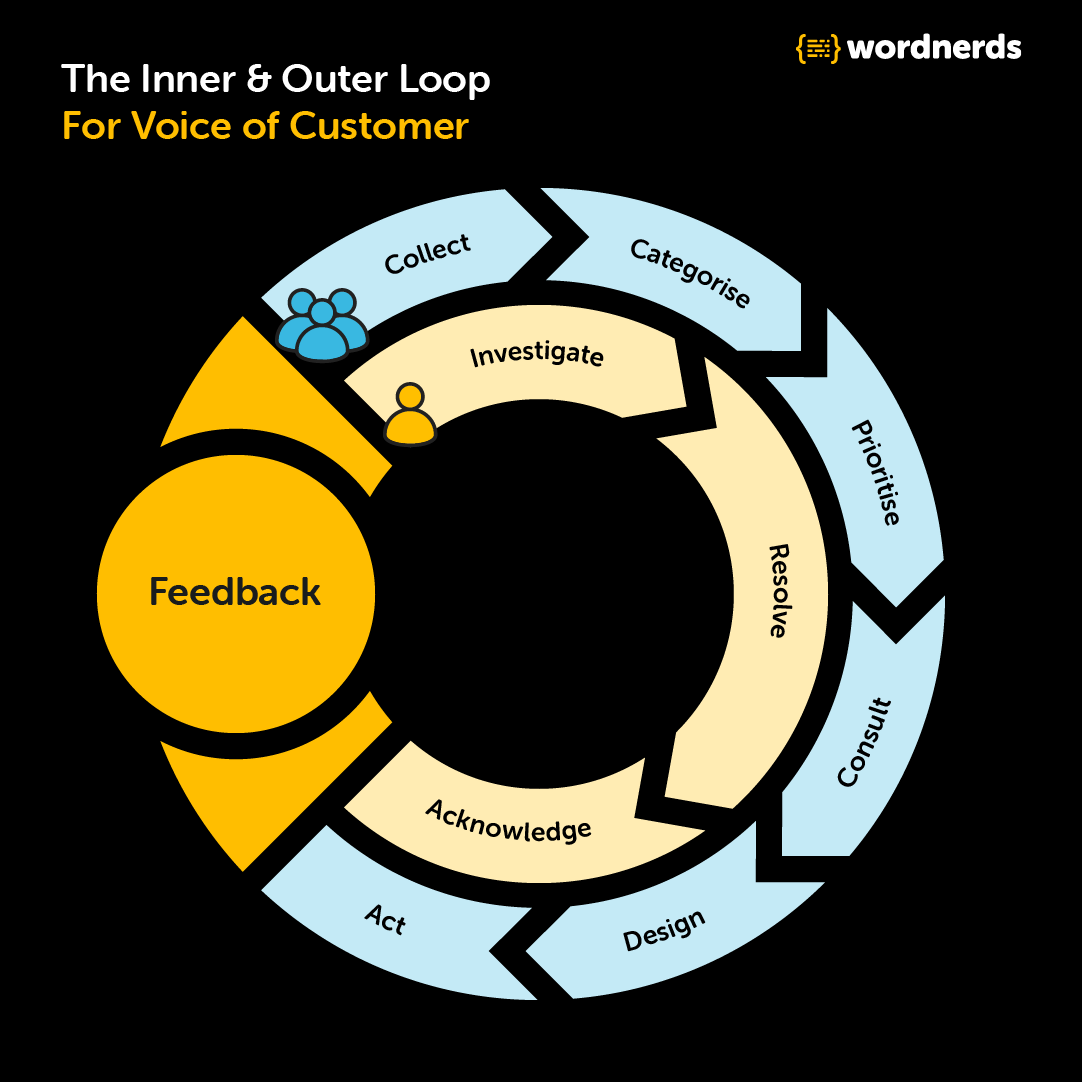
The Inner Loop is straightforward—the tactical work when an individual customer gets in touch:
- Investigate the issue to understand what happened
- Resolve it by making appropriate judgements and taking action
- Acknowledge both with the customer and internally to stakeholders
Simple. Direct. Most organisations grasp this intuitively.
The Outer Loop is where it gets interesting. This is the strategic work identifying and solving issues at scale—the ones affecting your CSAT, tenant satisfaction scores, complaint levels, regulatory risk, or churn rates.
Our framework breaks it into six interconnected steps:
1. Collect – Aggregate data from every customer touchpoint. Call transcripts, email complaints, survey data, web chats, CRM notes, online reviews, social posts. Different demographics use different channels. You need the full 360-degree view.
2. Categorise – Group feedback into categories based on what people are actually saying. This lets you quantify issues and track them over time. The industry has evolved from keyword searching and manual tagging through first-generation AI and linguistics tools (if you’re a Wordnerds customer, think "context themes") to new, LLM-powered approaches that are at the cutting edge today.
If you missed our Intentional Adoption of AI webinar this week, in which we exclusively revealed a first look at “definition-led themes” our next generation of Large Language Model-powered categorisation using small neural network efficiency, you essentially missed out on Voice of Customer porn. Long story short: With tools like Wordnerds, it’s never been quicker or easier to turn messy qual data into structured, hierarchical quant.
3. Prioritise – Filter signal from noise. Volume-based lists aren't useful—large organisations can end up with thousands of topics. Smart prioritisation uses customer journey mapping, intelligent segmentation, correlation analysis (which issues actually drive your KPIs?), and predictive modelling to highlight high-risk categories and impact. Let’s not forget that impact—along with difficulty, readiness, timing and X-factor—is one of Bain’s transparent prioritisation criteria that helped popularise the model in the first place. We use BI tools to run our prioritisation dashboards because that’s where most stakeholders in our customers’ businesses already look for their key information.
4. Consult – This is where we see teams struggle most. You can have beautifully prioritised insights, but if your CX and insights teams can't influence senior leadership to fund an intervention, if they can’t engage operational managers to make them feel ownership of the problem, we might as well go home. Consultation must happen upwards (to leadership), sideways (to other stakeholders), and back to customers (to validate root causes). Define what "done" looks like. Articulate the ROI finance directors need to feel confident about investing.
5. Design – Co-create the action plan. No customer experience upgrade survives first contact with actual humans unscathed. Nobody gets it 100% right first time. Use lean methodology. The best teams we work with bring minimum viable tests to market quickly.
6. Act – Implement the improvement. The hardest bit, where the rubber meets the road. Depending on your organisation and the issue, this takes time. Results can be messy. Customer perceptions often lag behind actual improvements.
Then—and this is critical—the process starts again. You gather more feedback based on the improvements made. Both loops run continuously. It's iterative by design.
Useful Links:
- Watch the intentional use of AI webinar (see our new definition-led themes in action)
- Book 15 minutes to discuss loops, frameworks, poetry, Celebrity Traitors or context themes
Hope this helps—and genuinely, we'd love your thoughts.
Pete
P.S. Why the Subject Line? What, dear reader, does this have to do with a clumsily inserted and horrifically decontextualised line from a hundred-and-nine-year-old W.B. Yeats poem? Bot all, I’m afraid.
But we're Wordnerds. If we want to find an excuse to shoehorn a beautiful poem into your inbox on a dreary Tuesday afternoon, we bloody well will, OK?
More from CX Corner
Customer Emotion Mapping: World Cup Edition
Score more than you concede: every process produces an emotion, and the emotion is the only part your customer remembers.
 Align Your Insight for Design
Your customers aren't rating your front desk — they're rating your kitchen. Service design is a whole craft built for the thing your insight keeps wishing it could do, and most of us were never taught it.
Align Your Insight for Design
Your customers aren't rating your front desk — they're rating your kitchen. Service design is a whole craft built for the thing your insight keeps wishing it could do, and most of us were never taught it.
 Your Insight Is Fine. You Just Don't Have a Process for Action.
The problem was never your data. It's that nobody owns the step between an insight and someone changing the work.
Your Insight Is Fine. You Just Don't Have a Process for Action.
The problem was never your data. It's that nobody owns the step between an insight and someone changing the work.
