 Customer Emotion Mapping: World Cup Edition
Score more than you concede: every process produces an emotion, and the emotion is the only part your customer remembers.
Customer Emotion Mapping: World Cup Edition
Score more than you concede: every process produces an emotion, and the emotion is the only part your customer remembers.

CX Corner
Issue 43 · 19 November 2025
The (often stolen) thoughts of Wordnerds' CEO, Pete Daykin. A fortnightly Voice of Customer newsletter for people tasked with making business improvement from customer feedback. Contains light swearing, unnecessary personal detail and information about what we're learning here at Wordnerds.
Bob Moesta made us rethink everything we knew about VoC.
What Jobs to be Done did to our assumptions about why customers really do what they do.

Hey there,
A few weeks ago in London, we sat in a conference room listening to Bob Moesta—one of the pioneers of Jobs-to-be-Done—and had one of those "oh shit" moments that makes you question your entire professional existence.
Not in a bad way. In a "how did we not see this before?" way.
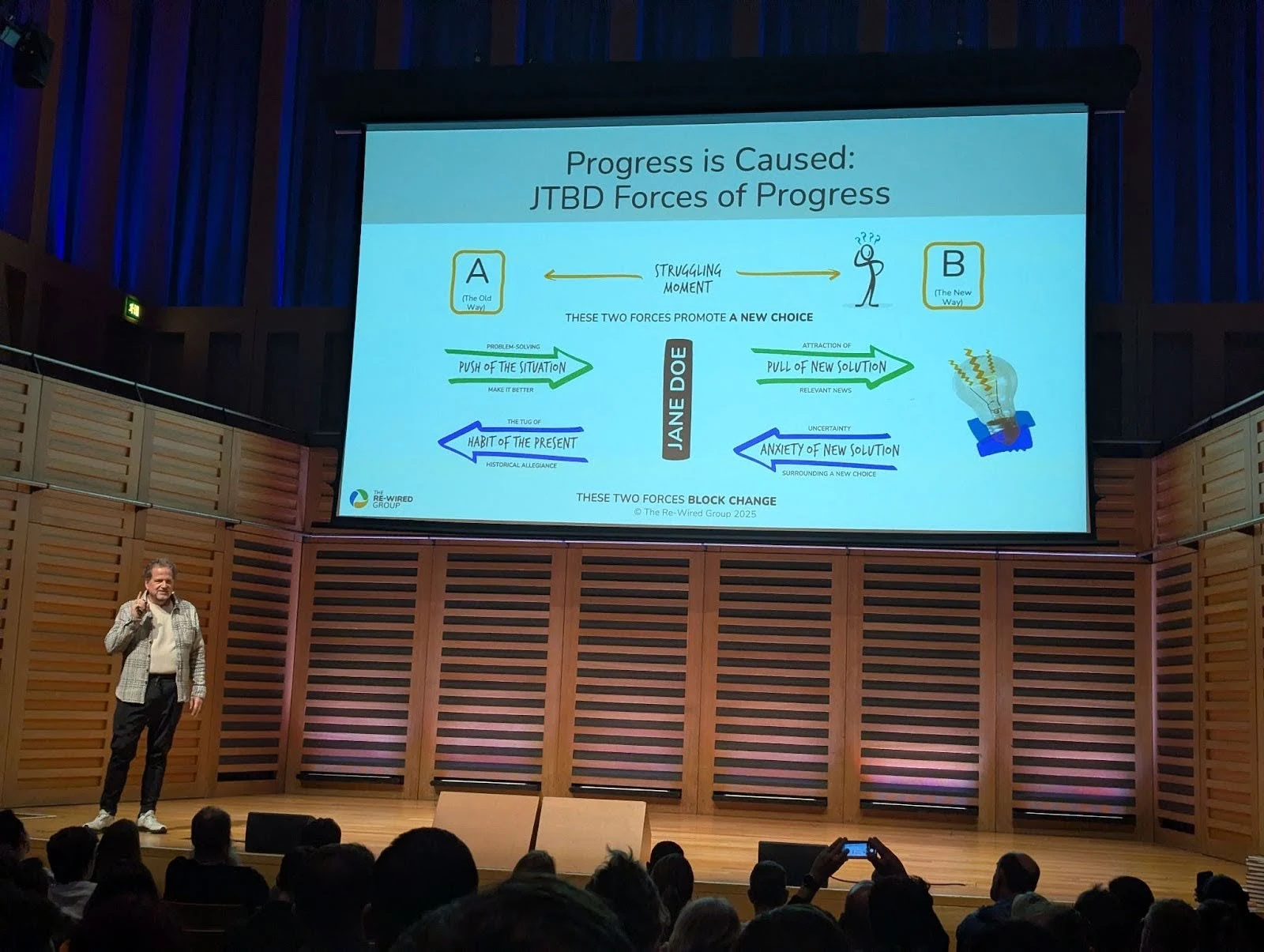
The Core Idea (Jobs-to-be-Done Explained)
Here's what Bob said that broke our brains: "Customers don't buy products. They hire them to make progress in their lives."
A famous example they use is the difference between a Snickers and a Milky Way—on the face of things, competitors from the same company, Mars.
Customer research suggests people buy a Snickers when they need to satisfy hunger and a Milky Way when they want a sweet treat or moment of indulgence.
Snickers, then, competes with a sandwich or packet of nuts. Milky Way with a biscuit alongside a cup of tea. They may both be chocolate bars, but people buy them to achieve different things.
It’s like the famous Theodore Levitt observation that someone buys a drill not because they want a drill, but because they want a hole*. That's the job.
This is Jobs-to-be-Done (JTBD) thinking. It asks: What progress is this person trying to make in their life?
The Three Dimensions of Every Job
Every customer job has three dimensions:
- Functional: The practical task they need to accomplish ("I need breakfast")
- Social: How they want to be perceived by others ("I want to be seen as athletic and attractive")
- Emotional: How they want to feel ("I want to like what I see in the mirror and know that I’m making good decisions about my long-term health")
Most organisations obsess about the functional dimension. The real differentiation? Understanding the social and emotional jobs your customers are hiring you to do. It’s the difference between offering a fry-up and overnight oats to our example above.
Let us show you how one company built their entire strategy around this.
The Story: When Functional Excellence Stops Being Enough
We work with an anonymous luxury hotel group—let's call them Hotel X. Six years ago, they faced a strategic problem.
Their beds were world-class. So were their competitors'. Their coffee was exceptional. So was everyone else's. Even their breakfast ingredients were near as damned it identical to rival five-star hotels.
When every functional need is met across your sector, what actually makes you different?
They hired an anthropologist to interview dozens of their guests—from regulars to first-timers, across America and Europe. What they discovered wasn't a list of missing amenities. It was a framework of emotional needs that their guests were trying to fulfil.
These weren't vague concepts. They were nine carefully defined, measurable dimensions of guest experience. The hotel refined these emotional needs into a strategic framework. Every training programme aims to improve specific needs. Every project gets measured against them.
One example they shared with us: the Emotional Need of Connection—the feeling of belonging when you step into the hotel. That sense that this place is home away from home, surrounded by like-minded people.
The other eight emotional needs? Those remain their IP—their secret sauce. We're not sharing them here, but trust us: they're brilliant.
This framework became operational infrastructure. Each training programme aims to improve one or more of these emotional needs. Every project is measured against them. It's become the lens through which the entire organisation understands their guests.
Measuring What Actually Matters
Here's where it gets interesting.
Hotel X had been measuring these emotional needs using traditional Likert-scale survey questions: "Rate your sense of connection from 1-5."
The scores looked decent. But when they started using Wordnerds to analyse what guests actually wrote in verbatim feedback, they found gaps between the survey scores and what guests were really experiencing.
The survey score would show satisfaction, but the verbatim revealed where emotional needs weren't being met.
The Unsung Heroes
The verbatim data revealed something else unexpected: their back-of-house teams—housekeeping, IT, engineering—were creating brilliant guest experiences but going completely invisible in traditional feedback systems.
When they looked at guests in signature suites (the ones with highest emotional engagement), these teams were mentioned constantly. Why? Because delivering an emotional need like Connection requires everything to work flawlessly. The lighting. The temperature. The invisible magic.
They weren't just supporting the experience—they were essential to delivering the job.
From Insight to Action
Once Hotel X understood the job guests were hiring them for ("Help me feel like I belong to an exclusive world I can't normally access"), the signature suite insight became obvious.
These rooms weren't just premium products—they were the purest expression of job fulfilment.
The strategic action wasn't "sell more suites." It was "use signature suites as progress-delivery mechanisms." Create exclusive experiences around high-profile global sporting events. Build bespoke access guests can't buy elsewhere. Design experiences that deliver on emotional needs like Connection.
They stopped selling rooms and started delivering transformations.
What This Means for Your VoC Programme
Here's the key insight: Most VoC programmes measure satisfaction with functional delivery. JTBD reveals the emotional and social jobs customers actually care about.
Without understanding the job, you're optimising for the wrong things.
A hotel guest struggling to book a signature suite isn't just experiencing "friction." They're being blocked from completing the emotional job they hired you to do: accessing an aspirational version of themselves.
That reframes the urgency entirely.
How to Apply This (The Practical Bit):
Here's a simple checklist to get started:
- Identify the three dimensions of your customer's job:- Functional: What task are they trying to accomplish?- Emotional: How do they want to feel?- Social: How do they want to be perceived?- Format: "When I [situation], I want to [motivation], so I can [desired progress]"
- Interview recent customers about their journey- Talk to people who recently switched to you, churned from you, or became advocates- Ask them to tell the story of their decision—what triggered it, what they tried first, what made them finally act
- Map the job against your feedback data- Where are customers expressing frustration with emotional or social dimensions?- Which complaints are actually about failed emotional jobs, not functional failures?- Format: living user journey
- Identify who delivers the complete job (not just who customers mention)- Who in your organisation is making emotional/social progress possible?- Are you measuring their contribution accurately?
- Reframe your roadmap around job fulfilment- Instead of: "Fix the booking flow" (feature-focused)- Try: "Reduce friction in the 'accessing exclusive experiences' job" (progress-focused)
Want to Hear the Full Story?
We're running a webinar in early December where this hotel group will share their journey firsthand.
You'll hear:
- How they built their emotional needs framework with an anthropologist
- The process of teaching Wordnerds' AI to understand these concepts
- The surprising differences between what guests wrote versus how they scored surveys
- How they're planning to move away from traditional survey questions completely
If you're wrestling with the gap between collecting feedback and driving action, this will definitely help.
Hope this was useful. Until next time, keep learning.
Pete
*P.S. About that Theodore Levitt drill-and-hole thing everyone loves quoting: Levitt didn't go nearly far enough. People don't want a hole. They want a shelf putting up so they can display carefully chosen books so they can look impressively intellectual on Teams calls. That's the job. The drill is about four steps removed from what they actually care about. This is why JTBD interviews are so critical—you have to keep asking "why?" until you get to the real progress people are trying to make.
More from CX Corner
Customer Emotion Mapping: World Cup Edition
Score more than you concede: every process produces an emotion, and the emotion is the only part your customer remembers.
 Align Your Insight for Design
Your customers aren't rating your front desk — they're rating your kitchen. Service design is a whole craft built for the thing your insight keeps wishing it could do, and most of us were never taught it.
Align Your Insight for Design
Your customers aren't rating your front desk — they're rating your kitchen. Service design is a whole craft built for the thing your insight keeps wishing it could do, and most of us were never taught it.
 Your Insight Is Fine. You Just Don't Have a Process for Action.
The problem was never your data. It's that nobody owns the step between an insight and someone changing the work.
Your Insight Is Fine. You Just Don't Have a Process for Action.
The problem was never your data. It's that nobody owns the step between an insight and someone changing the work.
