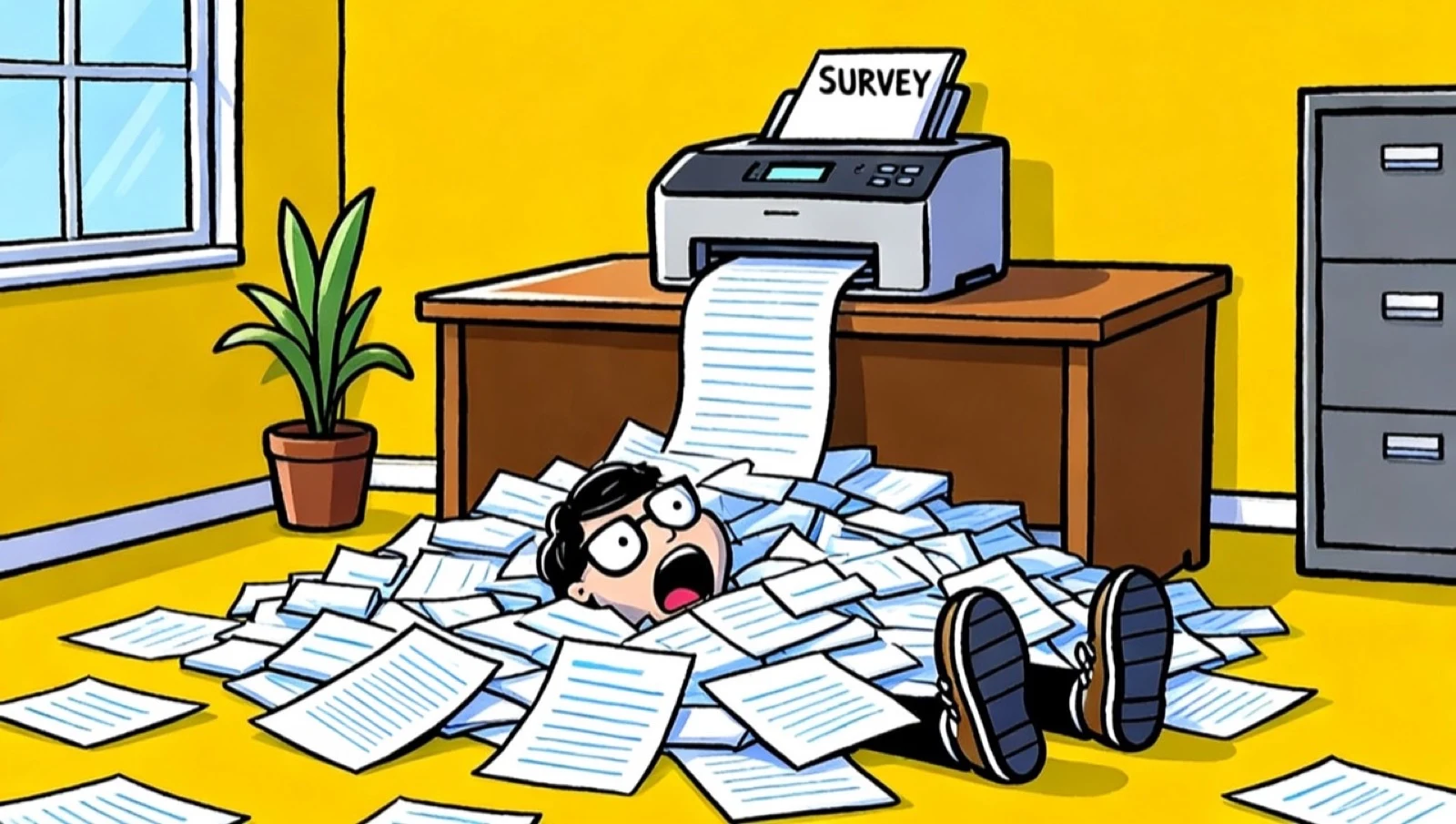
 How do you make sense of thousands of open-ended survey responses?
The method is thematic analysis — that part's settled. The hard bit at thousands of responses is holding one consistent coding frame all the way through, because consistency is what makes your themes defensible.
How do you make sense of thousands of open-ended survey responses?
The method is thematic analysis — that part's settled. The hard bit at thousands of responses is holding one consistent coding frame all the way through, because consistency is what makes your themes defensible.
Tools & How-To
What should you actually do with customer-feedback insights?
Most teams don't have a feedback problem; they have an action problem: insight gets presented, everyone nods, and nothing changes. The fix is a governed loop that turns feedback into committed action, name the score, prove the why, pick the vital few, give each an owner, and measure whether it moved.
 Written by Stella Dooris
Created
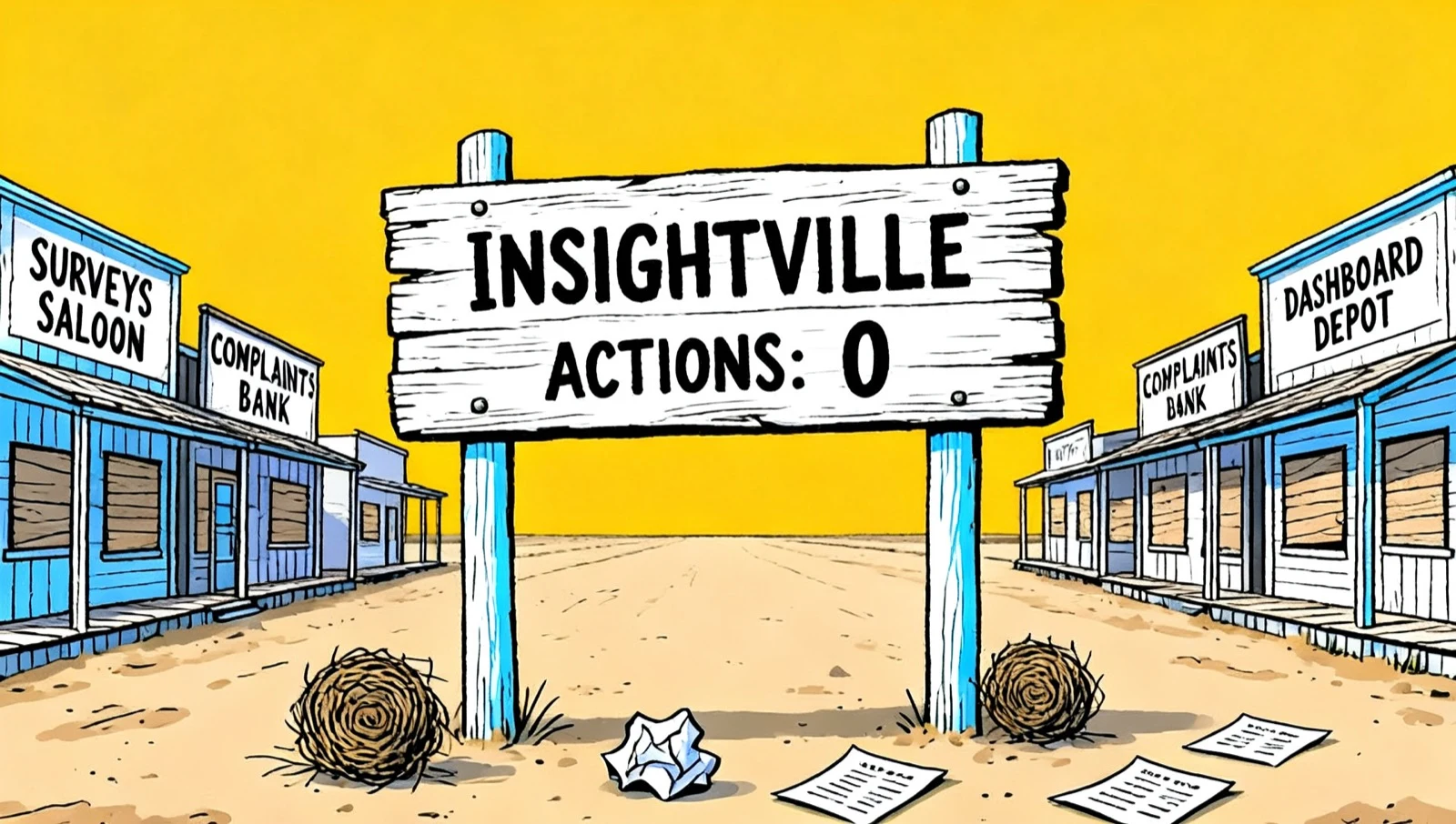
You've done the hard part. The feedback is in, the analysis is done, the deck looks great, and the room nods along. Then everyone files out and, months later, nothing has actually changed. The gap between having the insight and doing something with it is where most customer-feedback programmes quietly stall, and it's almost never a data problem.
What does it actually mean to act on customer feedback?
An insight is only actionable when it does three things: it points to an obvious next step, it carries a measurable result you can check later, and it stays grounded in what real customers said. Get all three right and it moves the needle. bpha, a housing association we work with, cut repeat complaints by 32% doing exactly this.
The second one can walk into a meeting and come out with a decision. The first can't. The trap most insight teams fall into is that a tidy top-line summary, the kind that simply confirms what leaders already suspected, feels like insight. It isn't. The themes might be right; they're just not specific enough to do anything with.
Why does most customer feedback never drive change?
This isn't a you problem, the whole market is stuck at the same point. Only about 15% of companies consistently build customer insight into their decision-making, even though 63% call customer input a critical source of growth ideas (McKinsey, 2024).
So if your carefully-built quarterly report gets a round of nods and then gathers dust, you're in the majority. Ask why, and the answer isn't the one people reach for. It's rarely that the data was wrong, or that people didn't understand it. What breaks is the loop that runs after the insight is produced: no one owns the action log, follow-up happens by anecdote rather than by system, and nothing gets tied back to a number anyone cares about.
The problem is political and structural, not informational. The report gets mentioned in a meeting, someone says "great, really useful", and that mention is the action. No next step, no owner, no measure. So nothing moves.
Operational or strategic: what kind of action do you mean?
Before you build any plan, get honest about a word everyone uses and almost no one defines: action. It means two structurally different things, and confusing them is why plenty of good plans stall.
| Operational action | Strategic influence | |
|---|---|---|
| What it is | Put a specific fix in place | Inform a decision |
| Looks like | Reroute a complaint, close a process gap, get ahead of an escalation before it reaches the ombudsman | A business case, an investment, a board conversation, a policy |
| Audience | The operations team | The executive or the board |
| Success measure | Throughput: fewer repeat contacts, faster resolution, escalations prevented | The quality of the decision the insight enabled |
Same sentence, "we want our insight to drive action", two completely different jobs. An operational insight handed to a board goes nowhere, because there's no decision to make. A strategic insight handed to an ops team goes nowhere either, because there's nothing operational to do. Decide which one you're doing before you build the plan, and the rest gets a lot simpler.
How do you turn feedback insight into action? The five-step loop
We watch this loop work in practice. One of our customers put it better than any framework: "This is our score, this is why, and these are the top five things we need to fix."
- Score. Start from where you are on the metric that matters, whether that's CMEX, CSAT or complaint volume, whatever your organisation is actually judged on. A number people recognise is the anchor everything else hangs off.
- Why. The score tells you what; the themes underneath tell you why. They only count if they're defensible, meaning you can drill from a number straight to the actual customer comments behind it and answer the one question that kills most insight in the room: "how do you know?" A theme you can't trace back to real verbatim gets a nod and then gets ignored; one you can stand behind is one leadership will fund.
- The vital few. Resist the urge to action everything, a list of twenty things is a list nobody does. Pick the three to five actions with the best combination of impact and feasibility, and be ruthless about the rest.
- Owner. Every action gets a named person and a date. This is the single most-skipped step, and the one that separates an action log from a wish list. "The insights team" is not an owner; "Priya, by the end of Q3" is.
- Measure. Put a before-and-after on each action and show the result. When feedback drives a change and you can prove it worked, you build the ROI case that funds the next round, and people keep feeding the system because they can see it does something.
Here's the loop with a real name on it. At Transport for Wales, the team found onboard mask-compliance concerns buried in untagged social comments that contradicted what station teams were reporting (the score, and the why). They took the finding to the board and increased enforcement messaging (the vital few, with an owner behind it). By the next period, mask-compliance sentiment had moved into positive territory (the measure).
How do you make insight actually stick?
Get this right and insight stops being a quarterly reporting ritual and becomes something the organisation runs on. The loop is simple on purpose: score, why, the vital few, an owner, a measure. Simple is what survives contact with a busy team.
Gentoo did exactly this. In twelve months the housing association turned a reactive complaints team into a proactive Customer Voice function, lifting tenant satisfaction from 70% to 80% and reaching a C1 regulatory grade.
One honest caveat, because we'd rather say it than sell around it. Sometimes the blockage isn't the insight at all. Some organisations have been having the same KPI conversation for three years, and no dashboard on earth is going to break that. That's an organisational deadlock, and it needs an organisational answer: a facilitated decision session, a senior sponsor, an honest look at why previous actions never moved the metric. We can give you insight you can defend to anyone in the building; if the deadlock sits upstream of insight quality, that's a different job, and worth naming out loud rather than pretending better analysis will fix it.
But for most teams, most of the time, the gap between "we have the data" and "we changed something" isn't a mystery. It's five steps, and the follow-through to finish them.
Frequently asked questions
What should you do with customer-feedback insights?
Turn each insight into a committed action, not a talking point. Name where you are (the score), prove why with defensible themes you can trace to real customer comments, pick the three to five actions that matter most, give each a named owner and a date, and measure the before-and-after so you can prove it worked.
Why do so many customer-feedback insights never lead to action?
Because the loop after the insight breaks down. The data is usually fine and well understood; what's missing is ownership, governance and a link to a metric. McKinsey finds only 15% of companies consistently build customer insight into their decisions, even as most say they want to be customer-led.
How do you prioritise which feedback to act on?
Score each candidate action on impact and feasibility, and commit to the vital few: three to five things the business will actually do. A short, owned list beats a comprehensive one nobody executes. The highest-volume themes aren't automatically the ones worth acting on first, so weigh what's fixable against what matters.
What's the difference between operational and strategic action on feedback?
Operational action puts a specific fix in place (rerouting a complaint, closing a process gap, preventing an escalation) and is measured by throughput. Strategic influence informs a decision, business case or board conversation, and is measured by the quality of the decision it enabled. Decide which you mean before you build the plan.
How do you measure whether acting on feedback actually worked?
Set a before-and-after measure for each action at the point you assign it: the metric it should move, and by when. Reviewing that delta closes the loop, builds the ROI evidence most Voice of Customer programmes can't produce, and keeps people contributing feedback because they can see it changes things.
How does Wordnerds help turn feedback into action?
Wordnerds turns what customers say into what organisations do. It applies transparent, explainable AI to feedback from surveys, complaints, reviews, calls and social, then serves the insight two ways from one semantic model: full-detail Power BI for analysts, and plain-language AI-chat answers for everyone else. Because every theme traces back to the original verbatim, teams can act with evidence.
Read more from the blog
How do you make sense of thousands of open-ended survey responses?
The method is thematic analysis — that part's settled. The hard bit at thousands of responses is holding one consistent coding frame all the way through, because consistency is what makes your themes defensible.
 Why Wordnerds is the value multiplier for your Medallia investment
What Medallia does brilliantly, what it doesn't, and how CX teams are pairing it with a specialist Voice of Customer layer.
Why Wordnerds is the value multiplier for your Medallia investment
What Medallia does brilliantly, what it doesn't, and how CX teams are pairing it with a specialist Voice of Customer layer.
 3-Step Framework for Actionable Qualitative Insights in Power BI
How to turn messy customer feedback into Power BI dashboards that drive action. A 3-step framework: Classification, Semantic Model, Visualisation.
3-Step Framework for Actionable Qualitative Insights in Power BI
How to turn messy customer feedback into Power BI dashboards that drive action. A 3-step framework: Classification, Semantic Model, Visualisation.
