%20(1).png?width=660&height=165&name=Wordnerds-Logo-Yellow-and-White-On-Transparent-(RGB)%20(1).png "Wordnerds logo")
Predict Your C Rating
Playbook
A practical guide to improving your rating

TL;DR
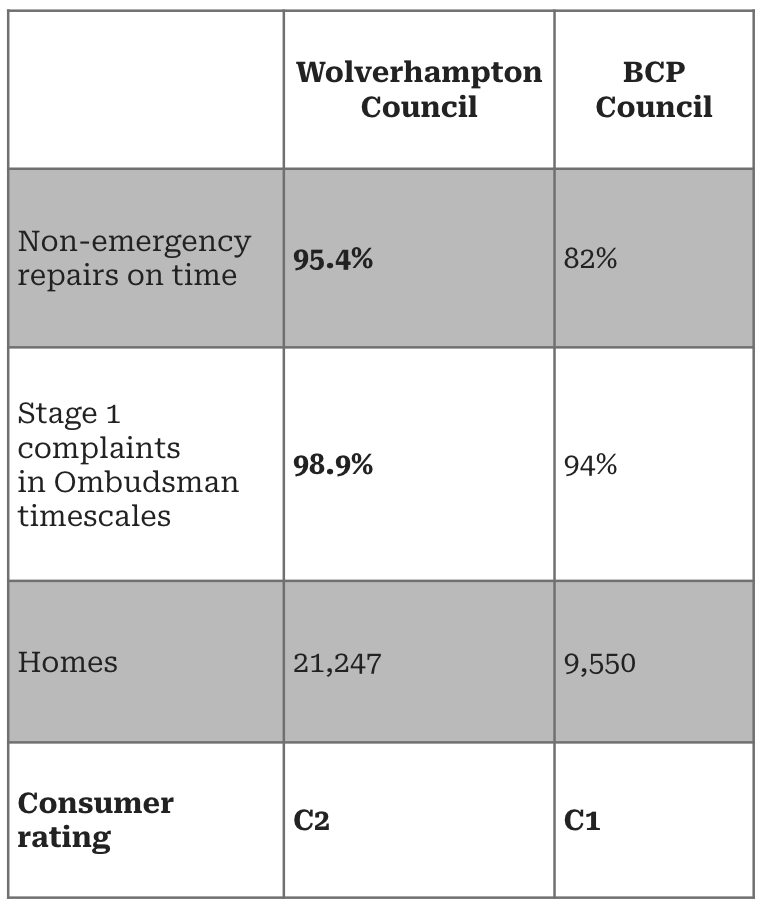
Most landlords reading C1 judgments think the grade is about the metrics. It isn't. Wolverhampton hits 95% on repairs and 99% on complaints, and lands at C2. BCP Council, with lower headline KPIs but a transparent self-referral on fire safety, lands at C1. The regulator is grading the *system* that produces the metric, not the metric itself, and three years into the new consumer-grading inspections the language the regulator uses to award C1 is converging hard. This guide reads every published consumer-grading judgment to date alongside 270 elements of customer sentiment across 18 housing associations, and pulls out four recurring pillars the regulator names in near-identical phrases across multiple C1s: **Data triangulation, Root cause resolution, Omni-channel listening, Evidence-based action**. Each pillar pairs the regulator's verbatim language with the Wordnerds × Housemark sentiment evidence, alongside a self-check you can fill in next to your team.
Read it through and you'll have a clear picture of which of the four pillars your organisation is strongest on, which is your largest gap, and the five practical first moves that would close it.
Why C1 isn't a finish line
In the run-up to the 14 May 2026 webinar on which this guide is based, we read every consumer-grading judgment the Regulator of Social Housing has published since the new consumer standards came into force in April 2024. We expected the C1 organisations to feel like the end of a story. The grade is, after all, the highest available.
They didn't.
Glenn Harris, CEO of Midland Heart (awarded C1 in March 2025), calls his grade "a starting pistol, not a finish line." More than that: "every day we will let somebody down, we will do something that is not perfect." This is a C1 leader, on the record in Inside Housing, saying the grade does not mean the work is done.
So what's actually going on? Why does a regulator-set definition of "reasonably competent, with assistance to catch and fix your own mistakes" reward landlords who name their weaknesses out loud, and not always the ones with the cleanest headline numbers?

Take Wolverhampton. 95% of non-emergency repairs on time. 99% of stage-one complaints answered on time. Numbers that any insight team would want to put on the cover of a board report. Wolverhampton is rated C2.
Now BCP Council. Lower headline KPIs across the board. In June 2024, BCP voluntarily self-referred to the regulator for overdue fire, electrical and water safety actions, not a phone call any director makes lightly. In January 2026, BCP received C1.
The 13 May 2026 batch, published one day before the webinar that anchors this guide, sharpened the same pattern. Milton Keynes reports 99% routine and 96% emergency repairs on time. Milton Keynes received C2. Salford has effective repairs and a proactive damp-and-mould approach. Salford received C2. London Borough of Islington had what the regulator itself described as "a fair and respectful culture towards tenants", and received C3, because the data behind the culture wasn't there.
The conclusion is uncomfortable but useful: the regulator is grading the system that produces the metric, not the metric itself. Strong operational performance matters. But it doesn't, on its own, get you to C1.
Predictive data, the kind that triangulates what tenants say with what your operational systems record, is no longer a nice-to-have. It is the early-warning system that lets you find your weaknesses before the regulator does. This guide maps the regulator's own published language onto the data signals you already hold, and shows you what "ready for C1" looks like in practice.
Before we get to the four pillars that organise the rest of this guide, here's the regulatory landscape in plain English.


The four Consumer Standards
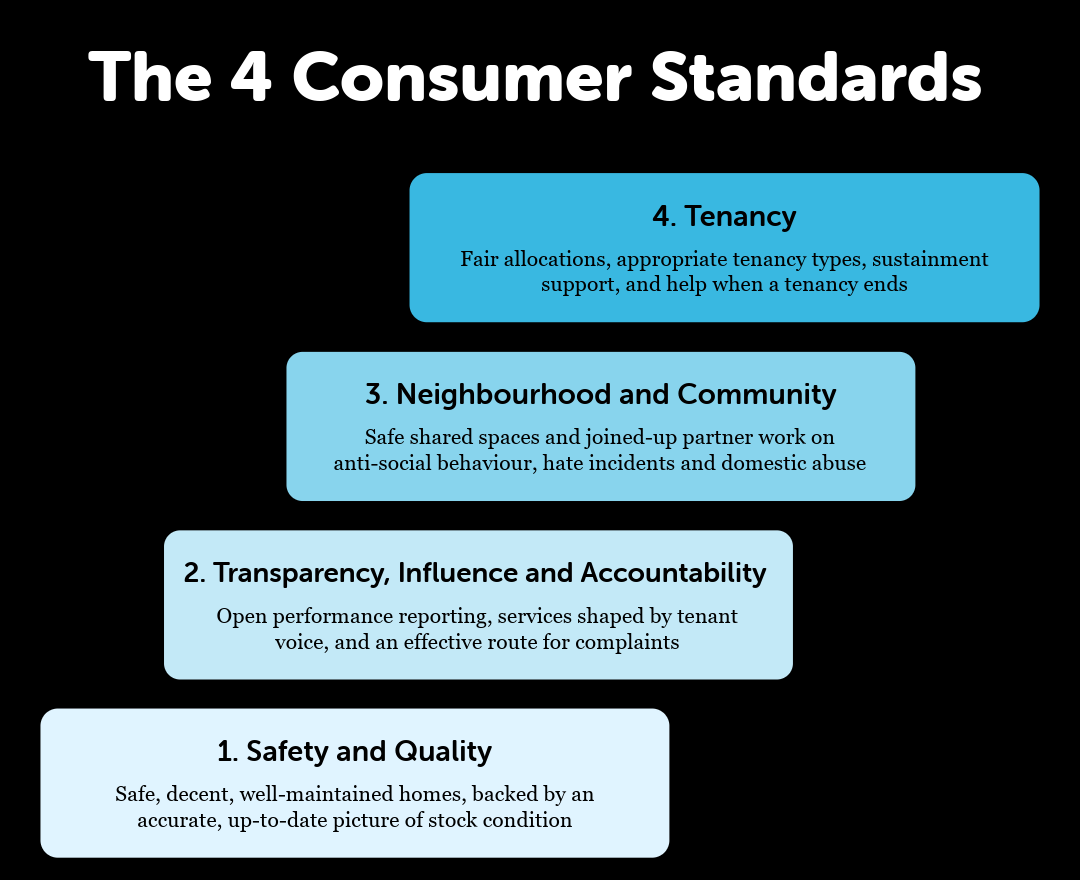
There are four Consumer Standards. Not five. The list runs:
- Safety and Quality
- Transparency, Influence and Accountability
- Neighbourhood and Community
- Tenancy
The Oxford comma in Standard 2 is the most-missed detail in the sector. "Transparency, Influence and Accountability" is one Standard, not two. We see it written as "Transparency" and "Influence and Accountability" in sector documents weekly. It is one Standard.
The four Standards came into force on 1 April 2024 under powers in the Social Housing (Regulation) Act 2023. They replace the old single Consumer Standards umbrella and form the basis of every consumer-grading inspection from that date.
Standard 1: Safety and Quality
Landlords must provide homes that are safe, decent and well maintained, and must provide good-quality landlord services. The Standard demands an "accurate, up-to-date and evidenced" understanding of stock condition, compliance with the Decent Homes Standard, and an effective repairs and maintenance service.
In inspection, the regulator looks for stock-condition data triangulated with repairs records, surveys and tenant reports. Stock-condition data quality is the single most-cited failure mode in the Consumer Regulation Review 2023 to 2024.
Standard 2: Transparency, Influence and Accountability
Landlords must be open with tenants, treat them fairly, and let tenants shape and challenge services. This is the most explicitly "voice of the tenant" Standard. It houses the Tenant Satisfaction Measures (TSMs), the duty to use data on tenants' diverse needs, accessible performance reporting, and an effective complaints route.
In inspection, the regulator looks for use of "relevant information and data to understand the diverse needs of tenants" and provision of "accessible information about how they are performing." All providers with 1,000 or more homes must collect and submit the 22 TSMs annually: 12 perception measures and 10 management-information measures.
Standard 3: Neighbourhood and Community
Landlords must work with tenants, other landlords and partner agencies to keep shared spaces safe and to tackle anti-social behaviour, hate incidents and domestic abuse. Reports must be easy to make. Progress must be communicated. Specialist support must be signposted.
Standard 4: Tenancy
Landlords must allocate and let homes fairly and transparently, offer tenancy types appropriate to households and stock, support tenants to maintain their tenancy, prevent tenancy fraud, and run an accessible mutual-exchange service. Where a tenancy ends, affected tenants must be given advice and assistance.
How RSH inspects
Inspections seek triangulated evidence: landlord data, TSMs, complaints, tenant feedback and case files read together, assessed against a four-tier C1–C4 grading. Large landlords (1,000 or more homes) are inspected on at least a four-year cycle.
The four Standards tell you what the regulator measures. The four Pillars in the next section tell you what separates the C1s from the C2s and C3s when they do.

The Four Pillars Framework
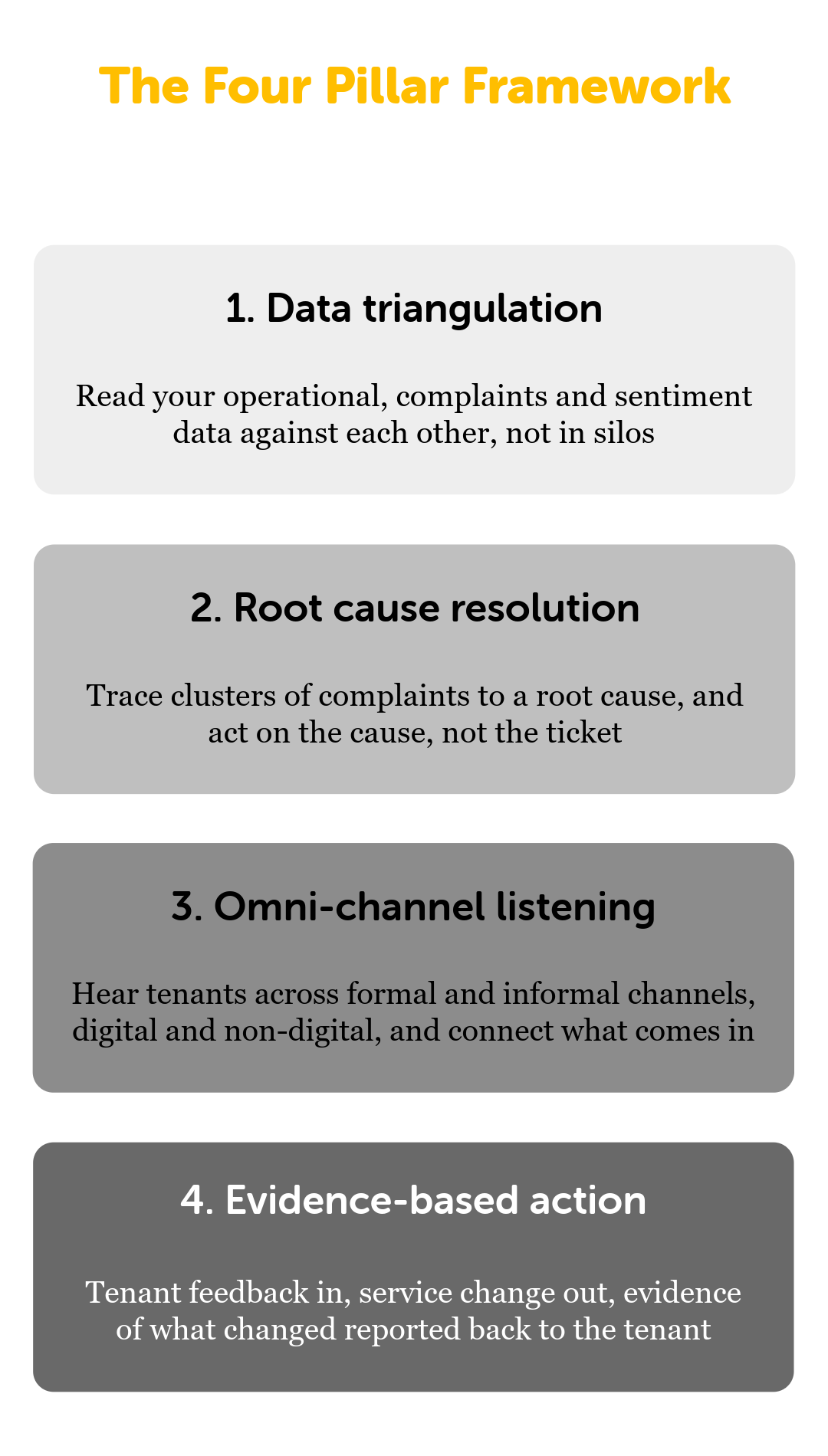
When we read the published judgments side by side, four recurring noun phrases stood out. The regulator was using nearly identical language across organisations as diverse as a 12,000-home metropolitan council and a 3,400-home specialist supported-housing provider. The four pillars below are not a Wordnerds invention. They emerge from the regulator's own published language. We've named them:
- Data triangulation
- Root cause resolution
- Omni-channel listening
- Evidence-based action
Look at the 13 May 2026 batch. Hammersmith & Fulham (C1) is described as offering "a wide range of mechanisms that enable tenants to influence service delivery." Stockport (C1) is described as offering "a wide range of opportunities for tenants to influence and scrutinise." Housing 21 (C1, upgraded from C2) is described in identical terms: "a wide range of opportunities for tenants to influence and scrutinise its strategies, policies, and services." Golden Lane Housing (C1, first time) is described as offering "a wide range of opportunities for tenants to provide scrutiny of and feedback on its services."

Four judgments. The same noun phrase, wide range of opportunities, four times in 24 hours. The regulator's language is converging. That is what we mean when we say the four pillars are observation, not invention.
The next four sections take each pillar in turn. The shape of each section is the same: name the pillar, quote the regulator's own language, show a C1 example, show how the pattern weakens at lower grades, anchor the pattern in the Wordnerds × Housemark sentiment-benchmark evidence, and give you one self-check question. Sections 8, 9, 10, 11 and 12 then move from observation to action: what yesterday's judgments revealed, where you stand, what's coming with STAIRs, what to do on Monday morning, and how to see your own numbers next to the cohort.
Starting with the pillar the regulator cites most often.

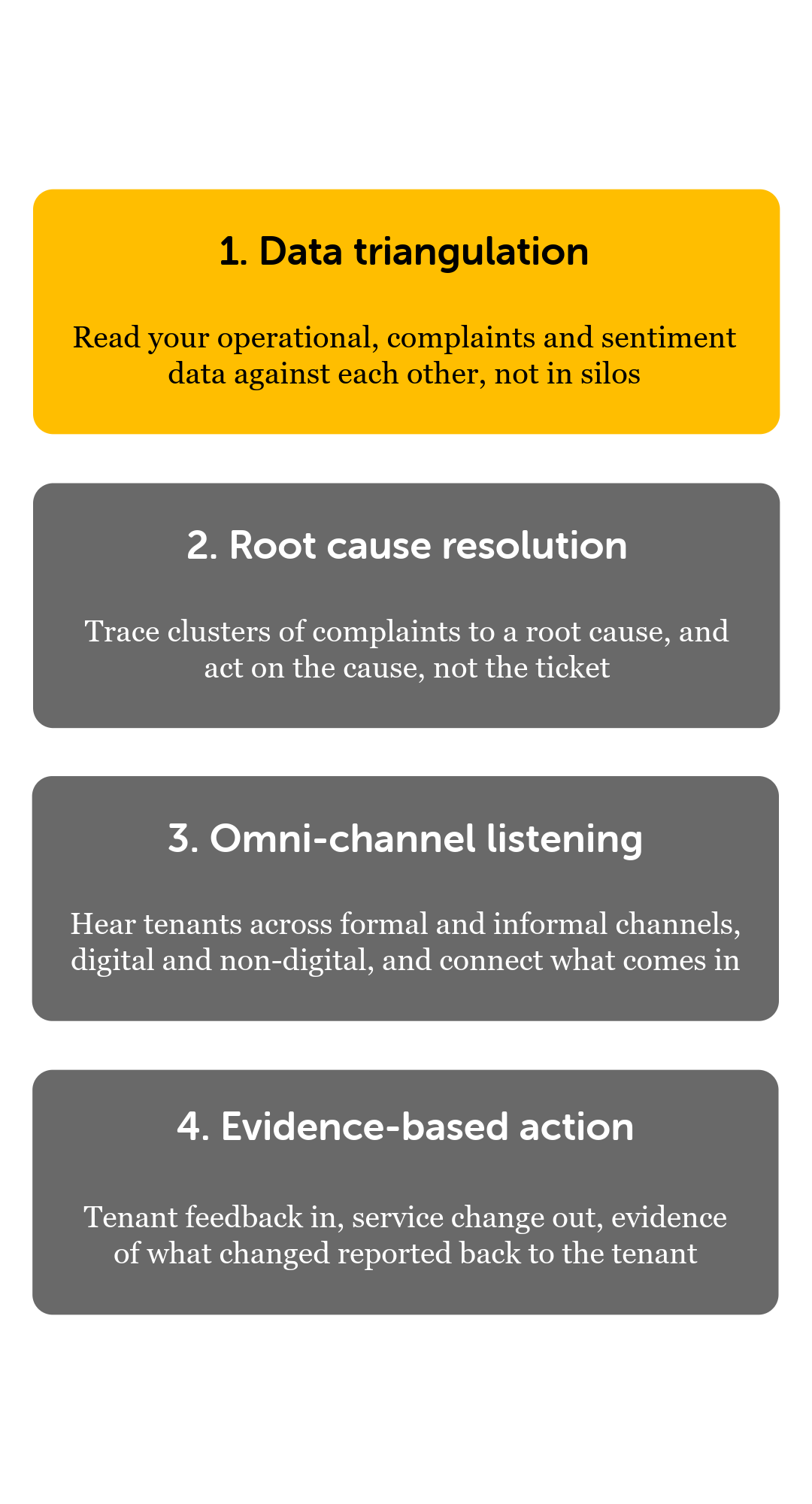
Pillar 1: Data triangulation
The regulator's own framing
In its publication on the first set of planned inspection outcomes, the Regulator of Social Housing wrote: "RSH is seeing evidence through inspections of landlords using and triangulating all of their data to pre-empt issues, facilitate challenge and continuously improve."
The verb is triangulating. Not holding data. Not reporting data. Not even collecting data. The regulator is grading whether you cross-reference multiple data sources against one another.
What this looks like in C1s
Stockport (C1, 13 May 2026) has "1,300 tenants participating in regular consultations on strategies, policies, and service changes through a customer voice membership group," alongside a complaints advisory panel. Triangulation here is not a single survey; it is several different listening surfaces read together.
Hammersmith & Fulham (C1, 13 May 2026) runs a "monthly complaints learning board" alongside performance reported in "both digital and non-digital formats": operational data, complaints data and a publication channel sitting together.
What this looks like below C1
In one of the 13 May 2026 C2 judgments, the regulator described a local-authority landlord collecting "information about its tenants at tenancy signup, this information is incomplete and not routinely updated." That is the triangulation pillar failing: not because there's no data, but because what is there is stale and not joined up.
The sentiment evidence
This is where the Wordnerds × Housemark Benchmark, 270 customer-experience elements across 18 housing associations, cut by consumer-grading cohort, produced its single sharpest finding. When tenants self-mentioned mental-health challenges in their TSM free text, C1 organisations scored on average 10 sentiment points higher than non-C1 organisations did in how they handled the conversation. That sentiment cut, vulnerability self-mention against TSM free-text response, is itself a triangulation. It is the work the regulator is asking of landlords.
The Housing Ombudsman now defines vulnerability not as a static demographic attribute but as a "dynamic state which arises from a combination of a resident's personal circumstances, characteristics and their housing complaint." That definition has a direct implication for your data: a vulnerability flag on a tenancy record is not enough. The flag must be event-stamped, time-varying, and joinable to your case data across ASB, repairs and complaints.
Self-check
Can you cut your TSM scores by recorded vulnerability flag? By tenure length? By stock condition? If the answer is no on any of those three, the regulator's triangulation question is sitting in front of you, unanswered.
Triangulating the data is the first pillar. Understanding why the patterns appear is the second.

Pillar 2: Root cause resolution
The regulator's own framing
Across the C1 judgments published in 2025–2026, the regulator returns to one specific verb: learn. Housing 21 (C1, 13 May 2026) was upgraded from C2 because "Housing 21 has made the planned improvements to how it monitors and reports complaints. It provides accessible information to residents about the type of complaints received and how it has learned from complaints."
Stockport's C1 judgment says "learning from complaints is systematically captured, shared with tenants through the website and other customer communications, and used to drive service improvements."
What this looks like in C1s
In the webinar, Ed Bramall from Curo walked through the C1 organisation's complaints learning report. The pivot point was granularity. Curo realised that aggregating complaints up to a "repairs" category was hiding the work. Most complaints would always be about repairs, because most of what a housing association does is repairs. The useful unit of analysis was finer: plumbing complaints versus electrical complaints, complaints about timeliness versus complaints about communication. Each category had a different root cause. Each unlocked a different action.
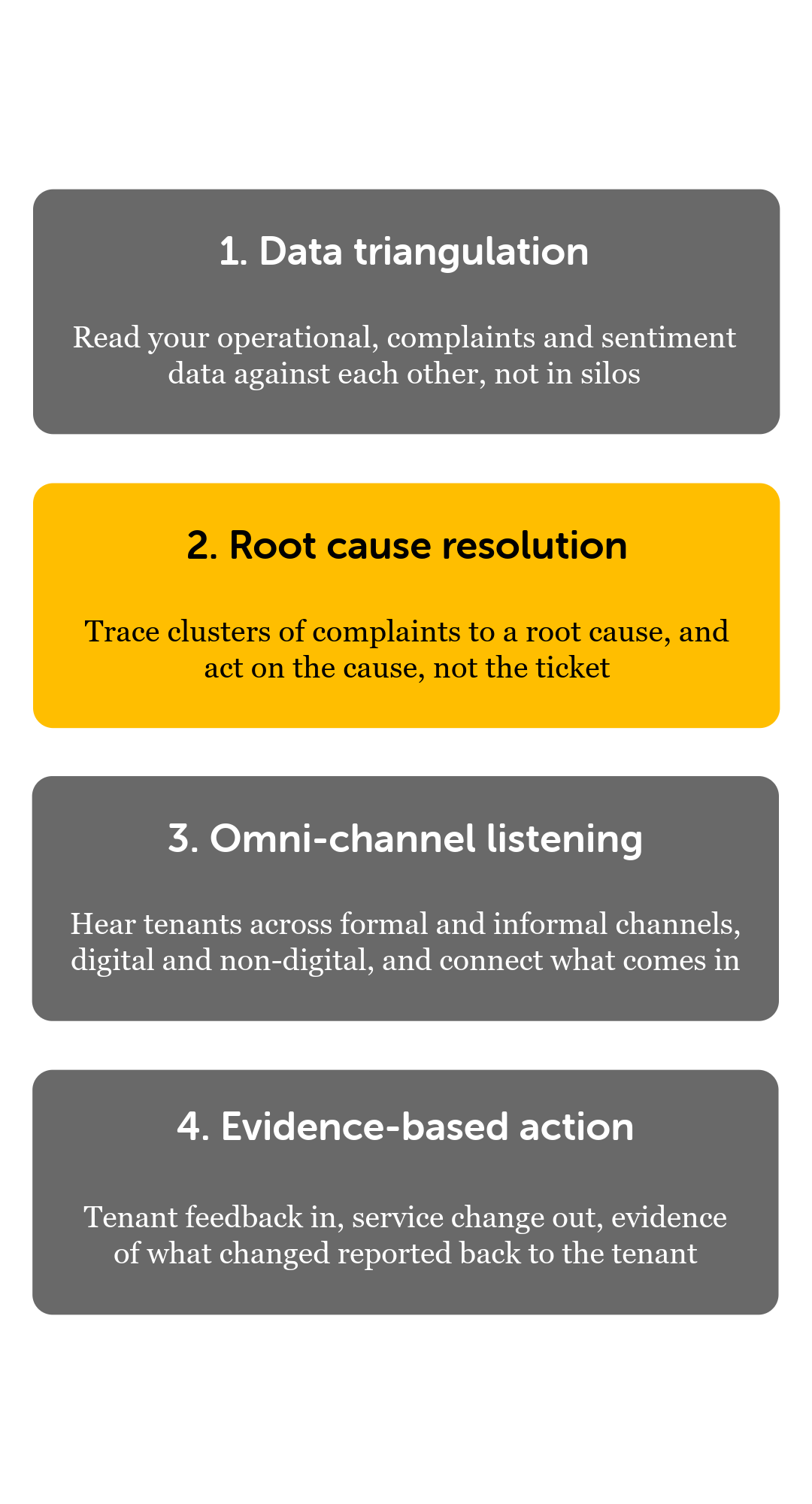
This is what the regulator means by learning. Not "we logged the complaint." Not even "we resolved the complaint." Specifically: "we found the root cause that links a cluster of complaints, and we did something about that cluster."
What this looks like below C1
The Housing Ombudsman's 'it's not a lifestyle' damp-and-mould Spotlight made this pillar's failure mode explicit. Landlords had been treating damp as a resident problem, a bathing or cooking habit, when it was overwhelmingly a building problem. The Awaab Ishak case found that Rochdale Boroughwide Housing staff had attributed the mould to the family's bathing and cooking habits; RBH later admitted it had made assumptions about lifestyle and that it "got that wrong". When landlords mis-attribute building pathology to vulnerable tenants, sentiment and operational outcomes both deteriorate. Root cause resolution is the pillar that closes that gap.
The sentiment evidence
In the Wordnerds × Housemark sample, C1 organisations show a particular pattern in their free-text complaints data: when a customer raises an issue, the language of the resolution clusters around the type of issue (plumbing leak, electrical safety, communication) and not around blame for the customer. The C2s and C3s, by contrast, show more sentiment around explanation and pushback. The difference is subtle in any single complaint. Across thousands of complaints it is the difference between a landlord that has solved a problem and one that has handled a complaint.
Self-check
When complaints cluster, do you trace them to a root cause, or close the ticket? If the latter, you have a complaints process. You don't yet have a learning process.
Knowing the root cause is one half. Hearing the signal in the first place is the other.

Pillar 3: Omni-channel listening
The regulator's own framing
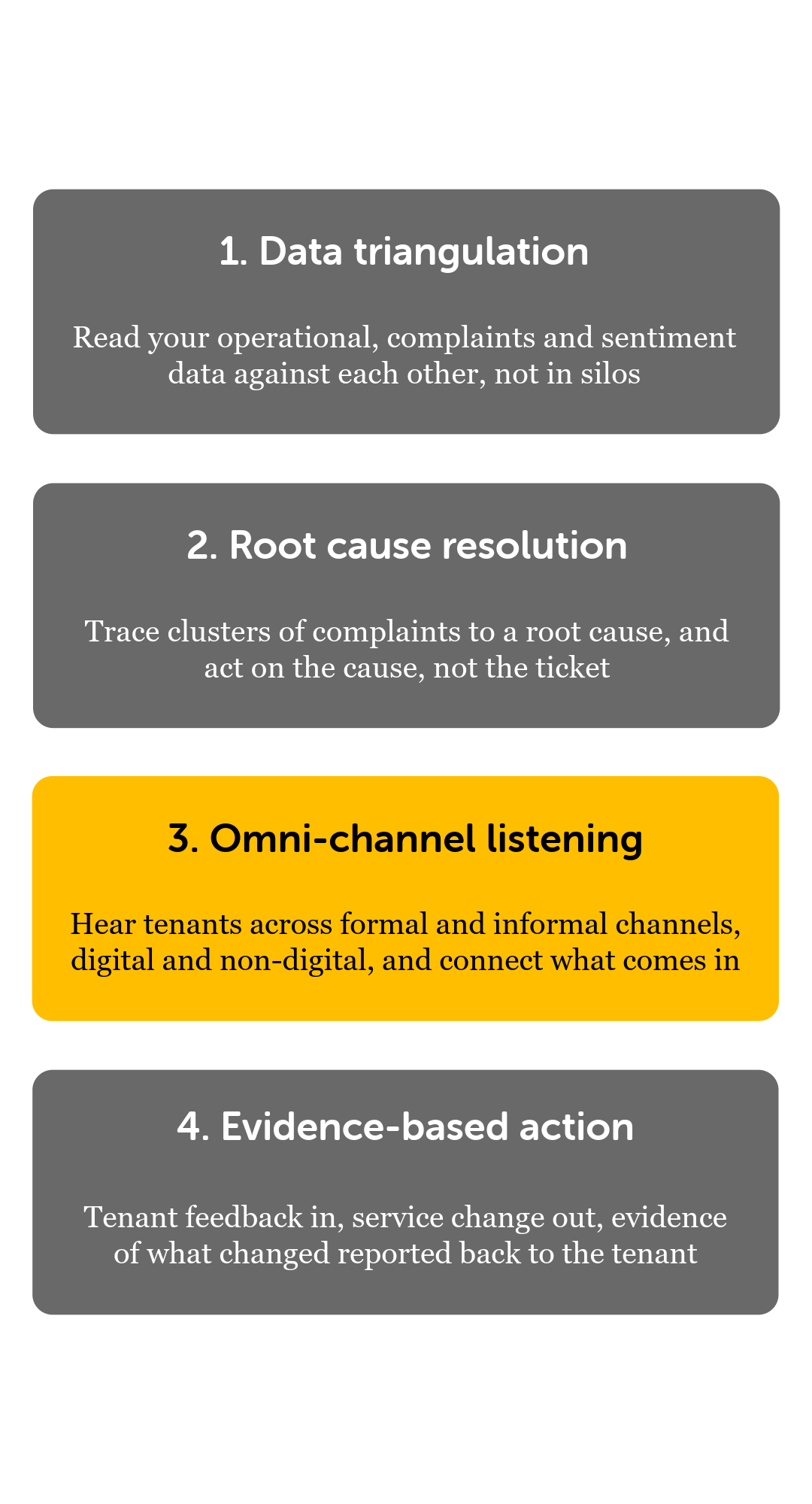
The Places for People C1 judgment (March 2025) called out "a range of formal and informal ways" in which tenants influence the organisation. The combination matters. Formal covers the regular survey, the official complaint, the scrutiny panel. Informal covers the chat with a housing officer, the comment on a community page, the line that gets added to a repair note. C1s have both.
The 13 May 2026 batch sharpened this. Hammersmith & Fulham (C1) reports performance through newsletters and the website in "both digital and non-digital formats." The qualifier non-digital is doing work: it covers the printed estate newsletter, the noticeboard in the block, the conversation at the surgery. Listening across channels means listening across surfaces.
What this looks like in C1s
Stockport's 1,300-tenant customer-voice membership group is one channel. Its complaints advisory panel is another. Its website-published learning is a third. Its TSM survey is a fourth. The regulator's verdict was not "Stockport has a survey." It was that Stockport has several different ways for tenants to be heard, and those ways are connected.
What this looks like below C1
In the 13 May 2026 batch, one C2 landlord posted 99% routine repairs and 96% emergency repairs on time, well above sector norms. The regulator did not penalise the metrics. It penalised the listening architecture: "most of these opportunities have only been developed over the past 12 months and need to be further developed." The implication: it isn't enough to have the channels. The regulator is grading maturity, how embedded those channels are, how long the loop has been running, how visible the result is to tenants.
The sentiment evidence
Our analysis revealed a cascade in the data. When digital-navigation sentiment was high, when customers could find the information they needed when they needed it, a downstream effect appeared: customers were more likely to say they felt informed. And when they felt informed, they were more likely to say they trusted the landlord.
The cascade is consistent with measurement literature in adjacent sectors. The Office for National Statistics' Trust in Government survey decomposes trust into five drivers: responsiveness, reliability, integrity, openness, fairness. Customer-experience literature broadly agrees that trust is a leading indicator: it moves before satisfaction does. That cascade is what it looks like inside a TSM dataset: tangible signals create intangible feelings create outcomes.
What's coming on 1 October 2026
The omni-channel listening pillar stops being a regulator preference and starts being a statutory tenant right on 1 October 2026, when the first phase of STAIRs (Social Tenant Access to Information Requirements) goes live. We unpack STAIRs in Section 10. For now, note that the publication-scheme obligation makes a lot of "what good looks like" in this pillar visible to every social tenant in England.
Self-check
How many tenant-feedback channels are you actively reading, beyond TSM and complaints? If the answer is fewer than three, you are listening through a narrow channel.
Hearing the signal is necessary. Showing the tenant what you did about it is the regulator's tell that you've crossed the line into C1.

Pillar 4: Evidence-based action
The regulator's own framing
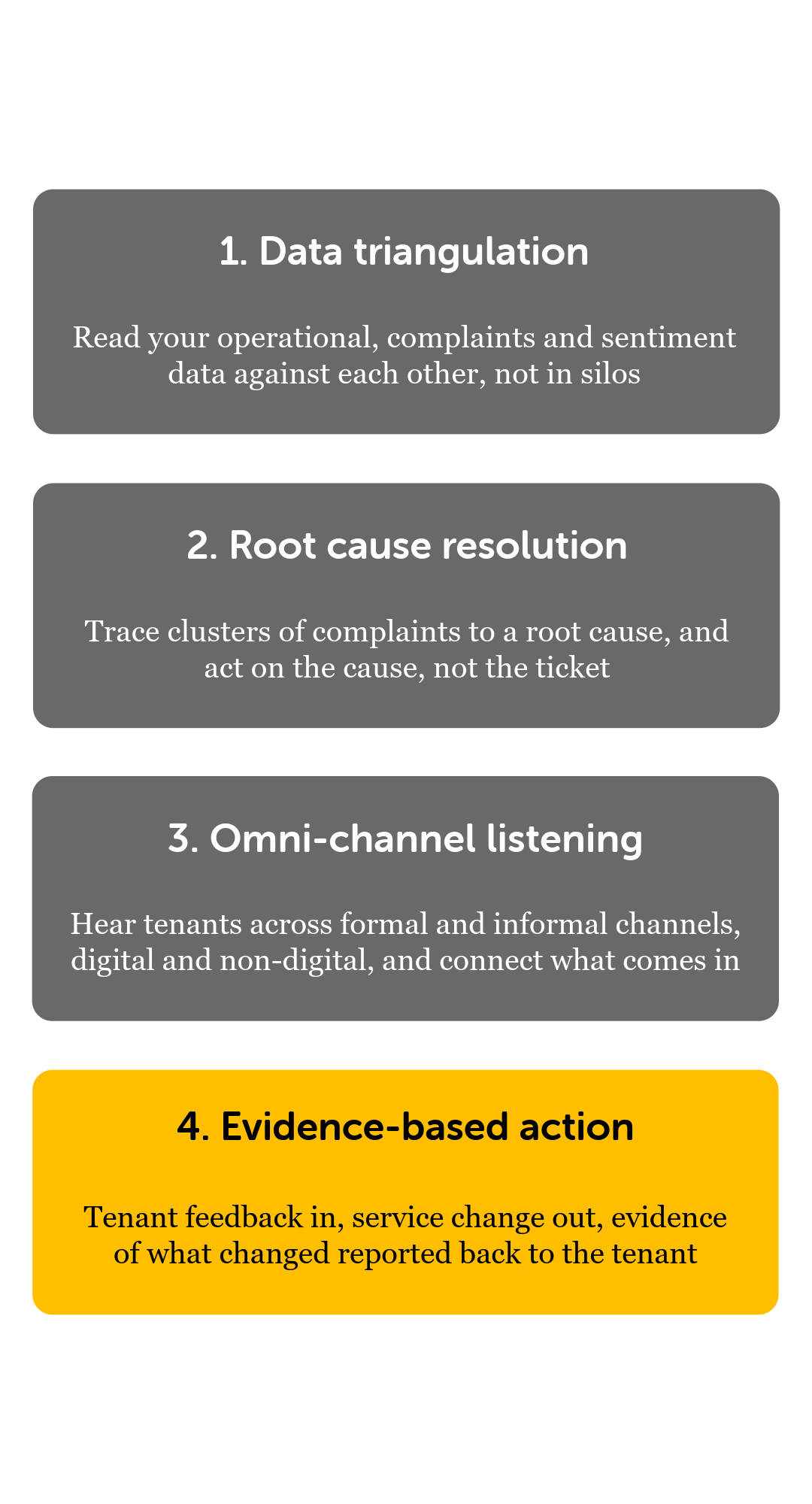
Every C1 judgment in 2025–2026 references the closed loop. The BCP Council judgment (C1, January 2026) names "'you said, we did' sections in tenant newsletters" verbatim. Stockport's judgment (C1, 13 May 2026) says "learning from complaints is systematically captured, shared with tenants through the website and other customer communications, and used to drive service improvements." Golden Lane Housing's judgment (C1, 13 May 2026) says "the views of tenants have influenced how it delivers services, and improved outcomes for tenants are clearly evidenced and reported."
The pattern is: tenant feedback in, service change out, reported back to the tenants who fed it in. Without that closure, the previous three pillars are not enough.
What this looks like in C1s
Ed described Curo's action tracker in the webinar. The tool itself is straightforward: a SharePoint list. The system around it is what counts. Analysis identifies an issue. The team goes to directors with the issue. Directors agree actions. The actions are logged on the tracker with owners and timescales. Progress is reviewed. Outcomes are reported into the customer feedback reports, and increasingly into the corporate-level board reports. The loop is closed not in a single product or platform but in a discipline that connects insight to decision to action to evidence.
Curo's wider data investment supports this. Over several years, they have built a data warehouse that brings together customer data, property data, transactional data and complaints categorisation from multiple source systems. The qualitative dimension, the words customers use, was the missing piece. Curo's complaints learning report, built in partnership with Wordnerds, sits on top of the warehouse and produces the categorised free-text analysis the action tracker consumes.
What this looks like below C1
In one of the 13 May 2026 C2 judgments, the regulator wrote that the landlord had "limited evidence of how it was using the information it holds to assess whether the housing and landlord services deliver fair and equitable outcomes for tenants." The data exists. The action loop does not.
Self-check
How does a tenant who fed back six months ago find out what happened? If the answer is "they don't," your evidence-based action loop is open at the tenant-facing end.
Those are the four pillars. Yesterday's batch of judgments brought a sharper picture of what they look like in practice, and what stops a high-performing landlord landing at C2.

What the 13 May 2026 batch revealed
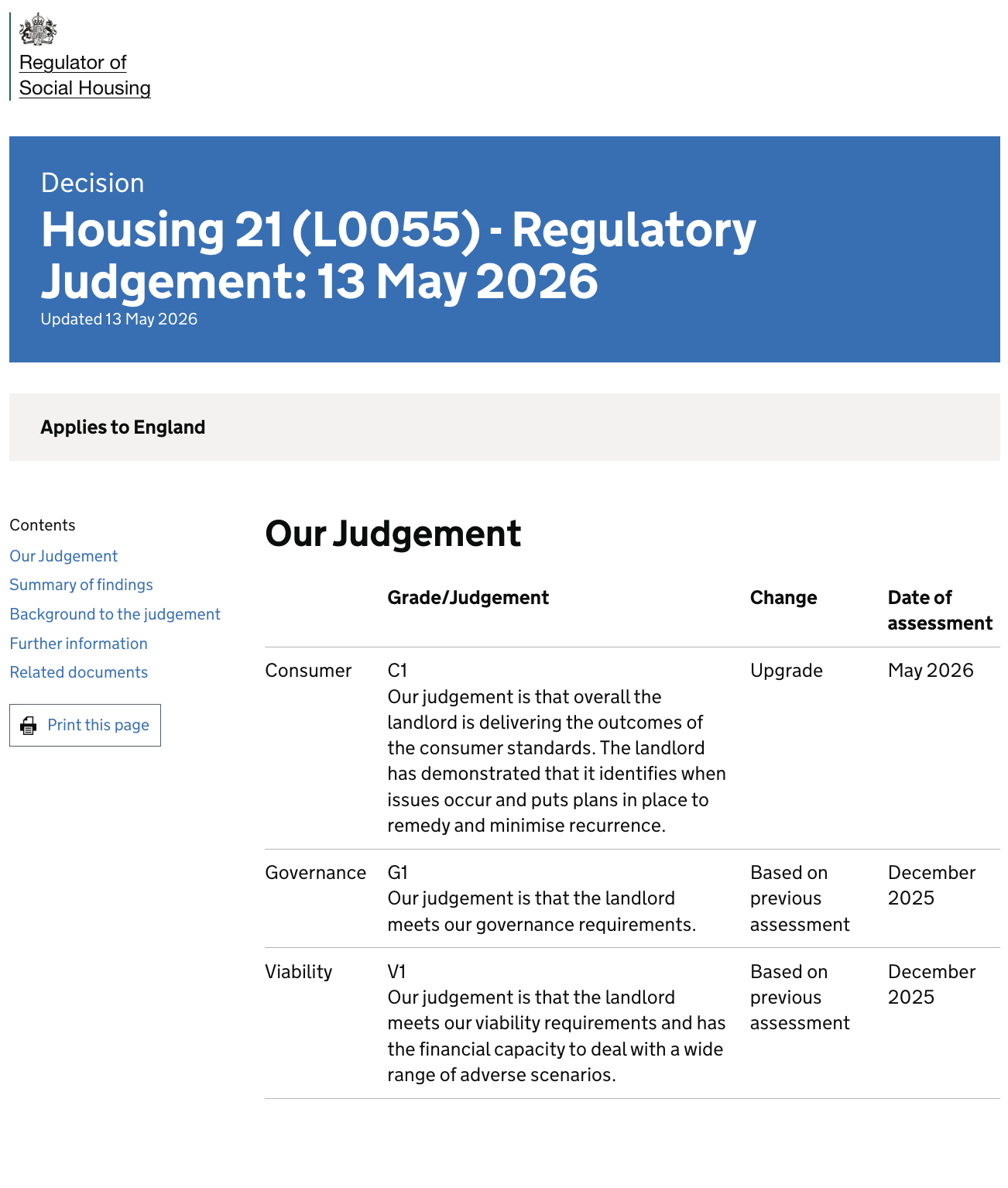
On Wednesday 13 May 2026, one day before the webinar this guide comes from, the regulator published eight judgments. Four new C1s (Stockport, Hammersmith & Fulham, Housing 21, Golden Lane Housing). Two C2s (Milton Keynes, Salford). One C3 (London Borough of Islington). One interim judgment for the newly-merged SettleParadigm entity (no consumer grade pending the merger that completed in October 2025).
We read every word. Three patterns stood out.
Pattern 1: The "wide range of opportunities" tell
The phrase "a wide range of opportunities for tenants to influence and scrutinise", or a near-identical variant, appears in all four new C1 judgments. Stockport, Hammersmith & Fulham, Housing 21 and Golden Lane Housing all received that language. The regulator is using the same noun phrase repeatedly because it is naming a single observed pattern: C1 organisations have multiple, mature, embedded channels for tenant influence, not one flagship vehicle.
Kate Dodsworth, the regulator's Chief of Regulatory Engagement, said it directly in the 13 May press release: "All social landlords should aim for a C1 grade as the minimum standard. To do this they need to understand the condition of tenants' homes and act on this to find and fix problems, and tackle the root cause."
The implication: the regulator's language is becoming an operational definition of C1.
Pattern 2: Self-referral pays
Stockport self-referred to the regulator in December 2025 for overdue fire-safety remedial actions. That fact appears inside the C1 judgment. The regulator wrote: "Stockport MBC acted quickly to implement appropriate mitigations and has clear plans for the completion of the works." The self-referral did not block the C1. It was treated as evidence of reasonable competence in the regulator's own terms.
BCP Council self-referred in June 2024 for overdue fire, electrical and water safety actions, and received C1 in January 2026.
The pattern is consistent across the regime: transparency about a weakness, plus a credible plan to fix it, counts for the grade, not against it. As Glenn Harris told Inside Housing days before the May batch: "every day we will let somebody down, we will do something that is not perfect." Saying so out loud is part of the C1 posture.
Pattern 3: Culture without data isn't C1
The 13 May 2026 batch's C3 is unusual. The judgment for London Borough of Islington explicitly praised the human layer: "Throughout the inspection, LB Islington's officers and councillors demonstrated a fair and respectful culture towards tenants." The C3 stuck anyway. Why?
"The majority of LB Islington's homes have a survey that is more than ten years old." "Information had been collected for around 13% of homes at the time of the inspection." "Over 1,000 overdue lift remedial actions, with up to 500 overdue for longer than a year." "Limited assurance on the accuracy of health and safety compliance data, which we consider a serious failing."
Culture is necessary. It is not, by the regulator's published definition, sufficient. The system that lets the culture do its work has to be there too. Cllr Una O'Halloran's response captured it: "This is not about a lack of commitment, but about systems and assurance that must be stronger."
What you can take from the batch
- Operational excellence alone is not enough. Milton Keynes (99% repairs on time) and Wolverhampton (95% and 99% headline KPIs) both received C2.
- Self-referring on a serious issue and showing a credible plan is compatible with C1. BCP and Stockport both did it.
- Stock-condition data quality is the single most-likely failure point. Of the C2 / C3 landlords in this and recent batches, the through-line is incomplete, stale, or thinly-covered stock-condition data.
If those are the patterns the regulator is rewarding, where do you stand? The next two pages help you find out.

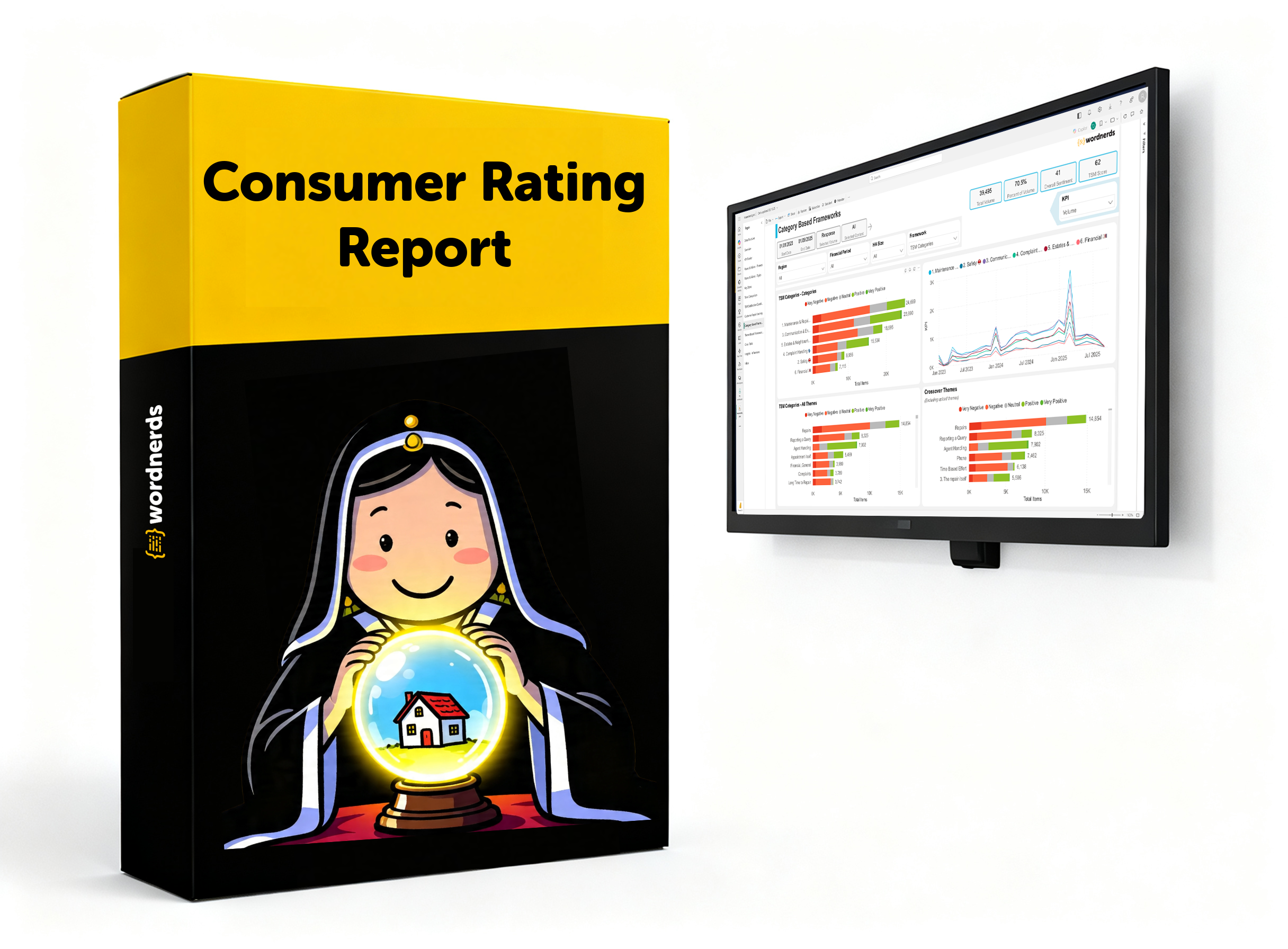
Limited Time Offer : The C Rating Report
If running the four-pillar framework against your own tenant feedback sounds more useful than working through this solo, that's what the C Rating Report is for.
We take the feedback you already hold (open-text TSMs, complaints, transactional surveys, contact-centre transcripts), map it against the C1 and C3 patterns from the published judgments, and walk you through where you sit, with a Power BI dashboard, an evidence-based plan, and a stakeholder workshop your team can keep using afterwards. Launch price £4,900, until the end of June 2026.
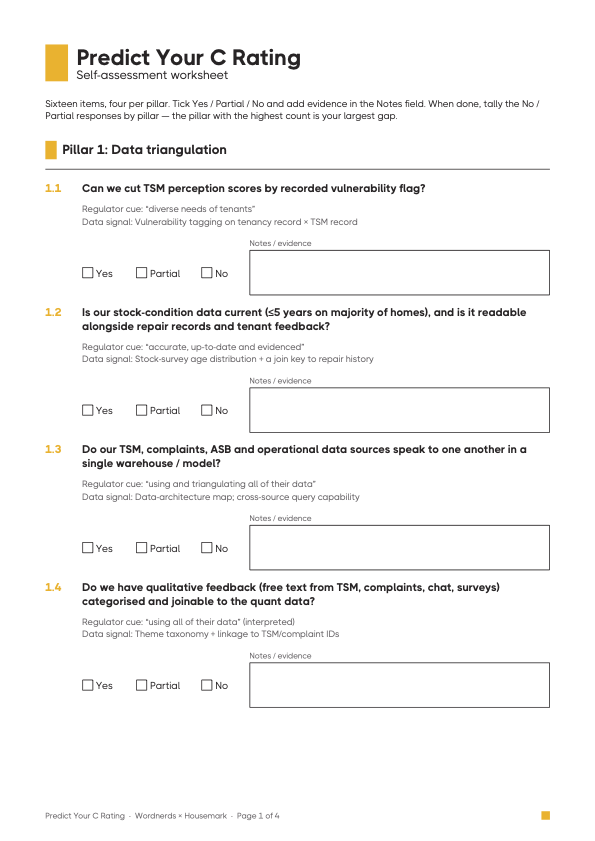
Self-assessment worksheet
Use this worksheet alone or with your team. There are 16 items, four per pillar. For each, score yourself Yes / Partial / No, and use the right-hand column for the data signal that supports your answer (or the gap that means you can't yet).
When you're done, tally the No and Partial responses by pillar. The pillar with the highest count of No / Partial is your largest gap. The pillar with the highest count of Yes is the foundation you can build from.
The worksheet does not produce a single score, and it deliberately doesn't try to predict your C grade. The regulator does not grade in a single number; this guide does not either. The point is to find the pillar with the largest gap, and start there.
Three months from now, those gaps become statutorily visible. The next section explains why.
What's coming with STAIRs
STAIRs is the Social Tenant Access to Information Requirements. The acronym is plural. You'll see it written STAIR in older sector documents, but the official consultation response (30 September 2025) uses STAIRs.
It is not a standalone statute. STAIRs is a set of requirements imposed via a direction from the Secretary of State to the Regulator, under powers in the Social Housing (Regulation) Act 2023. It is implemented through a regulatory standard binding on private registered providers (PRPs): housing associations and similar non-local-authority social landlords.
Two phases.
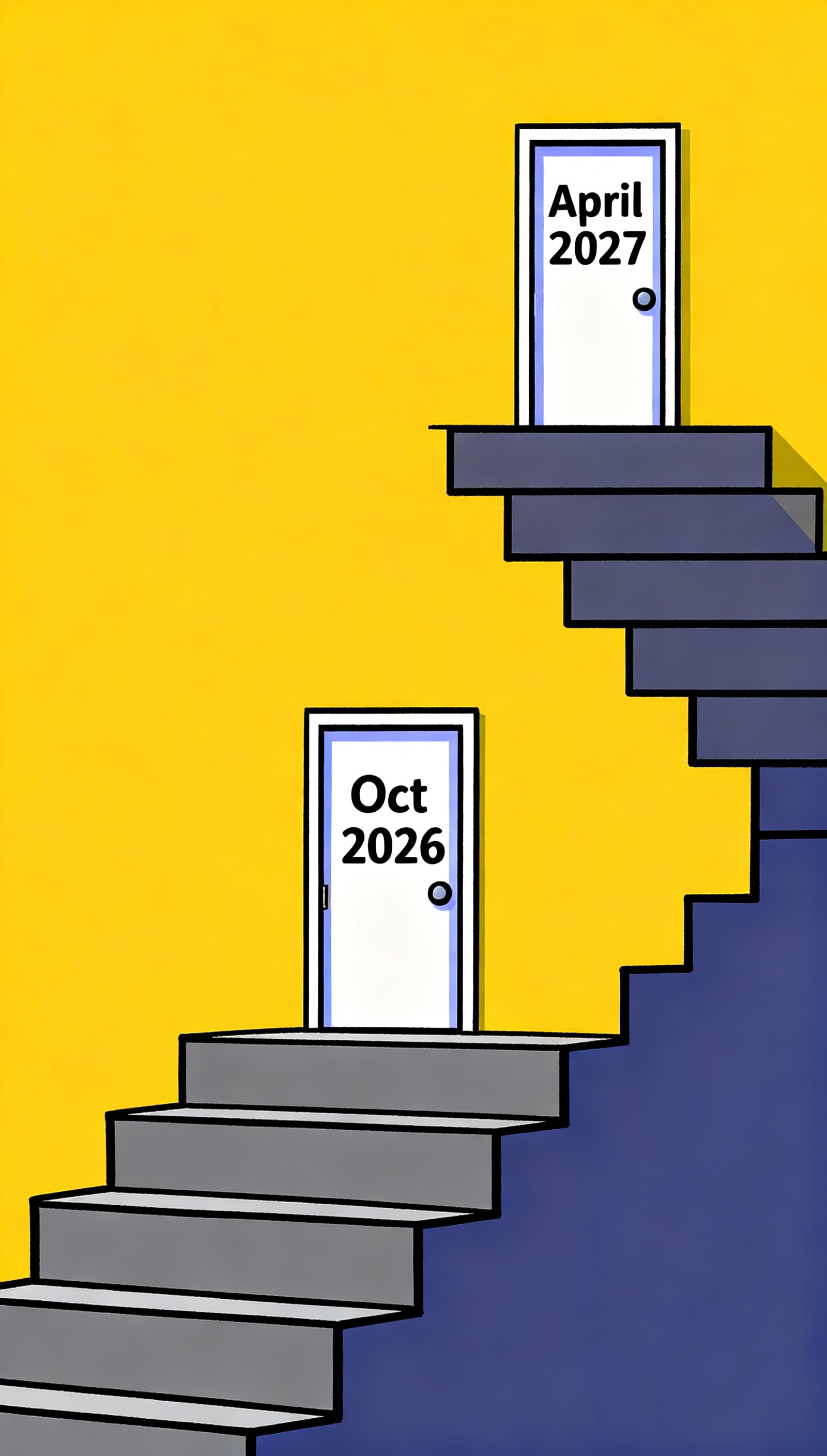
From 1 October 2026
Every PRP must operate a publication scheme that proactively publishes a defined set of housing-management information. Six classes are in scope:
- Governance and decision-making
- Spending
- Housing stock management
- Performance
- Housing services
- Lists and registers
The government's consultation response is clear: "PRPs will not be required to create new records to comply with the scheme requirements and information can be redacted where appropriate and reasonable to do so." You do not need to invent new datasets. You do need to publish what you already hold, in the six classes.
From 1 April 2027
PRPs must respond to individual information requests from tenants under STAIRs. There is a statutory internal review route for refusals or unsatisfactory responses, to be completed within 30 calendar days. Unresolved disputes can escalate to the Housing Ombudsman.
What this means for the four pillars
Pillar 3 (omni-channel listening) becomes statutorily visible from 1 October 2026. Pillar 4 (evidence-based action) becomes individually testable from 1 April 2027, every time a tenant exercises an information request.
Five months between now (May 2026) and the first phase. That is enough time to close a pillar gap, if you start now.

Where to start
We asked John Wickenden (Housemark) and Ed Bramall (Curo) on the webinar what they would tell a landlord starting from scratch. Two answers stood out.
John: "Map your documents. What documents do you have? Where do they map across to specific elements of the consumer standards? Have you got the information in the right place, and do you know where it is? Can you access it? Are you going to be supplying 3,000 documents to the regulator, which they're not going to appreciate, by the way?"
Ed: "Start small. Start with what you can get. Show the insight that you have, and then build from there."
Both answers come from people who have done this work for years. Both reject the urge to wait for the perfect dataset. Here are five practical first moves.

Move 1: Document map
Inventory every document you would expect to put in front of an inspector. Map each to the Consumer Standard it speaks to. Mark anything where the document is missing, out of date, or unreadable by someone outside the team that owns it. Aim for one document per Standard sub-element where possible; resist the urge to over-document.
Move 2: Triangulation audit
Identify the data sources that should be talking to one another but are not. The common pairs: TSM data and complaints data; complaints data and repair data; vulnerability flags and case data. Pick the one pair where the missing connection is hurting you most. Build the join. Show what falls out.
Move 3: One closed-loop pilot
Pick a single service area: repairs, ASB, complaints handling. Implement one closed loop: tenant feedback in, categorised, root cause identified, action agreed, action delivered, outcome reported back to the tenants who fed it in. Pillar 4 looks abstract; an end-to-end pilot makes it concrete.
Move 4: Publish one TSM trajectory with commentary
Pick one TSM where your score isn't where you want it. Publish the trajectory (last 4–8 quarters) with a one-paragraph commentary on what you've learned and what you're doing about it. This is the kind of move Places for People made publicly with its communication scores, and the regulator named that transparency in the C1 judgment. The point isn't to brag. The point is to demonstrate the posture.
Move 5: Book the executive-team prep conversations
The regulator expects executive directors to be fluent on TSM scores, trajectory and data quality, and not to deputise the conversation to a research expert or BI analyst. In our chat on the day of the webinar, three different C1 organisations told us their executive directors had to talk fluently about TSMs themselves during inspection, and that submitting too many documents (one organisation submitted around 3,000 pages) is its own warning sign.
Glenn Harris at Midland Heart frames the same posture differently. He told Inside Housing: he seeks out tenant feedback that "people in my position don't want the board to hear." The fluency comes from being unafraid of the data, not from being well-briefed on the day.
Book the prep conversations now. Make sure your executive team has the trajectory at their fingertips. Test their fluency in advance, not because the inspection is imminent, but because the fluency itself is the pillar.
1. Know where you sit, measurably. A side-by-side comparison of your tenant feedback against the patterns we see in C1 and C3 associations. Your position, mapped against the benchmark, in plain language your board will understand.
2. An evidence-based plan to improve. Specific recommendations on what to do next, not generic best practice. The actions C1s take, applied to your situation, prioritised by impact.
3. A Power BI dashboard you keep. Findings, comparisons and verbatim drill-downs in an interactive dashboard your team can share internally and present from. Not a one-off PDF.
4. A workshop to act on it. A facilitated session with your stakeholders to walk through the findings and lock in next steps.
How it works.
You register, and Sarah Wilson (our housing specialist) picks up the conversation within two working days. If it's the right fit, you send us the feedback you already hold (open-text TSMs, complaints, transactional surveys, contact-centre transcripts).
Our I&I (Insight & Innovation) team then run your data through the four-pillar framework, mapping your tenant feedback against the C1 and C3 patterns, building the dashboard, and pulling the report together. The report and dashboard go to your team first, then a workshop with the stakeholders you choose. Around 30 days end to end.
Launch price
£4,900, until the end of June 2026.

This guide was published by Wordnerds in May 2026 to accompany the joint Wordnerds × Housemark webinar Predict Your C Rating, broadcast on 14 May 2026.
Contributors: Sarah Wilson (host, Wordnerds), John Wickenden (Research Manager, Housemark), Steve Erdal (co-founder, Wordnerds), Ed Bramall (Head of Data and Insight, Curo).
Sources cited: the Regulator of Social Housing's published consumer-grading judgments (April 2024 to May 2026); the Consumer Regulation Review 2023 to 2024; the four Consumer Standards (April 2024 versions); the STAIRs consultation response (September 2025); the Housing Ombudsman's Spotlight series, including it's not a lifestyle, the Knowledge and Information Management Spotlight, and Relationship of Equals; the Wordnerds × Housemark Benchmark (18 housing associations); contributors' published commentary in Inside Housing and related trade press.
This guide makes observations about regulator patterns and does not draw causal claims. The pillars described are interpretations of the regulator's own language across published judgments. They are interesting, not definitive.