Read the full transcript
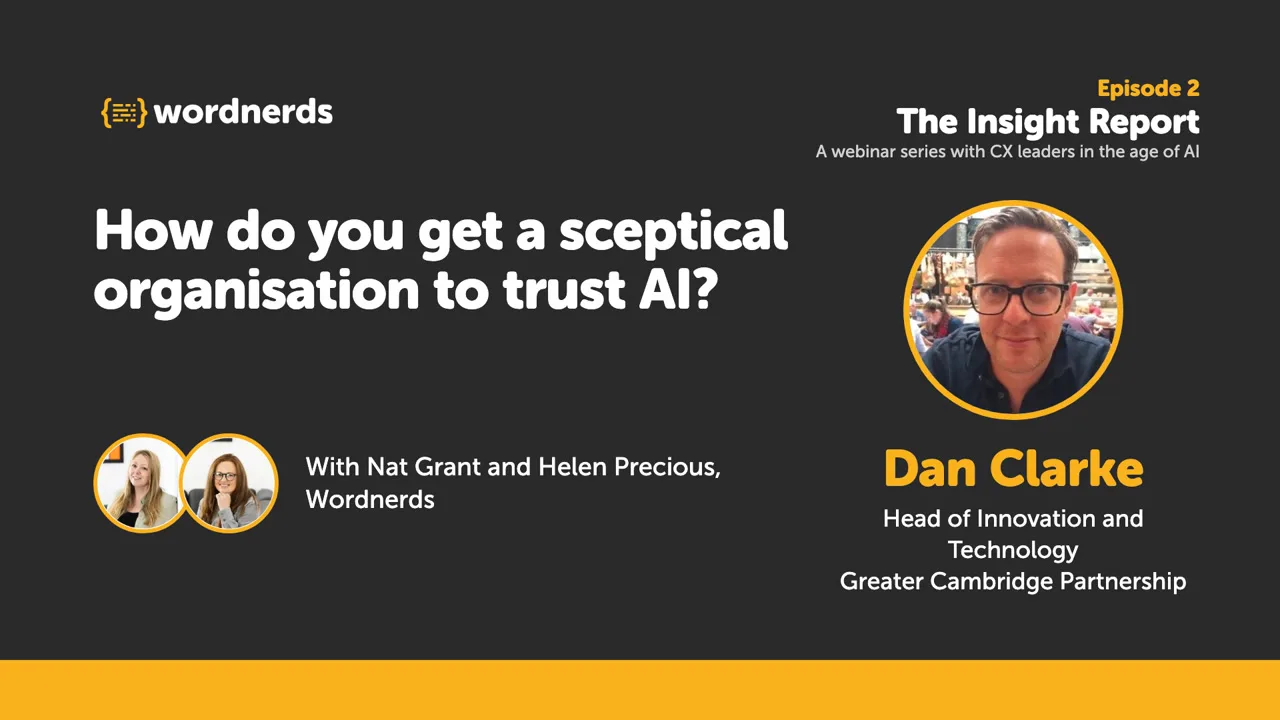
Helen Precious: I thought it'd be useful just to give you all a bit of an overview of The Insight Report. This is only our second episode. The first episode being last month. This time we've got Dan Clarke from the Greater Cambridge Partnership. This is a really exciting story and one that I think will resonate with a lot of people who are looking at developing their AI programmes and some of the things to look out for, particularly if you're at the start of that journey and also from a CX and qualitative insight point of view.
I think this really is a fantastic story and case study for the benefits of using AI deliberately but in a way that can be trusted and using it ethically. All things which I think are hugely important for our local authority style audiences as well as those further afield. Before we sort of introduce you to Dan, just to give you a bit of an introduction to myself and Nat. We are the I suppose the customer and prospect facing side of Wordnerds. This series that we've developed has been something that we've been thinking about for a really long time.
We're hearing a lot of challenges that CX teams and insight teams face particularly in the light of trying to prove value with your programmes, get the most from them and be using AI in responsible ways. And so we are essentially turning to some of the people that we admire and speak to on a regular basis to show how they're treating and working with qualitative data, particularly in light of the sort of environment that we find ourselves in within the sort of AI space. Not an AI led, webinar necessarily but it's changing all of our lives anyway so it feels like a good opportunity to be talking to people to see how people are interacting with this.
There's no slides. This is absolutely a conversation and something we forgot to mention last time. So if you would like to pop your headphones in and carry on and listen along, that is totally fine as well. We will be having a Q and A at the end of the day, of today's session, and we would invite you to ask your or bring your questions for Dan. I think, he's got an incredible story and, yeah, we definitely, recommend and welcome any questions that you guys have. Hi, Theo, thank you very much for popping something in the chat.
I know, it's very cold and grey today. I feel like it's dropped off final things from me then, as I say, hopefully the chat is working. If it's not, Stella is behind the scenes working things out. So if you are struggling with sound or anything like that, just let her know. Coming back in. Well, dropping out and coming back in sometimes is the fix, so hopefully you're all good there.
Nat Grant: Yeah, great. Thanks so much, Helen. And hi, everyone. Thank you so much for joining us and spending your Tuesday afternoon with us. Before we get cracking on our conversation with Dan, I just wanted to give a bit of context as to Dan's role. Dan is the head of Innovation and Technology at the Greater Cambridge Partnership. As Helen mentioned, that's a group of local authorities delivering the City Deal Transport programme. He led the Cambridgeshire Future Transport. He's built the Smart Cambridge programme and won the Smart Cities UK Leadership Award in 2018.
It's quite a long list of achievements there for me to rattle through. Dan does really interesting work, and I think part of what's made our work with him so interesting. And the reason why we thought this would be a good story to share is Dan's got a long history of working with machine learning that predates a lot of people's involvement using AI, which came about generally following the release of ChatGPT. So his experience prior to that has been really interesting to understand how that's influenced his thinking and we might get onto it in a bit more detail.
But he leads a weird and wonderful programme, of AI sort of projects at the moment, including looking at autonomous buses and things like that. Before we dive into all of that, though, Dan, as I mentioned, you have been working with AI for quite a long time. What has over 10 years of working with machine learning taught you about AI that people newer to it may miss?
Ten years of machine learning
Dan Clarke: Cool. Welcome, everyone, and thanks very much. For inviting me onto the webinar. We've been working with machine learning now for about 10 years. So AI isn't really anything new to us. Although the sudden explosion in tools is certainly novel and new. We started using machine learning because we wanted to collect data that our existing kind of methodologies wouldn't allow us. So we were using these things called loops in the road that basically count cars as they drive over them. And we were approached by some students at the university in Cambridge who were looking at using low resolution cameras, machine learning and neural networks to identify and classify movement within the road and pavement space.
And that showed us that you could use machine learning in a way that brought real value to the work that we were doing, gave us much richer data which allowed us to better plan and monitor the infrastructure that we were building. We did it in a very kind of phased and slow manner. Because with new technology there's always concerns, particularly here where we were using low resolution cameras around, things like privacy and how we collect and process the data. So all that kind of happened on the edge, but we still needed to bring our members and members of the public kind of along with us.
But the thing that did demonstrate was that there is very definitely a role for machine learning and AI as a tool, for local authorities in kind of achieving what they want to achieve. And since then we've used particularly machine learning in a number of different ways to kind of help us with the work that we do.
How wider AI adoption has changed the job
Helen Precious: Brilliant. Thanks. And Dan, just to sort of, as you've just sort of said there, AI has kind of exploded in the last 12 months and a lot of people are now kind of on to the, to the likes of Copilot, ChatGPT and the like. I suppose it is becoming everyone's business and certainly I think we're seeing the majority of businesses are now adopting some level of AI. From your experience thinking about that sort of journey where everyone's sort of picking up these new technologies, what has that changed for you particularly in your sort of innovation and technology role? You know, in, inside the organisation and with the public.
Dan Clarke: So it's a bit of a double edged sword I think the much wider adoption of AI particularly within the transport space has meant that we can do a lot of things that we couldn't do before. So particularly around predictive modelling, predicting what's going to happen on our road networks. We've used AI in our traffic signals. And also my planning colleagues have done some work looking at how they can support, parish councils in their response to planning applications. So at the moment they will write a, very lengthy response because some of these planning applications are huge.
So they will write a very lengthy response. And they now have a summarise, button because they meant to submit a summary as well and it summarises it for them. They can look at it so there's still a human in the loop. They can see, what the text says. Check that it, you know, it retains the meaning of the kind of longer, description that they put underneath. But it's a really, I think, a really neat example of how you can use AI to make people's lives better and easier.
It means that they're more likely to engage in the planning system, but they're still getting control over kind of what it says. So that's really important. I think the converse of it is that it has made it a lot easier for people to, put in Freedom of Information requests and we are being flooded with AI generated Freedom of Information requests. And of course, you know, freedom of information is a really important thing, being transparent in what we do. But what we find is that there is a lot of, technical jargon within them that actually doesn't, bear any relation to the kind of work that we're doing is being generated.
And because they're not technical experts, they don't realise that actually it's not, you know, technically correct. But just the sheer amount that, you know, the increase over the last year, has really caused us issues within our work.
The biggest barrier to using AI more
Helen Precious: Yeah, brilliant. And I guess, yeah, I think we'll definitely come on to, the sort of. The wealth of information that you're now having to deal with. That sort of story around the Freedom of Information request, I'm sure will, resonate with lots of people on this call. Just so as we were preparing for this call, I think one of the things that we looked at was, what the general trends are within AI adoption, across the UK, Europe and more widely. And there's a piece of research that's come out literally within the last sort of week from McKinsey, where they sort of are identifying, particularly in the UK and European markets, that, we're sort of seeing nine out of ten organisations are now using AI, which won't be a surprise, but only 6% are actually seeing a significant financial return from it, which I think shows that we're really sort of still using this tool in isolation in a lot of cases.
And we're still sort of trying to see where the, where the real benefits are to the organisation. I think that's why we're so excited about your case study, which we'll come on to later. Stella, who is our marketing guru in the background. I think we've got a poll for the audience at this stage, which is what's the biggest barrier to your organisation using AI more? Is it trust, risk, skills, value or ways of working? And I suppose, Dan, whilst our audience are just filling that out, sort of the question to you, which of these have you run into in terms of these, the different sort of, I suppose, barriers to AI adoption and which for you have been the hardest to get past.
Dan Clarke: So I think trust is the biggest thing because we are a public body and we are making decisions that impact members of the public. We have to make sure that whatever we're doing, however we're using AI, that we can explain how decisions have been made, that there's transparency in the processes that we're using. And obviously, you know, there are issues, there have been issues with kind of what people describe as black box AI. You put inputs in and you get an input out, but nobody can actually tell you how those, you know, how that output has been kind of arrived at.
So people are wary, I think, of AI. They're very wary of things, like bias being built into AI models. And you know, you have to be really careful about the data you put in, because if you put rubbish data in, you're going to get rubbish out. Even though you are using AI, it doesn't matter. So, yeah, you have, I think you have to think very carefully about how you, how you're using it, how you can build trust in it. And I think starting small, demonstrating value and then kind of scaling from there is one way of doing that by, you know, in the work that we did, we took a big consultation that had happened and we then used that historic data and we ran that through, your platform, using your methodology, and then we were able to compare one against the other.
And doing that offline where no decisions were being made meant that we could start to build trust in your kind of processes and your methodology, because, you know, there was no impact there. So I think that's a really good way of kind of starting and then we can move to running it in parallel with a live consultation and Then, you know, then we can look at, actual live consultations. But it's just a process of building trust in decision makers and, members of the public that what you're doing is right and proper and that you have the right safeguards in place.
Helen Precious: Yeah, I think. I think that's absolutely fair. And to be honest, it looks like the audience are split between trust and skills. So it feels like everything you've just said there probably resonates as well.
Dan Clarke: Yeah, I think skills is an issue. You know, even something as simple as Copilot, trying to kind of understand how you prompt and, how you. How you can use it to, you know, not just produce something that you can then, you know, a report that you then, circulate. But actually you start to think of it more as a tool, something that helps and supports you in the work that you're doing, more like an assistant and how to use that properly because, you know, otherwise I don't think you get the best out of it.
And you talked about value. I think it's very difficult sometimes to see, particularly with tools like copilot. Yes, they can make you more productive, but actually, what's the value of that? Are you getting through more work? How is that impacting the organisation? And what's the benefit and value that's being driven out from there can be quite difficult.
Helen Precious: Yeah, I totally agree with that. I think practically that's the thing here is how do we measure it? Interestingly, the McKinsey report that I referred to earlier, I think their point was all around, actually, we're still iterating. We're just making the processes that we do faster rather than really connecting those systems together, which, you know, I think Nat and I speak to people all the time. That systems connection piece is so tricky and really can't. It's not a short piece of work either. I think it's something that you'd sort of develop over time.
And, I'm sure that there's a lot more potential for where these AI tools can take us. But in the grand scheme of things, I still think, you know, for a lot of us, we've only really been sort of using these tools in earnest for probably less than 12 months. So hopefully in the grand scheme of things, there's, you know, there's lots more to come and, I suppose a lot more support from governance and some of those other departments in order to help us navigate that.
Dan Clarke: Yeah, and generally what people are doing is that they're replacing a human process with an AI driven process. But actually what AI could do is give you the opportunity to rethink the way that you deliver services and redesign a service from the kind of bottom up. Now that is really difficult. Cultural change is really difficult. People change is really difficult. But actually if we're going to use AI properly then that might be what we have to do and we can't just replace one for the other. Yeah, it speeds up processes. But are we really driving out the benefit that you could do?
Why use AI to analyse a public consultation?
Nat Grant: Yeah, I think that's really interesting Dan. And that's definitely, I think the shift in that we're seeing with organisations that we're working with is in this initial phase is seeing what the capability of the technology is but then really looking at what the value is and what the potential is over a longer time horizon. Speaking specifically about people who may well be joining us today who maybe have use cases in mind of where they want to use AI, and they want to be able to prove that value and that ROI that as Helen mentioned, only 6% are currently able to demonstrate that Despite already having a large roster of projects that are live at the moment using AI under your leadership, you've also decided to specifically point this at a public consultation which you spoke about briefly there.
Be really interested to know why did you think a public consultation analysis was the right use of AI and what was the ROI for you when you were going through that process and making that decision?
Dan Clarke: Yeah, sure. So we ran a really big consultation in about 2021 looking at something called a sustainable transport zone which is, it is a congestion charge for Cambridge but really controversial, I mean highly controversial. And the biggest consultation that we've run. So we got, I think it was just over 24,000 responses. And a lot of those responses were free text as well. So I think there were about 145,000 plus comments. And because of that the process ran for the process of analysis of that ran for about six months and cost the organisation about £500,000.
It was very expensive process to go through. The responses were manually coded. And the company that did the manual coding did a really great job but you know it's a huge amount of data to trawl through. And so I was asked the question by our then head of communications, is this something that AI and natural language processing could help with? You know, could we have shortened the process between going out to consult and getting the Results, and also could, we have, you know, reduced the cost of this and the length of time between closing the consultation and, you know, publishing the results.
I think is important because, you know, if it happens over a long period of time, there's an opportunity for, you know, kind of false stories to circulate about why it's taking such a period of time. Plus also, you know, people want to know how things are moving, how things are progressing. So, through the work that we did, running a, you know, that process, again using your, technology, we were able to significantly reduce the amount of time that took and it significantly reduced the cost, I mean, significantly reduced the cost.
So for us those were the two main measurable benefits. Reduction in cost, reduction in time. We, think the reduction in time also potentially in the future opens up new methodologies for consultations, consultation, much more iterative kind of consultation, because you could do it so quickly. But I think the main thing is, you know, we're all looking to drive value out of the kind of work that we do in the public sector. And so, you know, I think we proved that, AI definitely has a role in consultation.
You just have to be careful about how you use, needs to be auditable. We need to show that there's no kind of bias built into it. And so the tools that you built, which allowed us to go back and check some of the results that you were reporting, was really helpful for us and we could show people exactly where in the consultation responses, the results were. So, that has built trust in the kind of system that we were using. I think that's it.
Bringing elected members and the public along
Nat Grant: I mean you had a really diverse group of stakeholders and oftentimes, leaders who are trying to innovate and bring an organisation along with them are very much navigating that stakeholder piece. What for you were the specific challenges around this being public data and you dealing with elected members as some of your stakeholders.
Dan Clarke: So, you know, obviously we needed to show that we were following all, the kind of law around, GDPR, that we weren't, you know, we weren't relitigating the consultation process. So there were no decisions that were going to come out of this because, you know, they were all quite bruised and battered from the last time we did the consultation. And I don't think there's any appetite to reintroduce the congestion charge anytime soon. But, you know, particularly for the members of our board and our assembly, we've Had a lot of questions about, you know, what we're doing.
Is that ethical? And we've thought obviously long and hard about that. And you know, how will our residents benefit from this kind of initial period of work and investment? And we definitely think that, you know, by improving the consultation process, that's got to be a kind of a benefit for, our residents. So it's been a long kind of process of building trust. And we ran some webinars with yourselves, to help with that. We had members on there as well as officers who could potentially use the tool in the future.
What the AI found that manual coding missed
Nat Grant: Yeah, it's such an interesting challenge and you're trying to make sure that you're engaging everybody, but also not afraid to innovate and not afraid to move the organisation forward. Really interested that when we spoke about ROI on using, Wordnerds' AI to analyse the consultation responses. We focus a lot on the time saving and on the cost saving. I think it's fair to say it was also a bit surprising when we played back the results initially that the insight itself was different and there were some changes there as well.
And interested to know how that was received in the organisation. What you thought that this new method of analysis gave you, and you've spoken a little bit about how that may change how you run consultations going forward, but what does this open up for you?
Dan Clarke: Yeah. So, you know, I do think that there is definitely a different model of kind of consultation process that could be introduced on the back of this. And that's something that we are, thinking about at the moment. I think one of the really surprising things was some of the insights that you unearthed, because you were able to look across the kind of the silos of data, much more easily than a human who's coding it can do. And things like accessibility is obviously really important to us, making sure there's equity in the transport network.
And I think you kind of unearthed that, I think it was two thirds of the discussion about, bus accessibility was missed in the original report because it kind of sat in other silos, in other comments, was quite difficult to pick up. But the model did kind of pick up those and drew the links across different kind of subject areas. So it was really good at kind of unifying those, siloed areas of kind of, feedback and linking accessibility to things like bus capacity, which we hadn't really thought about before.
And also linking accessibility to the central bus station, which hadn't really been picked up in the reports. And then there were other things we looked at like demographic data, and you were able to pull out some really interesting things that we hadn't, kind of spotted. For example, you know, people between 55 and 64, were, you know, were opposed to the STZ. So that was the main kind of group who were opposed. But it was about the kind of impact on businesses and access to shops, which was their kind of main concern.
So it wasn't a personal concern for them, it was more about, you know, ensuring that the businesses in Cambridge survived and that they were able to access them. So yeah, it's been a really interesting process and I think it really drew out some insights that we hadn't been able to do through the kind of manual coding process.
Choosing an AI partner
Nat Grant: Yeah, and I think when we were working with you on that project we did think it was so interesting because we know so many organisations and understandably so, but they start from a position that manual coding will give them the best quality of insight and that the benefit of AI will just be in speed and cost. But actually to see that designing the right model and the right way of analysing that data can actually also garner better insights which, especially when you're trying to make really high stakes decisions off the back of them.
As you mentioned there Dan, being able to understand the why behind people's responses or scores is so important. Out of interest, when you had made the decision that you wanted to try using AI for consultation analysis, what were the other approaches you looked at and what was the criteria for you as you were going through that assessment? As I suspect a lot of people do think about using AI to analyse large volumes of text feedback, but they're not quite sure what they should be looking for when they're looking at different tools or different partners.
Dan Clarke: Yeah, so we went through obviously a tender process, an open market tender process, was surprised by the number of responses that we got actually. But I think it's fair to say that quite a lot of them had a standard approach, was we've got an LLM, we'll dump your data into there and then we'll ask it lots of questions and come out with the answers. We were very clear that what we wanted was a process which was robust, which was auditable, which allowed us to understand whether there were any biases within the data.
Allowed us to understand how outputs had been achieved and had been come by. What we didn't want was just the kind of you know, the black box approach of we'll shove it in one end and something will come out the other end and you know, and that's it. And I understand that in an open market tender, you know, you get all sorts of people applying, and a great, you know, range of approaches. But I think for a local authority we need to be really careful. We need to be sure that what we're doing is robust and auditable and that we are you know, we're very careful in the way that we use AI.
Building AI governance
Helen Precious: Brilliant. Really? Yeah, really interesting. I think a lot of people will probably resonate with that just that whole, your whole sort of ethos around where you kind of work with suppliers and your choices there. In preparing for this, Dan, obviously we spoke about where you are in terms of the Council's AI policy which arrived this year, but a lot that meant that for your team in particular, who've been using AI and machine learning for a lot longer, you've actually built your own governance. So what would you say to someone whose organisation perhaps hasn't caught up yet or is just starting to think about this AI policy and the governance in terms of working with suppliers? What's your advice for that journey?
Dan Clarke: Yeah, so I think obviously governance is really important. You know, we had a governance structure in place that we've kind of used, but that's a general decision making governance process. The council itself, has obviously been thinking about AI for a while. Now has a policy in place and is thinking much more about, you know, kind of what governance. They need to make sure that what everybody across the organisation who's potentially using AI is using it in a correct manner and that we've got kind of oversight across that.
I think you need to start thinking about these things now though. Start thinking about how you govern it, kind of an ethical framework around that, how it fits in with your existing IT approach, your information governance approach. I think one of the things that we've really learned is to get the foundations right. This isn't just about AI, this is the data that sits behind it. So really think hard about how you collect structured data. That just makes it so much easier to build AI across the top of it.
We use a lot of transport data, we have a transport data platform. We have a partner who has really helped us to think about how we can structure our data in a way that makes using AI tools much easier, much easier to introduce. Than when you've got really messy kind of unstructured data. So, yeah, I think you just have to really think carefully about, how you build the foundations that allow you to use AI in a proper and ethical manner.
What fast, affordable analysis makes possible
Helen Precious: Yeah, brilliant. Thank you. I can see that. We've got some questions coming in now as well. So, before we jump to our quick fire questions, just a last one, before we do. So if analysis no longer takes months, or costs six figures, what does that make possible? And I know you've already talked a little bit about how the sort of, you guys are now thinking about that sort of redesign of the consultation process to make it a bit more iterative, but do you see any other sort of opportunities or benefits that have come from a project like this?
Dan Clarke: Yeah, well, I think, you know, one of the issues has always been with consultations is that you run a consultation, you get some really good, you know, data and insights into the organisation. But the next time you run a consultation on a similar theme, you know that data seems to be forgotten and has been put in a cupboard somewhere. And there's lots of cupboards with lots of bits of consultation data in, and they're never reused. What this allows you to do is to start building a corpus of data, that you can then reuse, that you can feed into the work that you're doing.
You can start to, you know, aggregate consultation results. You can look back in time to say, well, you know, when we first started running consultations, people were, I don't know, dead against floating bus stops. But now we see actually over time the support for that has changed. So I think it really allows you to have a much better understanding of and join up conversations that are happening within the city, on transport, and not lose some of that kind of knowledge that's gained through the consultation process.
Quick-fire questions
Helen Precious: Yeah, I think a lot of people will resonate with that idea of not just losing the research that you've paid for or the consultation results that you've, that, you know, that you've invested in to then use elsewhere. I think that's, yeah, super smart. Thank you. Okay, quick fire questions. So the next, the next part is just, some sort of questions that we ask every guest, just to see what they're sort of thinking about. And I suppose the first one is around sort of your experiences of working with qualitative data or the consultation data in the, in the first instance. And, forgive the wording of the question. I'm going to blame that for this one. When did you become a nerd about words?
Dan Clarke: So I, you know, I think it was when we started going through the kind of results that you were getting from the, from the work that we had done. And there were some, you know, you were getting some results that we thought, well, instinctively I know that, but it didn't, it wasn't flagged in the original kind of consultation. And like that was a kind of a light bulb moment when you think about, okay, now this is really quite powerful.
Nat Grant: Yeah, amazing. Oftentimes we're dealing with insight teams who are increasingly under pressure, smaller teams dealing with a longer to do list. And something that they're often challenged on is what is the value in understanding qualitative feedback or qualitative data to begin with? As often organisations will focus on metrics and measures that are more quantitative. What would you say to people who are dealing with that challenge internally?
Dan Clarke: So, you know, I think qualitative data, gives you a much richer kind of understanding of worries, concerns, barriers than, you know, raw data that's collected that might just be a yes or a no or, you know, very simple kind of data. It allows you to gain a much richer picture of what people actually think and it allows people to kind of express what they want to express. Where sometimes I think they're really frustrated by a yes, no question. But you are right, that takes a lot of, analysing a lot of time and has a cost to it. But actually, you know, if we can remove the time and the cost barrier, then hopefully we can run much more informative, consultations.
Helen Precious: Great. And just thinking about, for someone who might be starting out with using insight from qual research or qual feedback or starting that first consultation, where should they start?
Dan Clarke: So, you know, I think it's thinking very carefully about, you know, what questions you want to ask, what information you want to gather and then how you're going to analyse that. But for me, the most important thing is then thinking about how you feedback and what the feedback loop in that process is. Because, you know, if we're asking people to give us information, then we should tell them how that has influenced the kind of decisions that we're making.
Nat Grant: Yeah, absolutely. There's a couple more questions from us and then we'll go over to audience questions. So if you do have a question, you haven't popped it in the chat yet, then do so now and we will get to it. Shortly. Dan, often we hear about using the right AI for the right job, beyond insight. So it may be insight related, it may be something else. How do you decide what is the right AI for the right job?
Dan Clarke: I mean, just think of AI as a tool. Think about what it is that you want to do, what are the outcomes and the kind of outputs you want. And then, you know, sometimes AI will be the right tool, sometimes it won't be. But that will help you decide, I think, what kind of AI it is that you want to use. So, you know, don't be afraid of it's, you know, I think the problem is it's been kind of hyped into this magical thing, but actually it's not, it is just a tool, a very powerful tool, for some of the right jobs, but just a tool. So, you know, just think about exactly what it is that you kind of want to do and how you want to use it.
Helen Precious: Thanks Dan. I think that's really great advice. Final one from us then. So, obviously you're working on some incredibly exciting projects at the moment, but can you share anything around how you're using AI day to day?
Dan Clarke: So, you know, I use AI quite a lot in my work. I just recently generated. We've set up because we're doing a lot of work with autonomous vehicles, a network of local authorities and we needed a logo and it produced this amazing logo. So, you know, I use it a lot in kind of, you know, in general kind of producing documents and helping with, PowerPoint presentation, that kind of thing. We are obviously using it in transport a lot. Say we've got three autonomous buses running around Cambridge at the moment and we've just signed an agreement with Nissan.
They use AI heavily within the way that those vehicles are kind of operated. So, yeah, that's probably the most exciting kind of application of AI within the city at the moment.
Audience questions
Nat Grant: Sounds like there's so much going on there, Dan, a lot of interesting projects you're involved with. I'll now hand it over to the audience questions. So the first one, is from Theo, so I will pop that on the screen now. Theo works in housing. Increasingly they're looking to invest in AI. How do they ensure they are investing in solutions that deliver measurable benefits for both residents and the organisation, rather than simply introducing new tech because it's available? Such a good question. Sentiment, I think we hear all the time, really interested to get your take on that, Dan?
Dan Clarke: Yeah, and, you know, we've talked about it a bit already, but I think it's really understanding what it is that you want to achieve. What's the value that you want to get at the end and then, you know, kind of working back from that. What tools do you need to help you do that? And then, you know, finding a, you know, the right tool for the job that may be AI that might not be, but I think if you've got a really good idea of what it is that you want to achieve, then that will help you, select what it is that the tool that you kind of want to use.
Nat Grant: I think that's really good advice and it just always means that it's harder because there's no easy answer. You can't just, sort of skip the part where you have to think about what you're actually trying to achieve. The next question is from Zoe. She says, from working with housing associations, I've seen this question being asked more recently. We're getting a lot of complaints from tenants that have clearly been written with AI. They're really long. Often quote the wrong legislation and it takes ages to work out what the actual problem is with the regulators deadlines on top.
It's a lot of pressure. Is there any advice around this? How are you dealing with it? I think it's a little bit like the FOI situation you described. I don't know if you've got any specific advice on that one, Dan.
Dan Clarke: It is, it is taking us, you know, so it is very similar to the FOI example in that, you know, people are generating lots of FOIs and we're suddenly being flooded with them. They're using AI and, you know, sometimes the AI is putting things into those FOIs which actually, you know, are wrong. And yeah, that is. It's a really difficult one. Because, you know, we have to respond, as I'm sure you have to respond to complaints and sometimes that means going through and, you know, having to go back to people and say, I'm really sorry.
But this, you know, that this doesn't make sense because we've, you know, it's got information or legislation in here which doesn't apply. I mean, you know, we are not at the point yet where we use, AI in FOI responses. However, we have had some conversations recently with people who are building AI tools and platforms for transport professionals, in things like doing the upfront work for business cases, for transport schemes. Etc. And one of the things that we've been doing, talking to them about is can you build into this an FOI tool so that when we get an FOI, in around that project, we can quite, you know, easily answer it, through, you know, potentially like a chat bot or kind of whatever it is. But building that in at the very beginning will hopefully, help and shorten the, that kind of FOI response process.
Nat Grant: Really interesting. And I know that, Helen, when we were having a chat about this sort of issue that I know has come up from other customers that we work with, I think you've had a couple of thoughts about how we approach this as well, or how people may want to approach this.
Helen Precious: Yes, I think, so full credit actually to our colleague Sarah, who kind of helped shape some thinking around this particular question. But I think what we're sort of seeing from our customer base is exactly this problem that you've just articulated, Zoe, of sort of the complaints being really long, often the legislation not being right. But I think, you know, maybe two years ago, maybe even a year ago, our treatment of the complaints where legislation is being quoted would probably force that complaint to be escalated pretty quickly because it was a sign of a more serious complaint.
I think nowadays it's just the sign of any type of complaint, whether the severity, it's not an indicator of severity anymore. And that makes it really tricky for complaints teams to work out actually which of these are ones that we need to sort of treat more specially, or because they've got more vulnerable, customers involved, or the sort of typical things that you would want to understand the context of. And because it's more difficult to spot this stuff now in amongst a much bigger complaint, it is a trickier job.
I think what we're finding is the AI is quite good at finding the sort of, the root cause of complaints within, the tools that we use in order to sort of do this on a more general trending basis. Understanding what's driving complaints, where processes might be falling down, where you're seeing sort of repeat things coming around again, and also giving your frontline teams the context in which they understand what a complaint that's likely to escalate might look like, looking at the patterns on what's happened previously and then being able to apply that to new complaints that are coming in to kind of give them more context around where severity might be coming from.
So in the sort of social housing space, I know, Zoe sort of referenced here things like the sort of, the obvious ones of damp and mould and vulnerable customers being in the same type of complaint or customer data. I think that's where AI can be really helpful in finding those patterns that are hard to spot when you're just trying to get through the pages and pages of an individual case.
Nat Grant: Yeah, absolutely. And I think, if I remember correctly, I believe our, CEO posted about this a while ago on LinkedIn and someone replied with some very sage advice which was like, if you really don't know what someone's saying, pick up the phone to them and ask. So, AI isn't coming for all of our jobs just yet. Sometimes we need to just get to the bottom of it ourselves. I think also potentially goes back a bit to what you were saying originally, Dan, about we're still in the early phase of AI adoption and we're sort of reacting to people using AI in their own way.
But as you were describing your colleagues now thinking about how can they design an FOI system or a planning system with AI in mind. I assume that we will get to that place with complaints, where we are designing that complaint process with AI in mind and making it easier for people to raise a complaint if they've got one, but not making it harder for us to be able to respond to them, deal with them. I don't believe we've got any other questions, that have come through.
I can see the chat was a bit lively, but I can't see anything else that's been flagged as a, question, in which case I might be very cheeky while anyone thinks of one they might want to ask. Our CEO is on holiday today, Dan, but the question that he always likes to ask people, so I'll do it on his behalf, is if you had a magic wand and could have a tool that did anything for you to help in your job, especially if it's sort of insight related, like what would that look like?
The magic wand question
Dan Clarke: So that is a really good question. Do you know what, honestly, we have a lot of data now. We have a lot of reports, we have the planning process generates a lot of information. I would like just a chat bot where I could ask simple question and it gave me an answer. So I would be able to say, I don't know what was the traffic like on Mill Road on October 25th? And what was the weather like? So they would say, you know, that give me data on the traffic flows or compare traffic flows, on Mill Road in October 2021 and 2025. That would be amazing.
Nat Grant: Sounds like a very niche tool but very I could see very useful if we apply it to sort of any data set. I think that's a really great idea that really we're just wanting to make it easier to query the data and get the insights out of it. Be it about traffic on a particular day or anything really that you're trying to get answers on.
Dan Clarke: Yeah, so I'm really keen on the democratisation of data and building tools that allow people who are not data experts to use data and I think that would, that would really help with our kind of data adoption. The other thing that I'd really like is a tool that allowed me to find the cheapest insurance, the cheapest gas and electric and just you know, swapped for me so I didn't have to bother with any of that.
Nat Grant: Yeah, that was a good one. Let's save a bit of money and life admin.
Helen Precious: Save the life admin, yeah, always brilliant. Well I think I've just triple checked that we've not missed anything, but I don't think we have. Dan. I think this has been a super conversation and really sage advice for anyone who's looking at adopting different types of tools and the types of things to look after. I think just sort of playing back some of your sort of I guess, ways of working around having an ethical and unbiased system that allows you to sort of look back and audit these things and it be transparent is absolutely something that I think we very much value at Wordnerds and have obviously tried to build a tool with that in mind.
So thank you very much for coming on today. I think it's been a brilliant conversation. Best of luck with the autonomous vehicles projects. I can't wait to be picked up in a, in a driverless Uber. Thanks all and thanks all for joining.
Dan Clarke: Thanks very much for having me.