 There You Are, Bernard: The Perfect Balanced Sample
What Yes Minister can teach you about how the wording of a question quietly decides its answer.
There You Are, Bernard: The Perfect Balanced Sample
What Yes Minister can teach you about how the wording of a question quietly decides its answer.

CX Corner
Issue 52 · 7 April 2026
The (often stolen) thoughts of Wordnerds' CEO, Pete Daykin. A fortnightly Voice of Customer newsletter for people tasked with making business improvement from customer feedback. Contains light swearing, unnecessary personal detail and information about what we're learning here at Wordnerds.
Demographics tell you who. They don't tell you why.
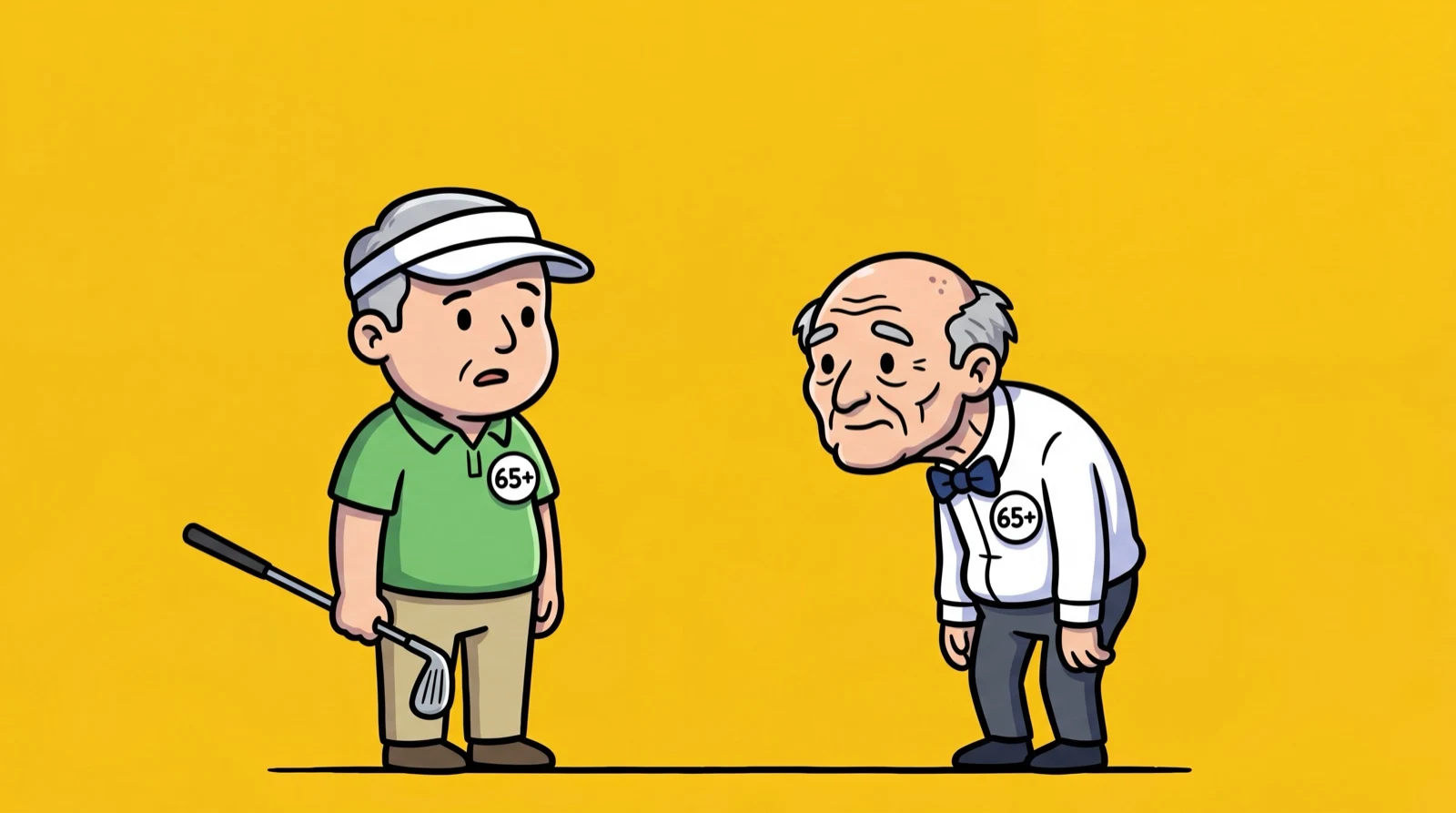
Your 65+ segment contains a marathon runner and a 91-year-old who watches Countdown. Same bracket, completely different people. Time to go deeper.
Hey there,
God, we love a long weekend. But a long weekend where you're culturally obliged to eat chocolate is some next level shizz. Did you survive Storm Dave, reader? How's the destruction in the garden? The Daykin family managed to combine the great British tradition of bank holiday drinkypoos (Simma's daughter's engagement party and Jason Cook's excellent Comedy Club at the South Shields Customs House) with every middle-aged person's sacred duty of obsessing over their lawn in early April. Simultaneously rock and roll and completely boring—just the way we like it!
But here's something you might not have picked up in all the excitement.
Yesterday, the state pension age officially rose to 67. Which means that "65+" bracket—the one that appears in every customer segmentation model ever built—just got even more meaningless. The same category now contains someone still years away from retirement who spends half their life on the golf course, and someone pushing a hundred who rarely leaves the house and has carers in twice a day. Two completely different people. Completely different needs. Same segment.
Most organisations already segment their customers. The question isn't whether you're doing it. It's whether your segments actually explain anything—or whether they're just expensive labels.
The silo problem
Everyone's segmenting—by age group, by product, by channel, by value tier, by Mosaic classification. But they're all doing it differently, often in isolation. The marketing team has their version. The service team has theirs. The data team has a third. Nobody's talking to each other. The result: duplicated effort, inconsistent messaging, and an experience for the customer that doesn't feel remotely joined up.
Insight can't travel when everyone's speaking a different language about the same people. And when every team thinks they "own" a particular customer group, you end up thinking product-first instead of audience-first—which is exactly backwards.
This isn't a niche problem. Research consistently shows that segmentation studies have a bad reputation for ending up on a shelf. Not because the work was poor, but because there's no operational bridge between the segments you've defined and the systems your teams actually use.
Four layers of understanding
Demographics tell you who someone is. Behaviour tells you what they do. But neither tells you why—and why is where the action is.
We've been thinking about this as four layers, each one adding explanatory power. Not a hierarchy you climb—layers you stack.
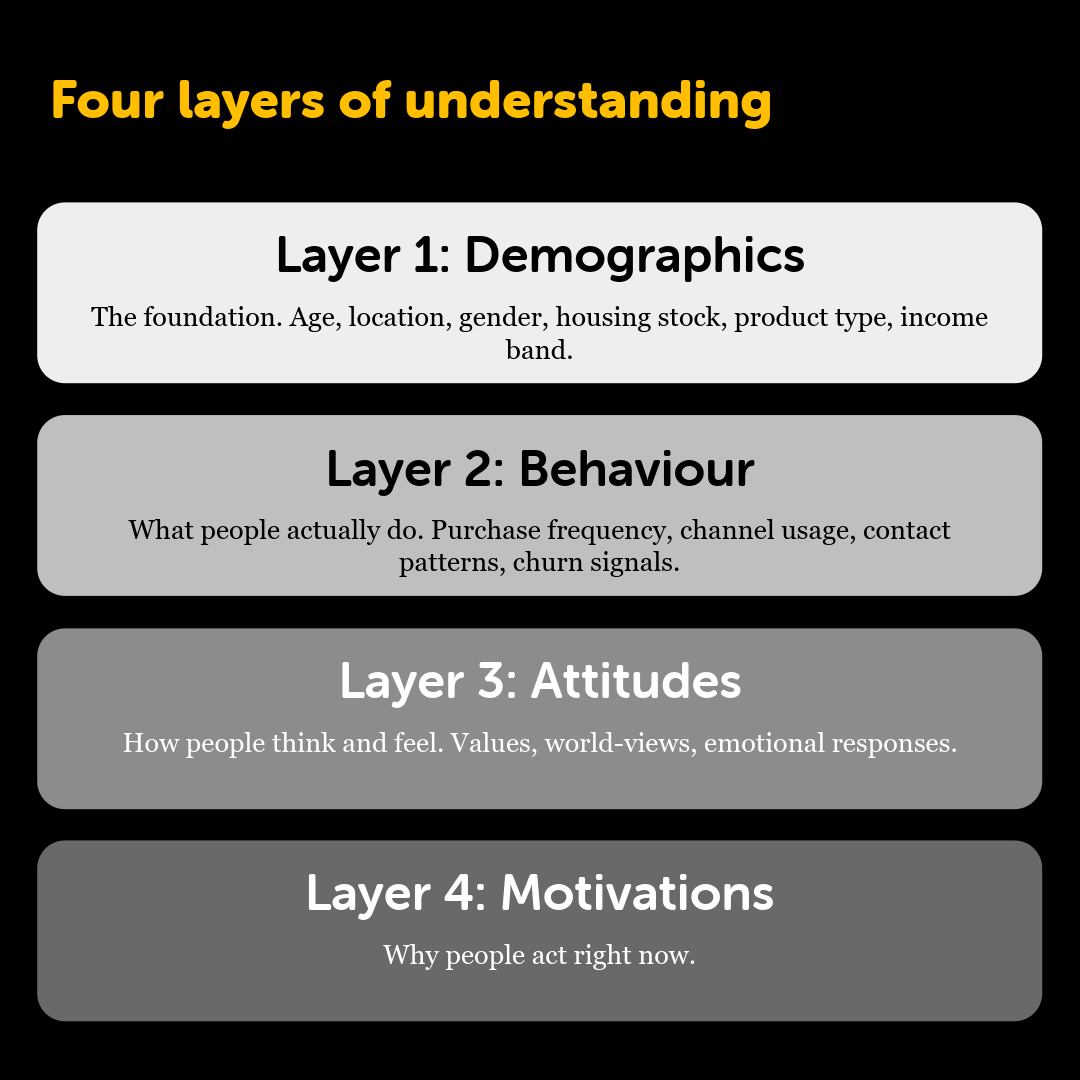
Layer 1: Demographics. Age, location, gender, housing stock, product type, income band. The foundation. Genuinely useful for broad filtering—if you work in housing, the difference between a tenant in a flat and a tenant in a house shows up clearly in feedback. But on its own, it describes people without explaining them.
Layer 2: Behaviour. What people actually do. Purchase frequency, channel usage, contact patterns, churn signals. We've done a lot of this—segmenting by long calls versus short calls to contact centres, high spend versus low spend, people who stopped using a product versus those who stayed. Behavioural data is richer than demographics. It tells you what's happening. It still doesn't tell you why.
Layer 3: Attitudes. How people think and feel. Values, worldviews, emotional responses. This is the layer most organisations know they need but struggle to operationalise. An attitude is relatively stable—it's a deep orientation that shapes how someone relates to your brand, your sector, your whole category. Attitudinal segmentation is where you start to understand that two people who buy the same product might be doing it for entirely different reasons.
Layer 4: Motivations. Why people act right now. Motivations are volatile—they change because someone saw something on the news this morning, because it's payday, because the weather's nice, because they're stressed. Someone who cares deeply about a cause won't necessarily donate to it today. Understanding the gap between a stable attitude and a volatile motivation is where the most actionable segmentation lives.
Most organisations have the first two layers covered. Some have started on the third. Almost nobody is systematically working with the fourth. And the irony is that the data to unlock layers three and four often already exists—sitting in your qualitative feedback, your open-ended survey responses, your call transcripts—but few organisations extract it at scale.
Where vulnerability breaks the model
A customer might be classified as vulnerable because they're elderly or have a disability. That's a demographic marker. But vulnerability is often situational and temporary—in the water industry, a customer without water for 48 hours is vulnerable regardless of their age, income, or postcode. In financial services, around 60% of UK adults exhibit at least one characteristic of vulnerability. It's not a fixed category. It's a fluid state that's as much attitudinal ("I feel overwhelmed," "I don't understand this letter") as it is circumstantial ("I've a young baby demanding my attention").
You can't segment for that with demographics alone. You need to hear what people are saying—and more importantly, how they're saying it.
People who are actually doing this
Razia Aziz, Head of Retention & Loyalty at Whittard of Chelsea, presented with us at the Richmond Market Insight Forum last year about exactly this problem. Whittard were seeing declining loose tea sales and rising churn in their tea category. Rather than just looking at purchase behaviour, Razia's team layered attitudinal and motivational survey data on top. They discovered that purchase drivers varied dramatically by persona within the same customer base—gifters cared about completely different things to daily drinkers. Surface-level segments had been hiding that completely. Once Whittard understood those differences, they were able to tailor communications by persona—busting myths about loose leaf tea for anxious newcomers, leading with packaging and gifting occasions for gifters—and saw email revenue jump 175% and customer acquisition rise 26%.
If you've been reading CX Corner for a while, you'll remember Niek de Rijcke from the Dorchester Collection. His team segments guests across nine measurable emotional dimensions. Not demographics. Not even behaviour. Emotions. That's the far end of what this looks like—and when a luxury hotel chain decides the most important thing to understand about their guests is how they want to feel, it tells you something about where segmentation is heading.
Fair4All Finance went even further in financial services—building six named segments covering 20.3 million financially vulnerable UK consumers, combining behavioural, demographic, lifestyle, and attitudinal variables. Segments like "Difficult Debts," "Unsteady Starters," and "(Un)golden Years." This isn't a research exercise. It's operational infrastructure that the entire financial services industry now uses.
There's a useful metaphor from Chris Robson in MarTech: customers move like starlings. "Consumers don't stay in neat boxes—behaviours evolve, influences spread, and groups form and dissolve in ways that traditional segmentation models can't predict." Segmentation needs to be as fluid as the attitudes it measures.
The counter-argument
We should acknowledge: not everyone agrees that deeper segmentation is the answer. Byron Sharp and the Ehrenberg-Bass Institute argue that segmentation encourages thinking about differences rather than commonalities—and that brands grow through reach, not targeting. One study found a company with five beautifully defined attitude segments where every competitor had virtually identical market share in each. Descriptively rich. Strategically useless.
They're not wrong about the failure mode. But the problem isn't attitudinal segmentation itself—it's bad attitudinal segmentation. Agree/disagree survey scales. Annual research studies that sit on a shelf gathering dust. No bridge between the PowerPoint and the systems your teams actually use every day.
The fix isn't to go back to demographics. It's to stop treating segmentation as a research project and start treating it as continuous infrastructure—fed by what customers are already telling you in their own words, not by what you're asking them in a survey once a year.
Three things you can do this week
- Audit your layers. How many of the four do you currently cover? If you're at demographics and behaviour, you're in the majority—and you're missing the why. That's not a criticism. It's a starting point.
- Filter your free text by your existing segments. Your customers are already volunteering their attitudes and motivations in open-ended feedback. What themes emerge when you look at what your 65+ segment is saying, rather than just how old they are? The data to understand why your customers do what they do is already sitting there.
- Pick one "demographic" segment and ask whether it's really fixed. Vulnerability is the obvious test case. Is it a permanent characteristic of those people, or a temporary state that shifts with circumstances? If it shifts, you need attitudinal data to see it—because the demographics won't change even when the person's situation has.
We're running a webinar next Tuesday with Emma Smith, Senior Voice of the Supporter Manager at the British Red Cross, who has built exactly this—a multi-layered segmentation model that gives the whole organisation a shared way of talking about and understanding their supporters. What she's done is brilliant, and the webinar goes into the kind of operational detail that CX Corner cannot. If this piece has you thinking, that session is the obvious next step, and you're all invited!
We're also presenting this four-layer framework publicly for the first time. We'd genuinely love to know: does it match your reality? What layer are you stuck at? What would you add? Hit reply and tell us—we read every one.
Until next time, keep learning!
Pete
P.S. One last thought. There's a distinction worth making between attitudes and motivations, and it matters more than you'd think. An attitude is something that lives with you—a deep orientation, a worldview, a way of seeing things that doesn't shift much from year to year. A motivation is what gets you off the sofa on a Tuesday. Someone who cares passionately about clean drinking water in developing countries won't necessarily donate to a water charity today. That gap between caring and acting? That's where the most interesting segmentation lives. Attitudes are the geology. Motivations are the weather. Both shape the landscape—but on very different timescales.
More from CX Corner
There You Are, Bernard: The Perfect Balanced Sample
What Yes Minister can teach you about how the wording of a question quietly decides its answer.
 The Death of Surveys and the Silent Signal Assassin
Why 2026 belongs to the signals customers leave without being asked — and what that means for your survey programme.
The Death of Surveys and the Silent Signal Assassin
Why 2026 belongs to the signals customers leave without being asked — and what that means for your survey programme.
 Customer Emotion Mapping: World Cup Edition
Score more than you concede: every process produces an emotion, and the emotion is the only part your customer remembers.
Customer Emotion Mapping: World Cup Edition
Score more than you concede: every process produces an emotion, and the emotion is the only part your customer remembers.
