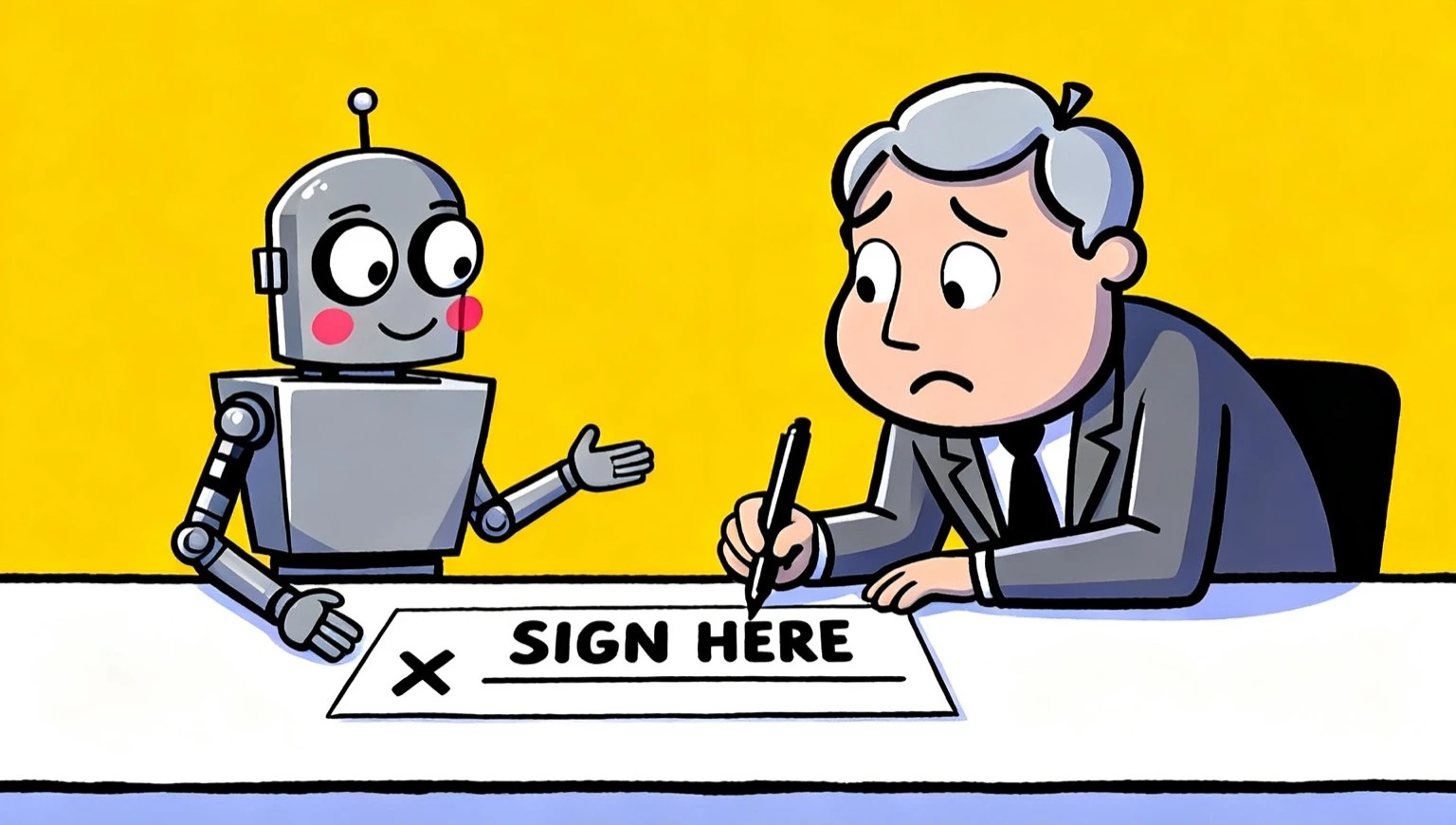
 Who's liable when AI analyses your customer feedback — the software, or you?
When an AI analyses your customers and gets something wrong, the liability lands on you, not the software. Where the line actually falls — and how to make sure you're never the one left defending a black box.
Who's liable when AI analyses your customer feedback — the software, or you?
When an AI analyses your customers and gets something wrong, the liability lands on you, not the software. Where the line actually falls — and how to make sure you're never the one left defending a black box.
Reading Customers Right
Guest Blog: The Comforting Myth of "Fairly Satisfied"
"Fairly satisfied" isn't a midpoint between happy and unhappy — it's a warning signal. Across 7,700+ tenant verbatim comments, the "fairly satisfied" group scored a sentiment of 40 — firmly negative. Chris Elliott of Housemark on what that means and how landlords should respond.

 Written by Chris Elliott, Housemark
Created · Last updated
Does "fairly satisfied" actually mean satisfied?
No. In tenant satisfaction reporting, few assumptions are as widely accepted and as misleading as the idea that a "fairly satisfied" score represents a positive outcome. In TSM surveys, 'fairly satisfied' and 'very satisfied' are combined into a single headline metric: % satisfied. On the surface that feels reasonable — both responses sit on the positive side of the scale. But our analysis challenges this assumption head-on.
Drawing on thousands of verbatim comments and sentiment analysis, the evidence suggests something far more uncomfortable: tenants who score themselves as "fairly satisfied" are often not satisfied at all. At best, they are passive and indifferent. More often, they are actively unhappy — quiet, but unhappy.
This blog unpacks that finding, grounded firmly in the data presented in the report, slides, and webinar, and strengthens it with methodological and academic rigour to explain why this matters and how landlords should respond.
How "fairly satisfied" becomes a blind spot
Tenant Satisfaction Measures (TSMs) report satisfaction by aggregating "fairly satisfied" and "very satisfied" responses. For example, an 80% satisfaction score might consist of 35% "very satisfied" tenants and 45% "fairly satisfied" tenants. The implicit assumption is that these groups are emotionally adjacent.
Our analysis shows they are not.
When we isolated responses from tenants who selected "fairly satisfied" and examined their written comments, a very different picture emerged. Across 7,700+ verbatim comments, this group produced an overall sentiment score of 40 — a score that sits firmly in negative territory and far closer to "fairly dissatisfied" than to "very satisfied".
In other words, while the numerical score suggests satisfaction, the emotional content of the feedback does not.
Methodological approach: why sentiment matters
To move beyond anecdote, we applied sentiment analysis to tenant verbatim at scale. This allowed us to:
- Quantify emotional tone consistently across thousands of free-text comments.
- Compare sentiment across different TSM score bands.
- Identify whether numerical satisfaction scores align with lived experience.
A key methodological decision was defining a sentiment threshold. In our model, sentiment scores below 45 are considered negative. This benchmark let us test a simple but powerful hypothesis: if "fairly satisfied" genuinely represents moderate satisfaction, we should observe neutral-to-positive sentiment in the associated verbatim. The data did not support this hypothesis.
Cross-category evidence: a consistent pattern
When we cross-tabulated TSM categories against sentiment, the results were strikingly consistent:
- In Maintenance and Repairs and Communication and Engagement, only tenants scoring "very satisfied" expressed positive sentiment
- Tenants scoring "fairly satisfied" showed negative sentiment across every category, with the sole exception of complaint handling
This matters because these are not marginal service areas. Maintenance, communication, and engagement are among the most operationally intensive and reputationally sensitive functions for housing providers.
The implication is clear and stark: "Fairly Satisfied" is not a midpoint between happy and unhappy. It is a warning signal.
What "fairly satisfied" tenants actually say
The qualitative data reinforces this conclusion. Verbatim comments from "fairly satisfied" tenants are dominated by themes we typically associate with dissatisfaction:
- Long call waiting times
- Repeated chasing for updates
- Poor or unclear communication
- Time-based effort and inconvenience
Examples include:
When I phone for repairs I can be in the queue for a long time, and sometimes this has caused me to give up.
It took two days to get to speak to someone.
I've been waiting on the phone sometimes for 30 or 40 minutes, and that's unacceptable.
It's obvious that these are not expressions of contentment. They are expressions of frustration that has not yet tipped into formal complaint behaviour… yet!
The CX lens: the zone of indifference
From a customer experience (CX) perspective, this group sits squarely in what is often called the zone of indifference. Customers in this zone are:
- Not happy enough to advocate.
- Not yet unhappy enough to escalate.
- They are however quietly losing confidence.
- They are highly vulnerable to future dissatisfaction.
Academic and CX literature consistently shows that indifference is more dangerous than overt dissatisfaction. Dissatisfied customers complain. Indifferent customers disengage. In a social housing context, this disengagement often manifests later as:
- Formal complaints.
- Escalations to regulators or ombudsmen.
- Sudden drops in satisfaction scores that appear to come out of nowhere.
In reality, the warning signs were always there hidden inside 'fairly satisfied'.
The risk of score-only leadership
One of the most significant risks identified in the report is misinterpretation at leadership level. When executive teams rely solely on headline TSM scores, a danger exists in that:
- "Fairly satisfied" is treated as success.
- Resources are allocated away from emerging issues.
- Known friction points are deprioritised.
This creates a false sense of security. The thing is that these problems do not disappear; they accumulate quietly until they become too large, or too visible, to ignore.
A missed opportunity — or the biggest one?
Crucially, this finding is not just a warning. It is also an opportunity. "Fairly satisfied" tenants are not offering vague complaints — they are providing high-quality feedback. Their comments clearly articulate:
- What is broken.
- Where effort is excessive.
- Which processes are failing in real life.
In our analysis, themes such as call waiting times and time-based effort accounted for both the highest volumes and the highest proportions of "fairly satisfied" responses, often paired with strongly negative sentiment. This makes the group uniquely valuable. They are close to being "very satisfied," but only if organisations act on what they are already being told.
Turning insight into action
Organisations that perform well do three things differently:
- They stop treating "fairly satisfied" as a win. Instead, they treat it as an early warning indicator.
- They combine scores with sentiment and verbatim. Quantitative and qualitative data are analysed together, not in isolation.
- They target small, high-impact fixes. Improvements in communication, responsiveness, and expectation setting often deliver disproportionate gains.
Our experience shows that when these actions are taken, movement from "fairly" to "very" satisfied can happen quickly and sustainably.
Conclusion: nearly there is not enough
The idea that "fairly satisfied" equals satisfied is comforting, but the reality is that it is simply wrong. The data shows that it often means:
"I'm coping, but frustrated" / "It works, but it's hard work" / "I haven't complained yet"
By listening more closely, especially to sentiment and verbatim, we can uncover the truth hidden behind the score. So let's retire the myth — "fairly satisfied" doesn't mean satisfied. It means nearly there, but not quite. And qualitative insight is the key to closing that gap.
Frequently asked questions
Does "fairly satisfied" mean a tenant is satisfied?
Often not. Across 7,700+ verbatim comments, tenants who scored themselves "fairly satisfied" produced an overall sentiment score of 40 — firmly negative, closer to "fairly dissatisfied" than to "very satisfied". The numerical score suggests satisfaction; the emotional content of the feedback does not.
Why is the "fairly satisfied" group a risk for landlords?
Because they sit in the zone of indifference: not happy enough to advocate, not yet unhappy enough to escalate, but quietly losing confidence. Indifferent customers disengage rather than complain, then later surface as formal complaints, regulator escalations, or sudden drops in satisfaction scores.
What sentiment threshold counts as negative?
In our model, sentiment scores below 45 are considered negative. The "fairly satisfied" group scored 40 — below that threshold and across every TSM category except complaint handling. That let us test, and disprove, the assumption that "fairly satisfied" reflects genuine moderate satisfaction.
What do "fairly satisfied" tenants actually complain about?
Their verbatim is dominated by dissatisfaction themes: long call waiting times, repeated chasing for updates, poor or unclear communication, and time-based effort and inconvenience. Call waiting times and time-based effort accounted for the highest volumes and proportions of "fairly satisfied" responses.
How should organisations respond to "fairly satisfied" scores?
Stop treating "fairly satisfied" as a win and treat it as an early warning indicator. Combine scores with sentiment and verbatim rather than analysing them in isolation, and target small, high-impact fixes in communication, responsiveness, and expectation setting — these often deliver disproportionate gains.
Read more from the blog
Who's liable when AI analyses your customer feedback — the software, or you?
When an AI analyses your customers and gets something wrong, the liability lands on you, not the software. Where the line actually falls — and how to make sure you're never the one left defending a black box.
 Guest Blog: Why Effort Deserves Centre Stage
Chris Elliott, Housemark's Principal Consultant, on why customer effort is one of the most consistently underestimated drivers of satisfaction.
Guest Blog: Why Effort Deserves Centre Stage
Chris Elliott, Housemark's Principal Consultant, on why customer effort is one of the most consistently underestimated drivers of satisfaction.
 Scottish Twitter — How to understand your customers when they all speak their own language
Scottish Twitter changed online conversation. Here's what that means for anyone trying to get actionable insight from messy, real-world language.
Scottish Twitter — How to understand your customers when they all speak their own language
Scottish Twitter changed online conversation. Here's what that means for anyone trying to get actionable insight from messy, real-world language.
