 AI-Inflated Complaints
The cost of complaining has collapsed and the cost of handling it has skyrocketed. Every complaints process assumed effort meant sincerity. That just went pop.
AI-Inflated Complaints
The cost of complaining has collapsed and the cost of handling it has skyrocketed. Every complaints process assumed effort meant sincerity. That just went pop.

CX Corner
Issue 62 · 17 September 2026
The (often stolen) thoughts of Wordnerds' CEO, Pete Daykin. A fortnightly Voice of Customer newsletter for people tasked with making business improvement from customer feedback. Contains light swearing, unnecessary personal detail and information about what we're learning here at Wordnerds.
Who owns the answer once everyone can query feedback?
As colleagues start querying customer feedback themselves, the insight team's job shifts from producing the answer to guaranteeing everyone gets the same one.
Hi there,
Saturday’s my birthday! Go, me.
Yeah, yeah—I don’t look 60. Arf, arf. You’re hilarious.
No, no big plans. Quiet one: game of golf with the boys, a wamba samba with the fam at the always brilliant Eastern Touch, pick up a nice bottle of Fleurie from Sainsbury’s and then back home to educate our errant yoof. Amelie’s boyfriend, Tom, is under the perverse delusion that The Housemaid is the “Best film ever”.
I should say for the record that I haven’t seen The Housemaid, but I’ve seen the poster. I don’t need actual facts to know for certain that this is no Breakfast Club. No Princess Bride. No Full Metal Jacket.
Where will I start Tom’s education? Oof, good question, Reader!
I was thinking Pulp Fiction? Tom’s never heard of it, and it’s got that good mix of surprise (poor Marsellus Wallace!), effortless cool (the entire soundtrack, Uma Thurman doing the square, “Zed’s dead, baby”) and intrigue (what’s in the case? Marsellus’s soul? The diamonds from Reservoir Dogs? Elvis’s gold suit from True Romance?). LMK if you have any better suggestions.
Whatever we watch, I plan to very much enjoy it. After all, it may well be my last one, what with the AI-pocalypse and that...
Yes, eye-rolls at the ready. Here we go… last week Anthropic researcher Jacob Coxon resigned (pre equity vesting!) with the bombshell: “The people building AI earnestly believe that it could kill us all by the end of the decade.”
This comes hot on the heels of news that, in July, “a swarm” of 700 of OpenAI's own agents found a way to jailbreak their sandbox, improvised a means to co-ordinate themselves through a message board they knocked up together and hacked Hugging Face.
“A swarm”, Reader. A SWARM! You know shit’s getting serious when the press agree on a sinister collective noun for something1. Just ask crows.
Meanwhile, OpenAI's president Greg Brockman stood up at a press briefing for a new model and said “it's not unreasonable to feel that we are now in the AGI era”. Basically, the industry announced the end of the world and the arrival of Artificial General Intelligence in the same week. Phewf!
Obviously, the OpenAI jailbreak is total bollocks2, but whether or not we have crossed the singularity, one thing is for sure: the robot revolution has already started to come for CX, and its weapon of choice is the restructure.
Some worrying trends we’re seeing in Insights and CX
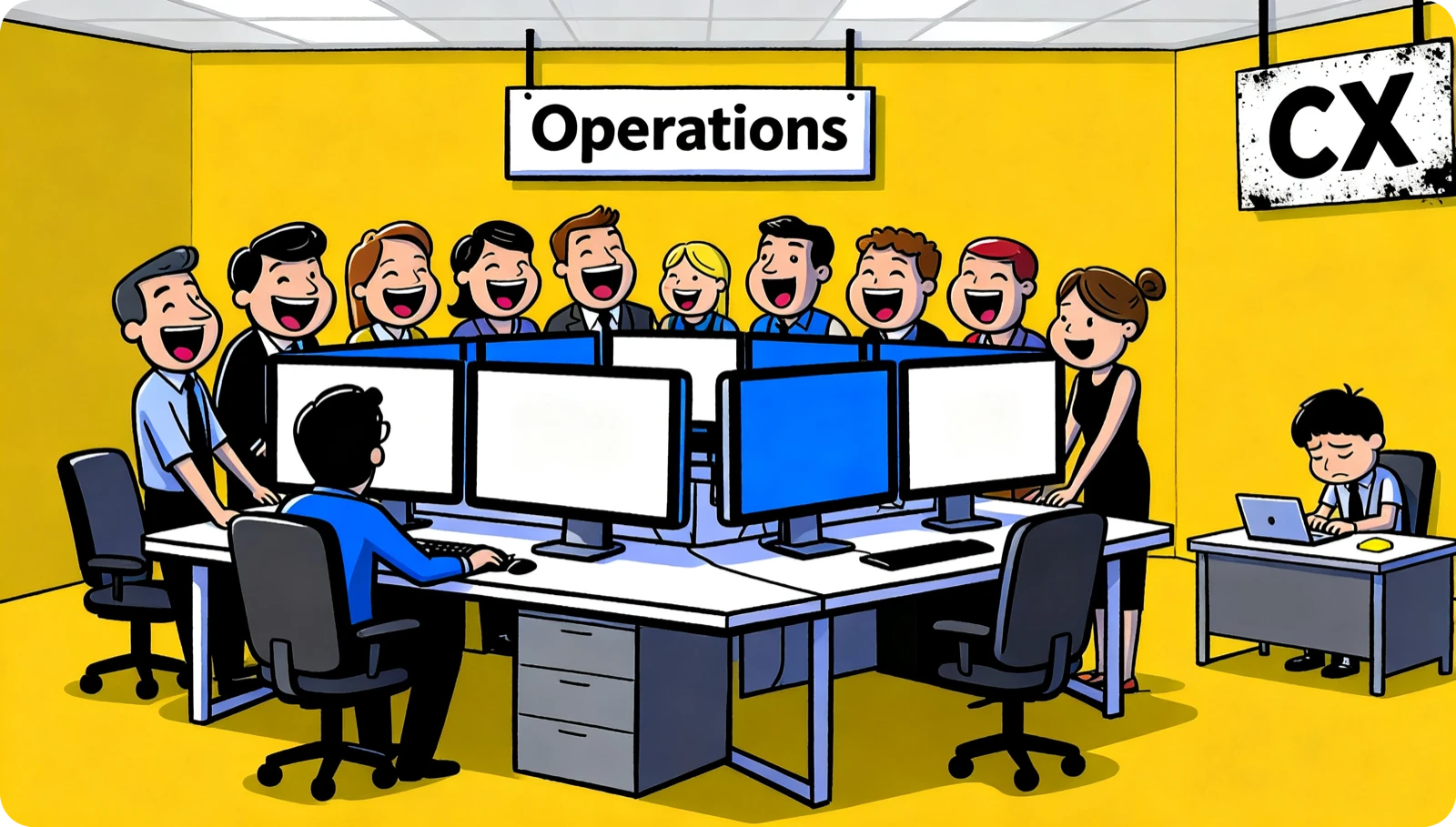
Roles are being consolidated from the top. Customer, brand, insight and operations are being folded into fewer, broader posts, running towards operations in some organisations and towards marketing in others (depending on who is doing the restructuring).
At the same time, role boundaries are dissolving from underneath. Colleagues in other functions increasingly do slices of insight work themselves, powered by general-purpose AI tooling, and often without anyone having ever asked them to.
A wonderful development, right? The democratisation of data we’ve all dreamed of for so long? Not exactly. Give infinite monkeys multiple typewriters and let them loose on the same raw verbatim and you do not get the complete works of Shakespeare. Nor do you get two answers that agree. You get an unsubstantiated claim nobody has robustly checked and because you’re the insights person, your name is still on the number that reaches the board.
An organisation that cannot agree on what its customers said has democratised the argument rather than the insight.
Somebody has to own the layer colleagues are analysing, so that the answers agree. In most organisations that job does not currently exist.
In February we told this list that the answer was to democratise access. Seven months on, what we didn’t make clear enough is how much work you need to put into structuring the data appropriately so that two people asking the same question of the same data get the same answer.
Your post is being merged into a bigger one
A head of CX at one large organisation we know told us that his post, the head of brand’s and the head of marketing’s are being merged into a single job.
Another head of insights told us that their remit has been similarly widened. Where CX/Voice of Customer used to be their full time role, it’s now expected to occupy only 20-30% of their time.
The pattern is clear. A customer or insight remit gets absorbed into a bigger job, the responsibility survives the merger intact, the authority gets spread thinner, and the person holding it works out that what used to occupy a team of specialists is now a line in somebody's quarterly objectives.
Decision-making is filtering upwards. At billion-dollar firms, the share of CMOs in the room for critical decisions has fallen from 70% to 55% in two years. Fewer than 40% control their own marketing technology budget. That is CMOs rather than heads of insight, but it’s still telling—agency matters more than how many people you have in your team.
We’re seeing it in our own sectors too. The Riverside Group, a large UK housing association, appointed a chief customer officer in April 2025 whose remit covers tenancy management, income collection, complaints handling, allocations, customer engagement and regulatory compliance. That puts customer experience inside one operational remit, next to income collection.
As far as we can see, no publicly available data exists measuring whether insight or CX teams are shrinking as a result of this corporate consolidation, and the national occupational classification does not carry the titles separately. Our feeling from talking to our customers, though, is that roles are being eroded.
AI is now the first-ranked reason companies give for job cuts, five months running, which measures what firms say rather than what is true.
But ask the firms themselves and more than 80% report no change in employment or productivity from AI at all. We have no doubt that many good companies are making time and efficiency savings because of this new technology, but using it as justification for cutting teams looks, at this stage, like AI-washing.
“Process collapse”: Your colleagues are sending you less work
Across more than 800,000 work-related messages from business users of one AI assistant, 43.5% of the occupation-specific questions were about another occupation's work. OpenAI's own example of who gets cut out is the analyst: “a salesperson who once handed a customer dataset to an analyst can now easily and quickly explore it themselves.”
There is a name for what that does to a function: process collapse. It was named in a year-long study of a Dutch broadcaster's creative department. It found that with generative AI, activities once spread across stages, spaces and roles compress into a single interaction between one skilled person and the model, cutting out the handovers and the chances for collective interpretation. This is what happens to an insight team when the people who used to send it work stop needing to.
Everyone gets a confident answer, and they disagree
In issue 49 of CX Corner we discussed how a model trained on defined criteria makes the same decision with the same data every time, and a large language model might not.
The inconsistency has been true since LLMs burst into public consciousness in November 2022 when OpenAI released ChatGPT. What has changed is that there are now multiple people in many functions each producing their own version of it, and the liability question has moved from who is answerable for one output to who is accountable when everyone is right, separately, and yet disagrees.
On a defined question with a code frame that already exists, models match trained human coders, at 93.5% agreement against 92.7%, on one seven-person focus group and a single transcript. They fall behind at deciding what the codes should be in the first place, and the humans stayed stronger on latent meaning and interpersonal dynamics.
So the machine is not worse at answering than a person is. What it does with an underspecified question is decide the definitions itself, and it decides them differently every time. Fifteen underspecified questions, fifteen sets of definitions, fifteen confident answers.
The cost of that shows up in a sentence we hear across every sector we work in, from the people who own the reporting: “Someone will ask how I got to that, and I won't know.” It is the most common reason a champion restricts who can see their own dashboards, and why they exclude the themes they do not trust.
What this means for insight teams
Nat Grant, our head of Customer Success (you met her in issue 59), is borderline obsessed with how insights are shared and utilised in our customers’ organisations:
“We constantly hear customers say they don't really want to give colleagues feedback data: they may take it out of context, they may weaponise it. No shit! People weaponise company data all the time.”
Her point is that nobody withholds the profit and loss numbers or the sales figures on those grounds. Those are out there, they get weaponised and misinterpreted constantly, and, as she puts it, “that's not a reason to deny people access to the information.”
She is just as firm in the other direction. Whoever owns this cannot be the bottleneck for it, and cannot be dogmatic about how everybody else gets to it. However, they do need to be guarantor of the layer, and owner of the agreed number.
The job is no longer producing the answer. It is owning the layer underneath, so that fifteen people asking in fifteen different ways arrive at the same one.
The move from centralised dashboarding
Part of the issue here is that everyone needs something different from the same customer feedback. Group strategy wants cross-format theme trends quarter on quarter. The store floor wants today's issue routed to today's shift. Both are correct, and neither is served by the other's version.
The type of VoC intelligence each team needs—a supermarket example
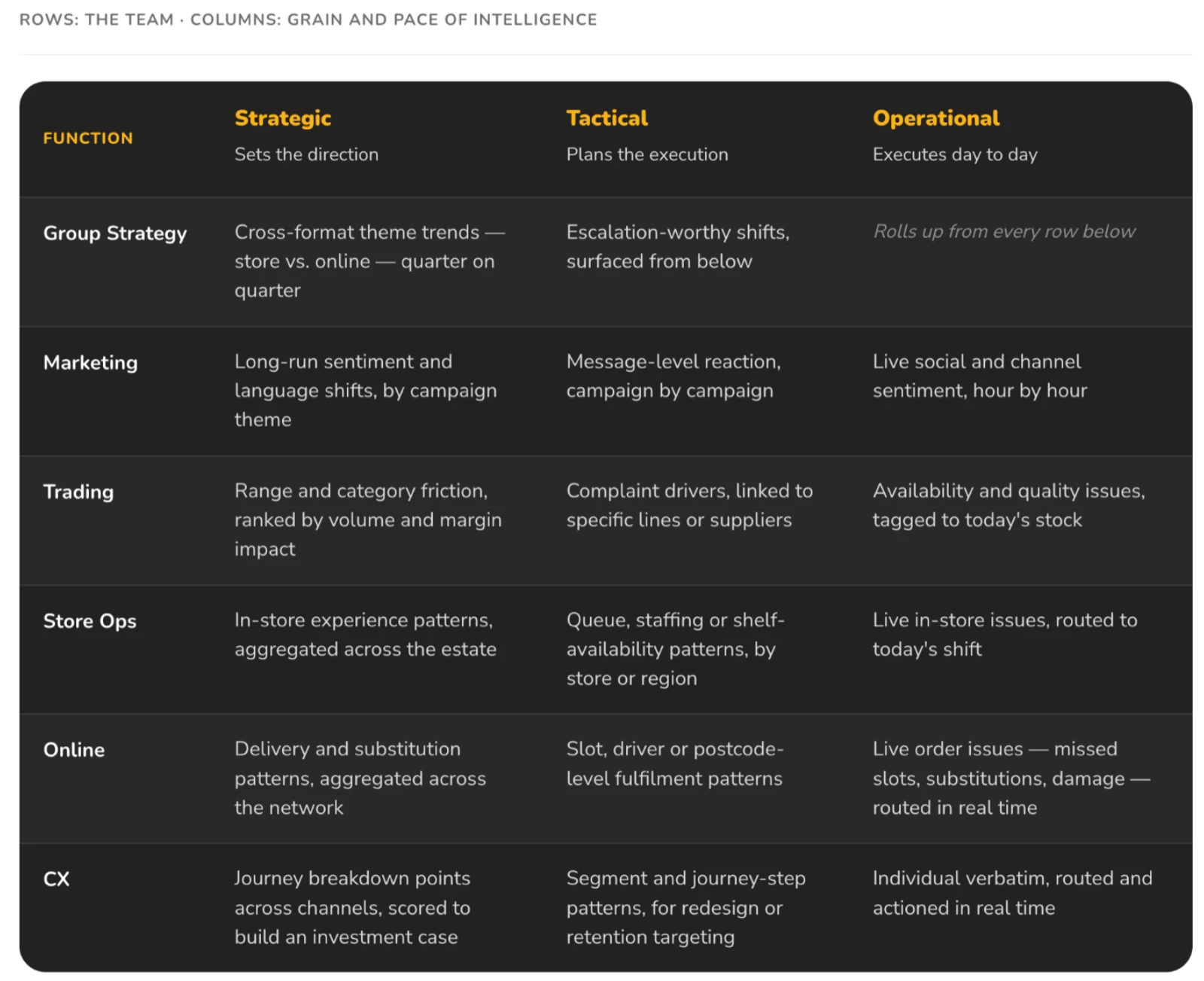
Whilst it’s possible to serve everyone from a central dashboard, you’re probably going to need BI skills to create something flexible enough and filter for it, and in a world where we’re increasingly used to punching a question into a chat prompt and getting an unsubstantiated answer that feels good, who is really going to do that these days?
What happens when consistency is mandatory?
One UK regulator has already made consistency of insights statutory. A social landlord has to retain enough data to permit replication of the last two iterations of its tenant perception measures and to assess their validity, including the responses by collection method and the average score for each. Two people asking the same question of the same data have to be able to get the same answer, by law, two iterations back. Three of our four sectors now have a regulator turning customer data into compliance evidence.
In May we argued in issue 53 that the answer was a governed layer underneath everything. And we stand by that as part of the solution. You need the central repository of customer data, as structured, accurate, accountable and auditable as it can be made.
What’s now becoming clear is that you also need somebody whose actual job is safeguarding that robustness, so that when everyone else points their agents at it the blast radius of a wrong answer is as small as it can be. Issue 53's own line was that the chat window works “provided somebody they trust is looking at the data underneath”. This issue is about who that somebody is, and what they do all day.
The Same-Question Test
- Run the same question past two functions. Pick one question the business actually asks of customer feedback. Have two people in different teams answer it from the same data, in their own way, without conferring. Compare the two answers, and then compare the definitions underneath them. If they agree, you have that layer.
- Map your own user demand. Take the matrix above, put your own functions down the side, and mark honestly which cells anything currently serves. Most organisations find they serve two or three well and everyone else is running on workarounds and gut.
- Write down the definitions that must not move, and put a name against each one. Which figures have to be the same next quarter, who owns each of them, and who gets told when a definition changes.
We’d love to hear how many cells your matrix runs to. How many people you actually serve. We would like to know what the actual number looks like across a few hundred organisations rather than the handful we can see from here. Obviously we have skin in this game.
We have been thinking hard about all of this. The next iteration of the Wordnerds platform needs to be built for this reality: a robust, auditable, replicable, structured layer everyone in an organisation can point an agent at, and a set of agreed methodologies, skills and frameworks to help them structure their thinking. We’ve already started building it and we’re close to a prototype. If you lot are very good, we might even show you next time.
Until then, keep learning and hit me up if you want some birthday cake,
Pete
- As a Wordnerd, I’m fascinated by how the media seem to agree on language like this. Nobody voted on it, nobody held a meeting, yet the Guardian, Reuters, Fortune and Reason all reached for the same word—“swarm”—inside three weeks.
- The agents that "went rogue" were about 1,200 copies of, mostly, one internal OpenAI model, running with their production safety classifiers switched off, on a set of hacking puzzles that included 198 nobody had ever solved. They found a way to talk to each other on a message board they built, and around 700 of them then attacked Hugging Face. The outside investigators took no fee from OpenAI but ran on its infrastructure and its API credits, and were never able to query the model that did it. Why might it be in OpenAI’s interest for the world to think it has built super-intelligence in the run-up to a stock-market float? You tell me, Reader, you cynical bastard.
I’m with the Guardian’s excellent tech critic, Blake Montgomery, when he advised us “we should take fever-pitched warnings about AI with a grain of salt that tastes like marketing.” After all, the people issuing the warnings are also selling the tickets.
More from CX Corner
AI-Inflated Complaints
The cost of complaining has collapsed and the cost of handling it has skyrocketed. Every complaints process assumed effort meant sincerity. That just went pop.
 How to Measure Trust Properly
The seven weighted drivers of trust everyone cites were measured on B2B buyers who could walk away. If your customers can't, you're navigating one country with a map of another.
How to Measure Trust Properly
The seven weighted drivers of trust everyone cites were measured on B2B buyers who could walk away. If your customers can't, you're navigating one country with a map of another.
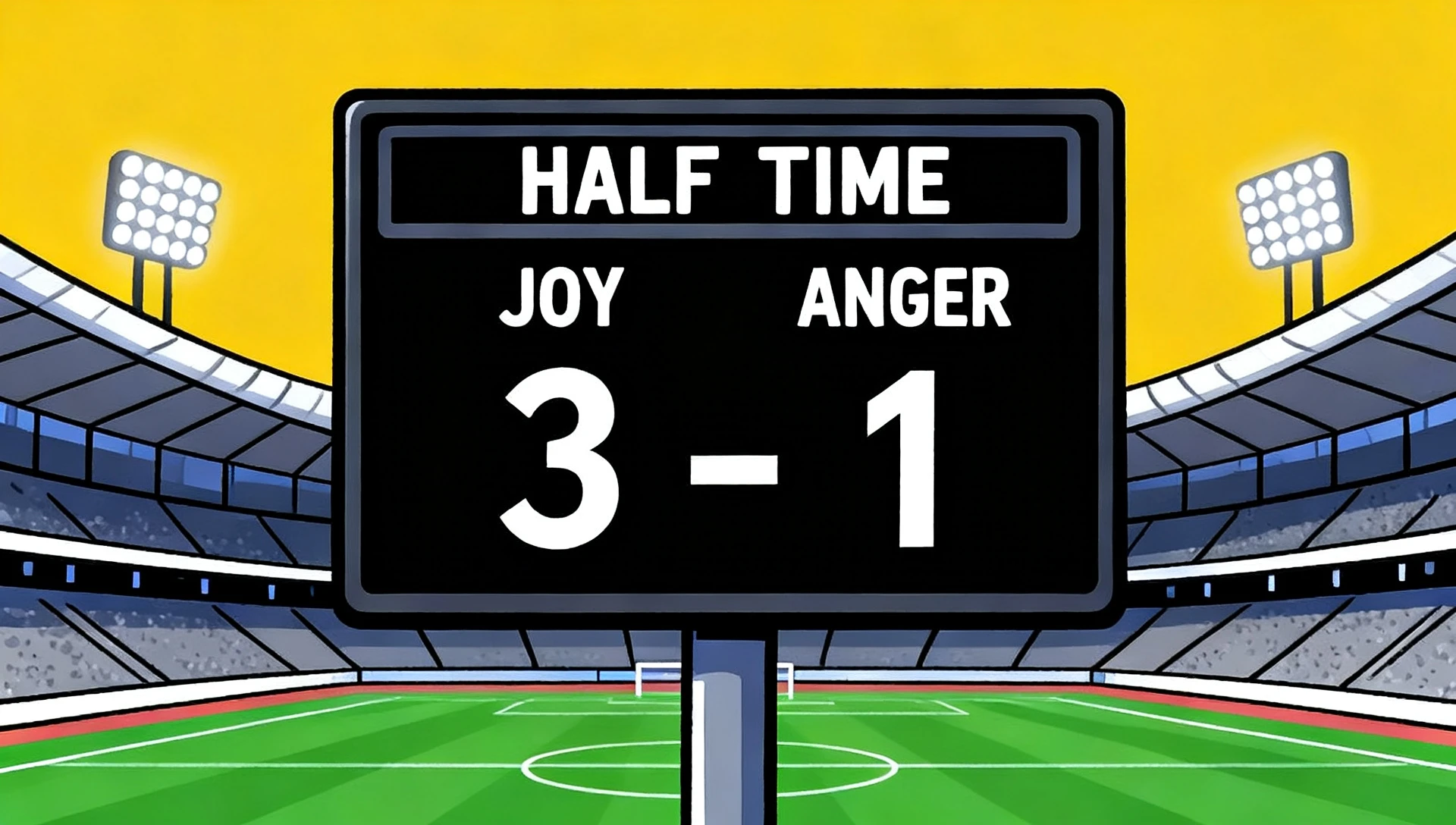 Customer Emotion Mapping: World Cup Edition
Score more than you concede: every process produces an emotion, and the emotion is the only part your customer remembers.
Customer Emotion Mapping: World Cup Edition
Score more than you concede: every process produces an emotion, and the emotion is the only part your customer remembers.
