 Who Owns the Answer?
As colleagues start querying customer feedback themselves, the insight team's job shifts from producing the answer to guaranteeing everyone gets the same one.
Who Owns the Answer?
As colleagues start querying customer feedback themselves, the insight team's job shifts from producing the answer to guaranteeing everyone gets the same one.

CX Corner
Issue 61 · 2 September 2026
The (often stolen) thoughts of Wordnerds' CEO, Pete Daykin. A fortnightly Voice of Customer newsletter for people tasked with making business improvement from customer feedback. Contains light swearing, unnecessary personal detail and information about what we're learning here at Wordnerds.
Everyone has a ghostwriter: what AI is doing to complaints, surveys, and the idea that effort means something
The cost of complaining has collapsed and the cost of handling it has skyrocketed. Every complaints process assumed effort meant sincerity. That just went pop.
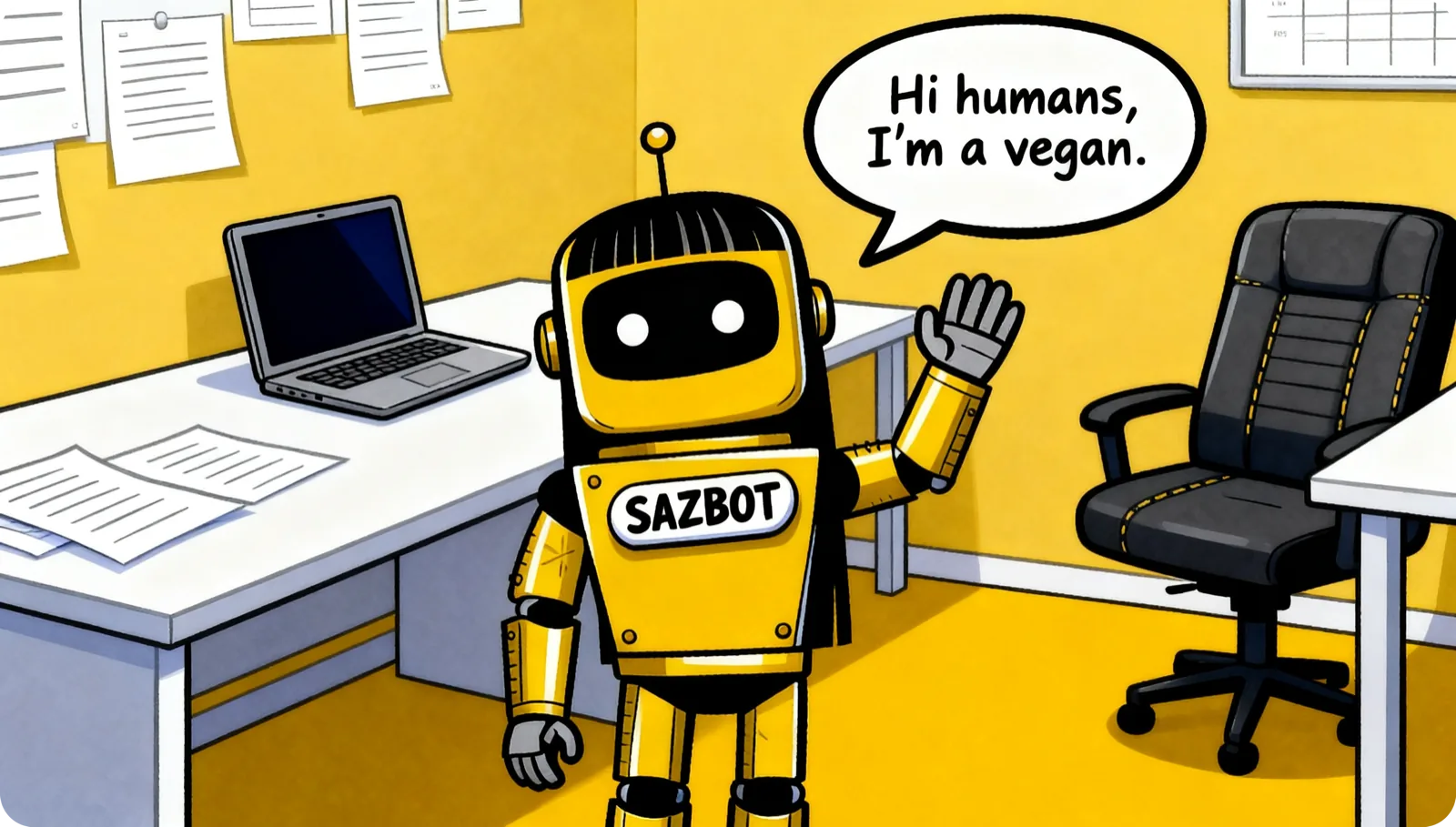
I feel like we know each other quite well now, Reader. We're mates, right? I'm going to tell you a secret: I think Saz might be a robot.
At this point, you probably need some context. Saz=Sarah Wilson, Wordnerds' housing-obsessed Account Manager and PROFESSIONAL VEGAN. I think she might have android tendencies because:
- She is world class at ever-so-slightly misunderstanding the brief
- She only eats beige food (and thinks it impossible for anyone to visit Greggs without buying a sausage roll)
- In a meeting a few weeks ago she began a sentence: "If I were a human, I would..."
I shit you not. Everyone in the office has been calling her Sazbot ever since.
Imagine my surprise, then, when she came bouncing down the exhibition hall of a conference we were at a few weeks ago (Housing 26. No, it wasn't great—too hot, quieter than normal) with a big grin on her main communication interface. "I've just been to an amazing talk on how customers are weaponising AI in complaints and feedback. Beep-boop. Crrrrrrrrrk".
She went on to explain a phenomenon we're hearing about more and more from Wordnerds customers. One that gets more and more nuanced the more I think about it.
A customer can now sit down and produce a two-thousand-word complaint, citing the exact regulation that governs your organisation, in the time it takes to microwave tri-colour heirloom quinoa and roasted purple sweet potatoes steeped in an Ayurvedic golden-milk coconut broth (did I mention Sazbot is a vegan?).
A year ago, most of them wouldn't have known that regulation existed. Today, somebody on your team has to plough through every overly verbose word, work out which bits are real, and answer it—usually inside a target time or legal deadline.
The cost of complaining has collapsed. The cost of handling it has skyrocketed.
Every complaints process has always run on one universally understood assumption: the more effort someone puts into telling you they're unhappy, the more they must actually mean it. Length, spelling, legal language—all of it got read as a signal of how much this person cared and is motivated to pursue things.
Those assumptions just went pop.
And before you assume you know where this is going, the result is a messier, more interesting battleground than the usual "AI is ruining complaints" take.
The opportunity to harness AI for complaint writing is great news for customers. For those of us in the industry, though, it's very difficult to know how to respond to this development and the latest in a long line of new pressures that makes CX teams want to eat their feelings; an entirely acceptable meal for a vegan like Saz.
Fighting AI with AI
In a world where the friction associated with writing a complaint goes down, it follows that the volume of complaints will go up.
But it also seems that AI-driven customer comms are increasing in length and complexity. A housing association we work with recently noticed complaints arriving that quoted Acts of Parliament. One came with a supporting PowerPoint!
They're not the only ones. Which? found that the Financial Ombudsman Service is seeing AI "make up fake laws" in bank complaints. A major international law firm—CMS Law—is watching the same thing hit schools, councils and the NHS. The Law Society is fielding it too. And in one piece that made it all the way to the BBC on the 25th of August, a council complaints team described watching submissions balloon from one side of A4 to twenty-plus pages, citing legislation that doesn't always exist.
The Financial Ombudsman Service's own review says AI may have contributed to up to a third of the responses it sees to its initial assessments. Some of what it's finding is badly argued. Some of it is inventing things entirely—fake regulations, misquoted rules, and, in the FOS's own words, "references to laws, regulations, and previous ombudsman decisions that are misleading, inaccurately analysed or non-existent."
Whilst this feels like a 2026 problem, it actually isn't new. As far back as 2023, a woman called Felicity Harber appealed a tax penalty to a UK tribunal, citing nine previous cases where people in her exact situation had won. None of the nine existed. A chatbot had invented them, complete with plausible names and outcomes. The judge accepted she hadn't done it on purpose... but dismissed the appeal anyway, noting that citing cases that don't exist wastes the tribunal's time and public money, and eats into the resources available to everyone else waiting for a hearing.
So what do we do with all that?
One entirely rational response could be to use AI yourself to preprocess complaints as they arrive. Triage incoming messages to fact-check them and work out which are most likely to escalate to the Ombudsman or require some kind of recompense—what our housing association friends called "fighting AI with AI".
The trap, when you're on the receiving end of one of these, is to match the effort. Answer all ten points. Escalate. Loop in legal, just in case.
We've written before about how customers behave when you ask them to expend effort (mostly by disappearing rather than complaining). The same logic applies here in reverse: match the effort on an AI-inflated complaint and you'll not only increase the cognitive load on your customer, you'll likely bankrupt your complaints function within a quarter. Because most of these aren't ten grievances. They're one or two real ones, wearing a flimsy legal costume.
When AI-generated complaints are a good thing
It would be very easy to stop there and trot out the standard "AI is ruining everything" trope. But it can be a good thing in this context too.
Yale researchers went through 1.1 million complaints filed with the US financial regulator, spanning nearly a decade. AI-assisted complaints succeeded 49.3% of the time. Human-only ones succeeded 39.9% of the time. Not because the underlying facts were any different—because the presentation was better. And the geographical areas where AI assistance was used most had higher rates of limited English language proficiency.
As one complainant, quoted by the BBC, put it: AI "made a real, practical difference in how I've been able to represent myself."
Back in issue 51 we discussed how organisations are less likely to hear from different types of customers. Sometimes it's because they're busy professionals who prioritise what they consider to be higher priority things, but in many cases it's because they physically can't, don't know how, or the whole process feels rigged against anyone without a law degree.
Any technology that helps someone who might otherwise struggle to articulate their experience, circumstance or sincerely held belief construct an effective argument should be encouraged.
The same technology that's drowning complaints departments right now is also the first thing that's ever let some people be properly heard.
And it's not just complaints
The same pattern is turning up in every ordinary feedback channel too, just more subtly.
We flagged back in issue 49 that AI-generated survey completions were becoming "a live challenge." That was the easy version: bots faking answers outright, no human involved at all. This Stanford study found that a third of survey respondents now admit to using an LLM to help write their open-text answers.
A real person, a real opinion, just not quite in their own words any more. And as far as we can tell, nobody in industry or academia has published a proper answer to what that means. That's either an oversight or an opportunity. Or both.
My gut feeling is that, just like the use of AI to widen the range of voices you hear, this is probably on balance a net positive. Real experiences and ideas delivered with less friction and more confidence. Though we obviously lose from not hearing it in the customer's authentic voice.
So could you actually tell?
Regardless of where you land on how helpful it is, the operational question remains. Could you tell? There are two broad ways to try:
Behavioural telemetry (also called typing/keystroke biometrics)
The first doesn't read the words at all—it watches how they arrived. Typing rhythm. Pauses. Where the cursor went. Whether a big block of text just appeared, all at once, out of nowhere.
This is broadly new to CX, but it's been pioneered in adjacent fields. It's roughly how Turnitin's Clarity tool catches student cheating, how banks use tools like BioCatch to detect fraud, and how some hiring platforms spotlight candidates who aren't answering their own interview questions.
A brilliant hotel group we work with already does something like this by hand: a genuine review takes about nine minutes to write; an AI-pasted one takes about twenty-two seconds. As far as we can find, nobody else has been able to put such specific numbers on the phenomenon.
There's an obvious hole in this, though. A pasted block of text can't tell you, by itself, whether it came from ChatGPT, from a Word document the person wrote entirely themselves or, as we are increasingly employing within Wordnerds, from one of the increasingly popular dictation tools like Superwhisper or Wispr Flow.
Or can it? Word and Google Docs both leave invisible fingerprints in anything copied out of them—formatting tags an AI chat window simply doesn't produce. Grammarly's own "Authorship" feature already uses something like this to tell the two apart. Not a perfect answer. But better than nothing.
Semantic similarity
The second approach compares a new submission against a huge pile of other text to see how "AI-shaped" it looks. Only there's nothing obvious and reliable doing this in the CX space right now.
Turnitin has a 300-word minimum before it will even attempt a verdict—nowhere near a forty-word complaint. And unless you're using something trained on your data, the research suggests you'll struggle with accuracy.
In one Stanford study, the same kind of detector wrongly flagged non-native English speakers' writing as AI-generated 61% of the time.
Autistic and ADHD writers are particularly at risk of being falsely flagged as AI: precise, formal, low-variance prose reads as machine-generated whether a human or a model produced it.
Researchers took the same flagged non-native-speaker essays and asked ChatGPT to make the vocabulary sound more like a native speaker's. The false-accusation rate dropped from 61% to 12%.
The tool was never measuring "AI." It was measuring "doesn't sound like it went to a good school."
If you build a detector to catch AI-inflated complaints, and it's more likely to flag exactly the people the last section said AI is finally helping, that detector punishes the people it should be protecting.
Even if you could detect AI-generated feedback, what would you do with that information?
Last month, The Property Ombudsman—the UK's official redress scheme for estate agents, letting agents, and property managers—ruled that complainants don't have to declare whether they used AI at all.
Their stated reasoning was jurisdictional—their codes bind agents, not consumers—and they noted that AI-assisted submissions make the evidence harder to identify, adding pressure on the Ombudsman's own resources and costs.
They stopped there. No ruling on whether the extra volume should change how a complaint gets treated.
Our own, admittedly unfinished, view:
A flag should change what gets checked, never what gets believed.
If something looks AI-assisted, go and verify the citations. Don't discount the grievance underneath them.
Some job hiring platforms work the same way—a flagged signal goes to a human for a second look, never straight to a rejection.
Try this tomorrow
Three things worth doing this week:
- Look at your online webforms, survey inputs and other feedback capture. Most platforms already capture some of the raw material for behavioural telemetry—focus events, paste events, timing information.
- Before you build any detection at all, decide what a flag is actually for. Verification routing (who checks it and what for?), or a legitimacy test (is there a reason to discount, deprioritise, or think less of the complaint?). Write it down. Most organisations don't have a plan, which means whoever's triaging complaints on the day ends up deciding policy for you.
- Go back through your last five "difficult" complaints and ask: how many used AI in their creation? How many are really one or two genuine grievances spun out into compelling legalese? What are those root cause issues? How prevalent are they across the dataset? What else did you learn? What hypotheses did they surface?
Nothing here requires any new technology at all. Nevertheless, we've been looking into what it would take to actually build some of this into the Wordnerds process—both the behavioural telemetry stuff and the text-detection side.
Given what we've said about the range of behaviours this could catch, we don't yet know whether either would be useful to you, or whether it's solving a problem you don't actually have. We clearly need a plan for dealing with verbose, complex and sometimes spurious complaints, but would knowing feedback was written by AI somewhere down the line change what you do with it?
Maybe you can give us some advice?
Until next time, keep learning.
Pete
P.S. I feel equally conflicted about the Saz/Sazbot debate. Is she human? Is she robot? Does it make a difference? I mean, whom would I lunch-shame if Sazbot ever went offline? Who would provide the slightly inappropriate commentary and tales of hilarious misadventure in morning standup? What if this whole issue is a question without a problem attached?
More from CX Corner
Who Owns the Answer?
As colleagues start querying customer feedback themselves, the insight team's job shifts from producing the answer to guaranteeing everyone gets the same one.
 How to Measure Trust Properly
The seven weighted drivers of trust everyone cites were measured on B2B buyers who could walk away. If your customers can't, you're navigating one country with a map of another.
How to Measure Trust Properly
The seven weighted drivers of trust everyone cites were measured on B2B buyers who could walk away. If your customers can't, you're navigating one country with a map of another.
 Customer Emotion Mapping: World Cup Edition
Score more than you concede: every process produces an emotion, and the emotion is the only part your customer remembers.
Customer Emotion Mapping: World Cup Edition
Score more than you concede: every process produces an emotion, and the emotion is the only part your customer remembers.
