 The Wolverhampton Paradox: why better repairs figures didn't win the better RSH grade
Wolverhampton's repairs and complaints figures beat BCP's on every measure, and BCP got the better RSH grade on the same day. What the regulator rewards instead.
Reading Customers Right
Customer sentiment analysis: why sentiment isn't emotion
Sentiment is the guiding light you can track. Emotion is the rainbow that explains it, and every organisation's rainbow is different.

 Written by Steve Erdal
Created · Last updated
Grab a box of tissues and a sharing bar of Dairy Milk: today we’re talking about emotion and sentiment.
Emotion is having one heck of a moment in customer experience. Forrester CX brain Pete Jacques wrote in August 2026 that emotion "is often the strongest predictor of customer loyalty, advocacy, and retention". It makes sentiment analysis seem delightfully retro.
And yet. I bet that somewhere in your insight reporting, probably quite near the top of the page, there is a sentiment score. And you’re not alone. Wordnerds turns what customers say into what organisations do, and every organisation we work with tracks a sentiment score.
Expect a mixture of real science and tortuous film analogies, the way only Wordnerds can.
What is customer sentiment analysis?
Customer sentiment analysis classifies each piece of feedback as positive, negative or neutral, then combines the results into a score. At Wordnerds, it’s done at a sentence level, averaged across a comment, and then normalised on a 0-100 scale.
Every analysis of customer feedback, however complex, starts with two questions: what are customers saying, and how do they feel about it? Sentiment gives you a simple answer to that second question, which you can then track by month, theme, journey stage or any other cut that matters to you.
A single direction makes for a great KPI, and for most of our customers, sentiment is one of the first numbers they check.
How does customer sentiment analysis work?
Sentiment analysis runs in three stages:
- Score each comment for how positive or negative its language is.
- Combine the scores into an average for a group of comments.
- Track the average over time, and split it by theme, channel or customer group.
So why not just ask the customers how they’re feeling? Well, in a 2026 guest analysis, friend of the Nerds and all-round legend Chris Elliott of Housemark looked at tenants who ticked "fairly satisfied" in their satisfaction survey. Across 7,700+ verbatim comments, that group produced an overall sentiment score of 40, and "sentiment scores below 45 are considered negative".
Customers were ticking fairly satisfied, but their comments suggested they didn’t feel good about it. They’re measuring two different things, and if you ignore what they tell you in favour of what they score, you risk being blindsided by customer churn, new complaints and, ironically, falling scores.
But comment-level sentiment is a blunt tool. A comment praising the repair and complaining about the booking process gets one blended score.
What is the difference between sentiment and emotion?
You know how you’d call Brokeback Mountain an emotional film, and Three Men and a Little Lady a sentimental film? It’s kind of that.
- Sentiment is a direction: big, broad, overarching feeling, clear and spelled out.
- Emotion is a set of feelings: smaller, nuanced, personal and powerful.
The two can point you in opposite directions, even in the same sentence. Consider this sentence, from a 2017 review in ACM Computing Surveys: "My family thinks it's a good decision to continue my education overseas, though they feel sad to miss me". It’s a statement with a positive opinion, but clear negative emotion. Which would you listen to?
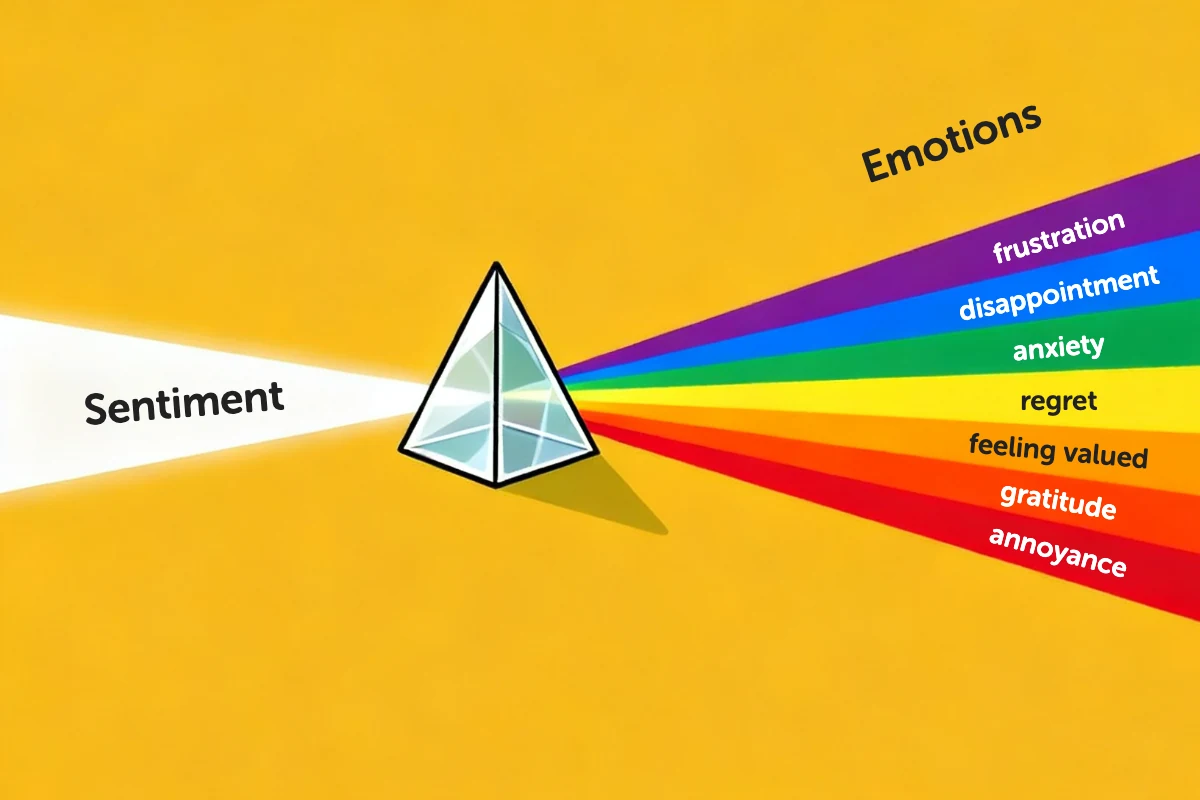
God help me as a floppy-haired arts graduate, but I'm going to attempt a science metaphor. I like to think of sentiment as the white light. It’s one beam, pointing in one direction.
Emotion is the rainbow: that white light fractured into all the different ways people feel, positive and negative. Understanding these common emotional states is how you actually understand your customers.
But these emotions can't guide you. Using emotion to understand the direction your CX Programme is heading is like putting a disco ball in a lighthouse.
Why is sentiment more dependable than emotion?
Much like Three Men and a Little Lady, sentiment analysis still holds up in 2026, and the reason is its reliability.
People disagree more on emotions. A 2023 study of Dutch customer-service conversations on Twitter shows it. Four trained annotators labelled each tweet’s emotions and how positive or negative it was. They used a measurement called Krippendorff’s alpha (basically: 1.0 means everyone agreed perfectly, 0 means it was totally random). The annotators scored 0.633 on positive to negative and 0.483 on individual emotion labels.
AI models have the same problem. On a GoEmotions dataset of Reddit comments, a 2020 ACL paper reported a macro-average F1 score of 0.69 with emotions grouped into four sentiment classes, against 0.46 across 27 emotions plus neutral.
A multiple-choice test with 4 options is easier than one with 28. And that’s as true for computers as it is for us.
Why does emotion matter if sentiment is dependable?
Have we come full circle then? Should we ignore emotion and focus entirely on sentiment? Is Three Men and a Little Lady actually better than Brokeback Mountain?
The truth is that some of the most powerful, impactful insight work we’ve ever seen our customers do has been down to emotional analysis. My mind jumps immediately to the magnificent Mr Niek de Rijcke from Dorchester Collection, who presented with us in a 2025 webinar. Dorchester hired an anthropologist, who found guests were coming to fulfil "specific emotional needs". They built a framework of "nine measurable emotional dimensions", and taught Wordnerds' AI to recognise them in verbatim feedback.
That’s the brilliant thing about specific emotions: they can predict what customers do next. A 1999 study in the Journal of Service Research found regret "had a direct effect on customers' switching, over and above the effect of dissatisfaction", while disappointment had a direct effect on word of mouth.
Different emotions need different responses. Gelbrich's 2010 research in the Journal of the Academy of Marketing Science found that "a retrospective explanation mitigates anger, whereas a prospective explanation mitigates helplessness". Tell an angry customer what happened, and a helpless one what happens next.
And when you improve the emotions, the sentiment moves with them.
Why is your organisation's emotional rainbow different from everyone else's?
In 2015, Pixar had a problem, and if you run emotional analysis, it’s a problem you’ll hit too. Emotion scientists (phenomenal job title) Paul Ekman and Dacher Keltner served as consultants on the movie Inside Out. One of them suggested "the full array of emotions now studied in science". The director turned it down because "the story could handle only five or six characters".
Your customers aren't limited to five emotions, but there is a limit on the number you can usefully track. And the emotions that your customers feel about you are completely unique.
Take retail: in a 2025 Wordnerds webinar, Stella Dooris showed that in Trustpilot reviews of UK supermarkets, “emotional effort — things like anxiety or stress towards their shopping or journey” was the top mentioned thing. This is totally different from Niek’s matrix for Dorchester.
Off-the-shelf emotion lists miss differences like these. A 2024 LREC-COLING review gave a pretty stark warning: "The commonly used predefined emotion categories may not adequately capture the nuances required for the downstream task".
So emotion can give you a unique insight into your customers, but only if you’re actually looking at their specific emotions.
Can you ask ChatGPT to do sentiment and emotion analysis?
Short answer, yes. Long answer, it depends. I’m known for my linguistic economy.
General-purpose AI does reasonably well on positive and negative, and much worse on fine-grained emotion. A 2023 study in Information Fusion found ChatGPT about 12% behind the best specialist models on tweet sentiment, and about 52% behind on GoEmotions' 27 emotion categories.
Cost per comment is small. A 2023 PNAS study put ChatGPT annotation at under $0.003 an item. The harder problems are tailoring a general model to your own data and getting the same answer twice. That Information Fusion study also noted:
Even with the same setup, its results may vary with each launch.
You can read our Copilot comparison here if you want to understand how generic models start costing you at scale.
What should you ask before using ChatGPT for sentiment analysis?
So you can absolutely ask ChatGPT to do sentiment and emotion analysis, and for a lot of you, it may give you what you need. The key questions you need to ask are:
- How big is my dataset? As it grows, costs climb.
- How specific are the emotions I’m trying to understand? Generic AI isn’t good with specific emotion.
- Do I need to do this again? Without a lot of work, ChatGPT can give you different answers each time. So if you see a change in sentiment, you won’t know whether it was your customers who changed, or the model.
How do UK regulators treat sentiment and emotion?
On the face of it, not much. No UK regulator requires sentiment or emotion analysis. But often, these analyses answer a lot of the regulator’s questions. A few examples, in key sectors:
Finance: The Financial Conduct Authority’s 2021 vulnerable-customer guidance, FG21/1, associates low emotional resilience with vulnerability and asks staff to look out for "signs of agitation" and "signs of confusion". Train your emotional framework right, and that’s exactly the kind of signal it can surface.
Power: Ofgem's July 2026 vulnerability strategy progress report talks about one supplier using sentiment analysis, alongside contact-pattern analysis, to help identify consumers "who may be hesitant to disclose information."
Housing: The Regulator of Social Housing is ahead of the game: its revised Transparency, Influence and Accountability Standard, in force from 1 October 2026, asks landlords to tell tenants "how they have taken tenants' views into account to improve landlord services, information and communication".
Whatever your regulator asks, the same signals tell you where complaints and churn are coming from next.
How do you use sentiment and emotion together?
Three steps put the two to work:
- Track sentiment as your KPI. Trended monthly and split by theme, it tells you whether things are getting better or worse.
- Split it into your own emotions. Name them from what your customers write.
- Show people the feeling, then fix the cause. The emotion gets people to care, and the theme behind it tells you which team acts.
At Grainger, Jenny Jeffcoat (another of my absolute heroes) told our 2025 Insight to Influence webinar how she had leaders guess customer sentiment at each of nine journey stages before showing them the real Wordnerds scores. "I needed them to emotionally buy in," she said.
All insight is about action, and nothing will happen if people don't care. Some people care because of numbers and ROI; others care about emotion, and you have to cater to them. Emotion is how you connect with people.
At your next quarterly board meeting, the sentiment line is still on the slide. Beside it sit the two emotions that moved it, in your customers' words, and the team fixing each one.
Or failing that, just show them Three Men and a Little Lady. You can’t go wrong with Guttenberg.
To see what your own rainbow looks like, book a diagnostic. Not ready for that? Read Nat Grant's guide to customer emotion mapping and subscribe to CX Corner.
This article was last reviewed on 2026-10-20. Next review: 2027-01-20.
Frequently asked questions
What does Wordnerds do?
Wordnerds turns what customers say into what organisations do. Wordnerds ingests feedback from surveys, complaints, reviews, calls and social; applies transparent, explainable AI to surface themes and drivers; and serves the insight two ways from one semantic model: full-detail Power BI for analysts, plain-language AI-chat answers for everyone else. Built for UK housing associations, transport operators and regulated sectors that need auditable evidence, not a black box.
Is sentiment analysis reliable enough to use as a KPI?
Sentiment works well as a KPI for direction, as long as it isn't the only measure. Survey research points the same way: a 2015 study in the International Journal of Research in Marketing found top-2-box satisfaction scores predicted customer retention best, and that combining feedback measures "improves predictions even further". Pair the sentiment trend with the emotions and themes behind it.
Which emotions should customer feedback analysis look for?
Start with the emotions your customers actually express, and name them in your own terms. Standard lists only go so far: Ekman's six basic emotions include just one positive emotion, happiness. Feedback full of thanks, relief or pride needs more room on the positive side than that.
Can sentiment analysis cope with sarcasm?
Not reliably. Researchers at the University of Sheffield found that sarcasm "does not always reverse polarity", so flipping a positive score to negative doesn't fix it, and they called sarcasm "an inherent part of British culture". For UK feedback, check a sample of strongly positive comments by hand before trusting the score.
What does a neutral sentiment score hide?
A neutral score can hide very different customers. A June 2026 preprint by a feedback-analytics vendor, covering 70,450 support conversations, found neutral was the most common sentiment label, and warned that a single tone label is "doing the work of describing customers who were quietly fine and customers who were quietly giving up".
Can emotion analysis tell how a customer really feels?
Emotion analysis reads the emotion a customer expresses in words, which is not always what they feel. Saif Mohammad's 2022 ethics sheet in Computational Linguistics says emotion recognition systems "should not claim to determine one's emotional state" and at best capture "what one is trying to convey". In feedback, what customers choose to convey is still worth knowing.
Do positive or negative emotions matter more for customer outcomes?
Positive emotions, on the evidence so far. A 2020 meta-analysis in the Journal of the Academy of Marketing Science, covering 1,035 effect sizes, found the greatest impact came from gratitude and that "positive emotions show consistently stronger effect sizes than do negative emotions". Tracking only what annoys customers misses what keeps them.
Read more from the blog
The Wolverhampton Paradox: why better repairs figures didn't win the better RSH grade
Wolverhampton's repairs and complaints figures beat BCP's on every measure, and BCP got the better RSH grade on the same day. What the regulator rewards instead.
 What 26,119 pieces of customer feedback couldn't tell us
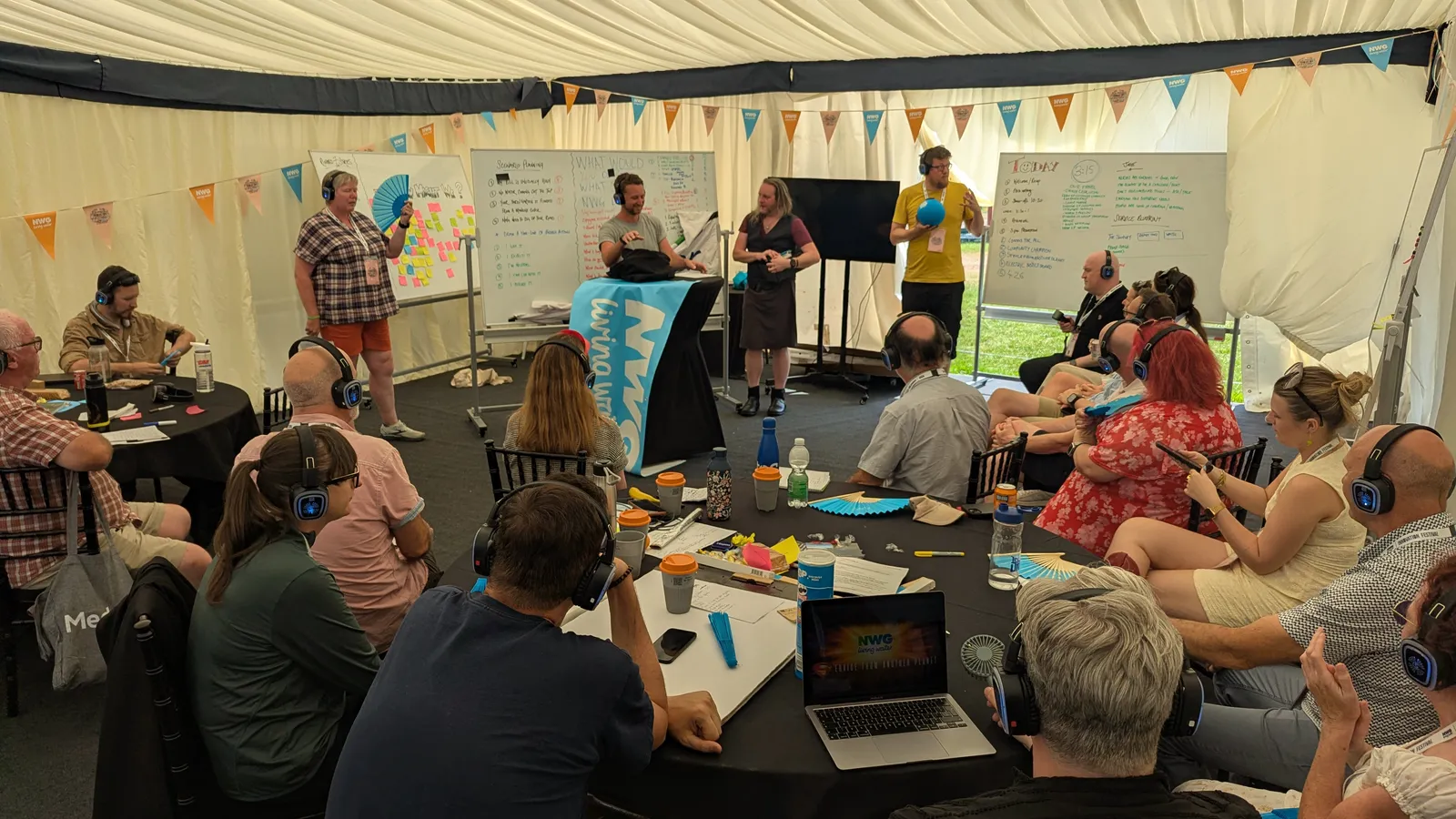
Explain ran a four-day deliberative sprint with 27 Northumbrian Water customers while we analysed 26,119 pieces of their feedback alongside it. Fourteen of the group's 45 ideas had no trace in the data at all.
 Who's liable when AI analyses your customer feedback — the software, or you?
When an AI analyses your customers and gets something wrong, the liability lands on you, not the software. Where the line actually falls — and how to make sure you're never the one left defending a black box.
